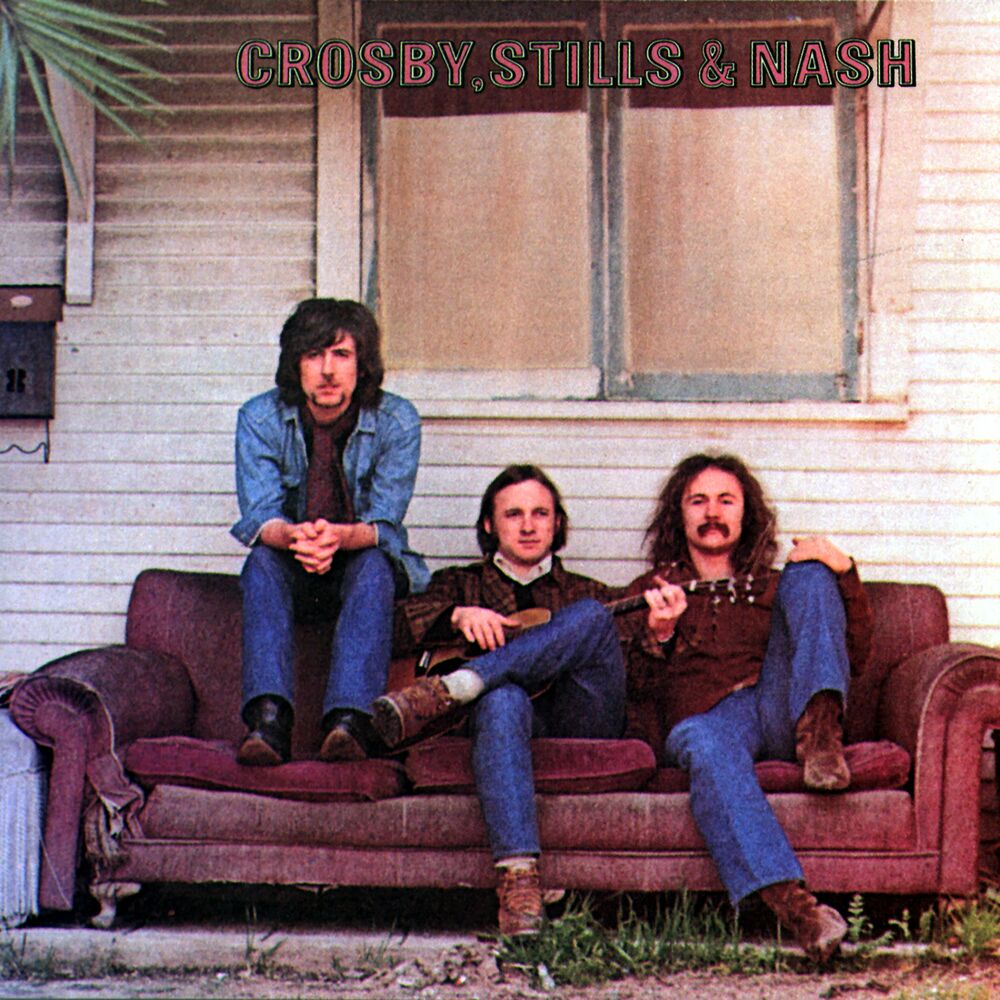
Crosby, Stills & Nash
- Released23 January 2006
- UK peak No. 25
- Weeks on UK chart 5
- Entered UK chart 17 August 1969
- LabelRhino Atlantic
- Tracks14 · 53 min
One track from it charted as a single. Press a flag to play it in the chart where it peaked.
Tracks
| 1 | Suite: Judy Blue Eyes (2005 Remaster) | 7:24 | |
| 2 | Marrakesh Express (2005 Remaster) No. 17 · 1969 | 2:36 | |
| 3 | Guinnevere (2005 Remaster) | 4:37 | |
| 4 | You Don't Have to Cry (2005 Remaster) | 2:42 | |
| 5 | Pre-Road Downs (2005 Remaster) | 2:55 | |
| 6 | Wooden Ships (2005 Remaster) | 5:26 | |
| 7 | Lady of the Island (2005 Remaster) | 2:36 | |
| 8 | Helplessly Hoping (2005 Remaster) | 2:37 | |
| 9 | Long Time Gone (2005 Remaster) | 4:16 | |
| 10 | 49 Bye-Byes (2005 Remaster) | 5:05 | |
| 11 | Do for the Others | 2:47 | |
| 12 | Song with No Words | 3:17 | |
| 13 | Everybody's Talkin' | 3:13 | |
| 14 | Teach Your Children (Crosby, Stills, Nash & Young) | 3:14 |
About the album
Déjà Vu is the second studio album by American folk rock group Crosby, Stills & Nash, and their first as a quartet with Neil Young. Released on March 11, 1970, by Atlantic Records, it topped the Billboard 200 chart for one week and generated three US Top 40 singles: "Woodstock", "Teach Your Children", and "Our House". It was re-released in 1977 and an expanded edition was released in 2021 to mark its 50th anniversary.
In 2003, the album was ranked No. 148 on Rolling Stone magazine's list of the 500 greatest albums of all time, and later was ranked No. 220 on the 2020 edition of the list. Certified 7× platinum by RIAA, the album's sales currently sit at over 8 million copies. It remains the highest-selling album of each member's career to date.
Recording
The album was recorded between July 1969 and January 1970 at Wally Heider's Studio C in San Francisco, and Wally Heider's Studio 3 in Hollywood. It was produced by all four members of the band. Stephen Stills estimates that the album took around 800 hours of studio time to record; this figure may be exaggerated, even though the individual tracks display meticulous attention to detail. The songs, except for "Woodstock," "Almost Cut my Hair," and "Helpless," were recorded as individual sessions by each member, with each contributing whatever was needed that could be agreed upon. Young appears on only half of the tracks, with Nash stating he "generally recorded his tracks alone in Los Angeles then brought them back to the recording studio to put our voices on, then took it away to mix it".
Young's "Helpless" was released on his Neil Young Archives Vol. 1 (1963-1972) in 2009 in a different mix with a harmonica introduction.
Release
By January 1970, Atlantic Records had taken in $2 million in preorders; anticipation for the album was high. Déjà Vu was released on March 11, 1970, under Atlantic Records catalogue SD 7200. It was re-released in 1977 as SD-19188 and the cover was changed from black to brown in some foreign releases.
It was certified Gold in the US, 14 days after release on March 25, 1970, spending 88 weeks in the Billboard 200 charts.
Four singles were released from the album with all but the last, "Carry On", charting on the Billboard Hot 100. The song "Country Girl" by Young is a suite put together from three song fragments entitled "Whiskey Boot Hill", "Down Down Down", and "Country Girl (I Think You're Pretty)", and is so identified in the credits.
The album was issued on compact disc a second time on September 6, 1994, after being remastered from the original tapes at Ocean View Digital by Joe Gastwirt.
Reception
Contemporary reception was mixed, with Robert Christgau saying that there were "five or seven memorable tunes" and that it was "Young's guitar—with help from Stills and hired hands Taylor and Reeves—that make the music work, not those blessed harmonies".
Langdon Winner wrote for Rolling Stone that, despite the addition of Young, the sound "is still too sweet, too soothing, too perfect, and too good to be true". He has high praise for "Carry On", "Teach Your Children" and "Helpless" on Side One. Side Two has "precision playing, glittering harmonies, a relaxed but forceful rhythm, and impeccable twelve-string guitars" but no first rate songs. The Village Voice called it "Tight. Uptight, even."
Nick Logan and Bob Woffinden, of ZigZag and The New Musical Express, were critical of Crosby's and Nash's contributions, while stating that all of the other songs were "easily outclassed by the immensely superior material of Young."
Legacy
The popularity of the album contributed to the success of the four albums released by each of the members in the wake of Déjà vu – Neil Young's After the Gold Rush, Stephen Stills' self-titled solo debut, David Crosby's If I Could Only Remember My Name, and Graham Nash's Songs for Beginners. In 2003, the album was placed at number 148 on Rolling Stone magazine's list of the 500 greatest albums of all time, moving up to 147 in a 2012 revised listing, and then down to number 220 in a 2020 revised listing. The TV network VH1 named Déjà vu the 61st greatest album of all time. It was voted number 106 in Colin Larkin's All Time Top 1000 Albums 3rd Edition (2000).
Déjà Vu was selected by the Library of Congress for preservation in the National Recording Registry in 2023.
In 2012, Déjà Vu was inducted into the Grammy Hall of Fame.