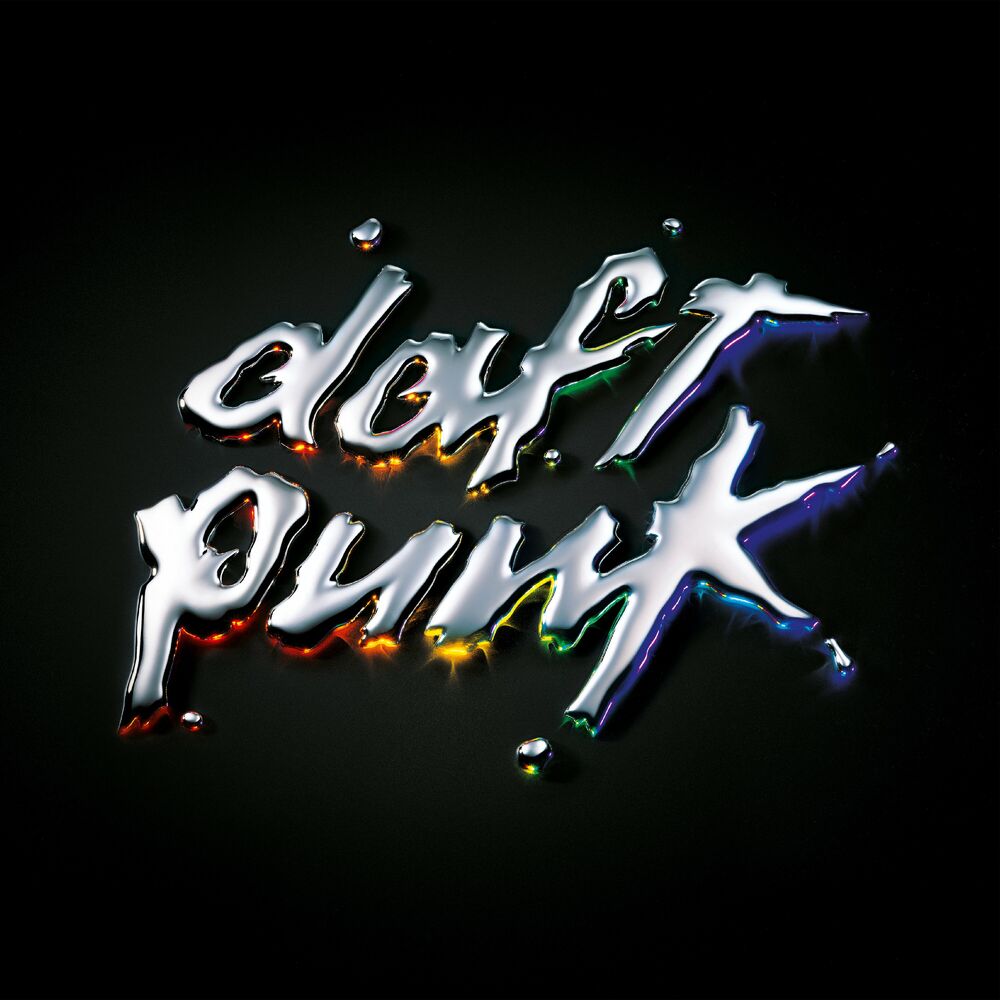
Discovery
- Released7 March 2001
- UK peak No. 2
- Weeks on UK chart 62
- Entered UK chart 18 March 2001
- LabelDaft Life Ltd./ADA France
- Tracks14 · 61 min
4 tracks from it charted as singles. Press a flag to play it in the chart where it peaked.
Tracks
| 1 | 5:20 | ||
| 2 | Aerodynamic No. 97 · 2001 | 3:32 | |
| 3 | Digital Love No. 14 · 2001 | 5:01 | |
| 4 | Harder, Better, Faster, Stronger No. 25 · 2001 | 3:46 | |
| 5 | Crescendolls | 3:31 | |
| 6 | Nightvision | 1:44 | |
| 7 | Superheroes | 3:57 | |
| 8 | High Life | 3:21 | |
| 9 | Something About Us | 3:52 | |
| 10 | Voyager | 3:47 | |
| 11 | Veridis Quo | 5:45 | |
| 12 | Short Circuit | 3:26 | |
| 13 | Face to Face | 4:00 | |
| 14 | Too Long | 10:00 |
About the album
Discovery is the second studio album by the French electronic music duo Daft Punk, released on 12 March 2001 by Virgin Records. It moved from the Chicago house of their first album, Homework (1997), to a house style inspired by disco, post-disco, garage house, and R&B. Thomas Bangalter of Daft Punk described Discovery as an exploration of song structures, musical forms, and childhood nostalgia, compared to the "raw" electronic music of Homework.
Discovery was recorded at Bangalter's home in Paris between 1998 and 2000. It features extensive sampling; some samples are from older records, while others were created by Daft Punk. The electronic musicians Romanthony, Todd Edwards, and DJ Sneak collaborated on some tracks. For the music videos, Daft Punk developed a concept that merged science fiction with the entertainment industry. Inspired by their childhood love for Japanese anime, the duo collaborated with Leiji Matsumoto to produce Interstella 5555: The 5tory of the 5ecret 5tar 5ystem, an anime film with Discovery as the soundtrack.
Before Discovery's release, Daft Punk adopted robot costumes. They also launched Daft Club, a website featuring exclusive tracks and bonus material. Discovery peaked high on several international charts upon release. Critics praised Daft Punk for innovating in house music as they had done with Homework.
Background and recording
After their debut album, Homework, was released, Thomas Bangalter and Guy-Manuel de Homem-Christo spent most of 1997 touring on the Daftendirektour. For the first half of 1998, the duo were focused on their own personal labels while also working on the video collection D.A.F.T.: A Story About Dogs, Androids, Firemen and Tomatoes. In 1999 and 2000, their time was split between making music for their own labels and recording Discovery. Bangalter noted that Homework influenced many other artists to mimic its sound, prompting Daft Punk to pursue a different direction to better distinguish themselves.
Daft Punk recorded Discovery in their studio, Daft House, in Bangalter's home in Paris. Work started in 1998 and lasted two years. Bangalter and Homem-Christo made music together and separately, in a similar process to Homework. Rather than rely on the drum machines typical for house music, the Roland TR-808 and the TR-909, Daft Punk used an Oberheim DMX, a LinnDrum and a Sequential Circuits Drumtraks.
Composition
In his review for AllMusic, John Bush wrote that Discovery is "definitely the New York garage edition" of Homework. He said Daft Punk produced a "glammier, poppier" version of Eurodisco and R&B by over-embellishing their pitch-bend and vocoder effects, including loops of divas, synth-guitars, and electric piano. Stylus Magazine's Keith Gwillim described Discovery as a disco album, with disco's "danceable" and "sappy" elements, including its processed vocals and "prefabricated" guitar solos. Other critics described it as post-disco and electro-funk. Uproxx said it also incorporates French house, while Stereogum described the album as disco-house.
The opening track, "One More Time", features heavily Auto-Tuned and compressed vocals from Romanthony. "Aerodynamic" has a funk groove, an electric guitar solo, and ends with a separate "spacier" electronic segment. The arpeggiated solo was compared to Yngwie Malmsteen by Pulse!. "Digital Love" contains a solo performed on Wurlitzer piano, vintage synthesisers and sequencers; it incorporates elements of pop, new wave, jazz, funk and disco.
Promotion and release
Daft Punk initially planned to release every song on Discovery as a single, according to Orla Lee-Fisher, who was head of marketing for Virgin Records UK at the time, although this plan was eventually shelved. "One More Time" was released in 2000, ahead of the album's release. The album was released on 12 March 2001, followed by singles for "Aerodynamic", "Digital Love", "Harder, Better, Faster, Stronger", "Something About Us", and "Face to Face".
The ideas for music videos formed during the early Discovery recording sessions. The album was originally intended to be accompanied by "a live-action film with each song being a part of the film", according to Todd Edwards. Daft Punk decided instead to concentrate on an anime production. Their concept involved the merging of science fiction with entertainment industry culture. The duo recalled watching Japanese anime as children, including favourites such as Captain Harlock, Grendizer, and Candy Candy.
Commercial performance
Discovery reached number two on the UK Albums Chart and the French Albums Chart and number 23 on the US Billboard 200. It debuted at number two on the Canadian Albums Chart, selling 13,850 copies in its first week. It was certified triple platinum in France in 2007 for shipments of 600,000 copies and certified gold by the Recording Industry Association of America on 11 October 2010.
As of May 2013, Discovery had sold 802,000 copies in the US. "One More Time" was its most successful single, reaching number one on the French charts and the Billboard Hot Dance Club Songs charts and reaching the top ten on seven other charts. It remained Daft Punk's most successful single until the release of "Get Lucky" in 2013. The fifth single, "Face to Face", reached number one on the Billboard Hot Dance Club Songs chart in 2004. Discovery had sold at least 2.6 million copies as of 2005.
Critical reception
At Metacritic, which assigns a normalised rating out of 100 to reviews from mainstream publications, Discovery has an average score of 74, based on 19 reviews. Some listeners were confused by the more polished sound, the heavy metal element of "Aerodynamic", and the use of Auto-Tune. AllMusic's John Bush said that, with their comprehensive productions and loops, Daft Punk had developed a sound that was "worthy of bygone electro-pop technicians from Giorgio Moroder to Todd Rundgren to Steve Miller." Q wrote that Discovery was vigorous and innovative in its exploration of "old questions and spent ideals", hailing it as "a towering, persuasive tour de force" that "transcends the dance label" with no shortage of ideas, humour, or "brilliance". Q named Discovery one of the best 50 albums of 2001.
Joshua Clover, writing in Spin, dubbed Discovery disco's "latest triumph". He felt that while it "flags a bit" near the end, the opening songs were on par with albums such as Prince's Sign o' the Times (1987) and Nirvana's Nevermind (1991).