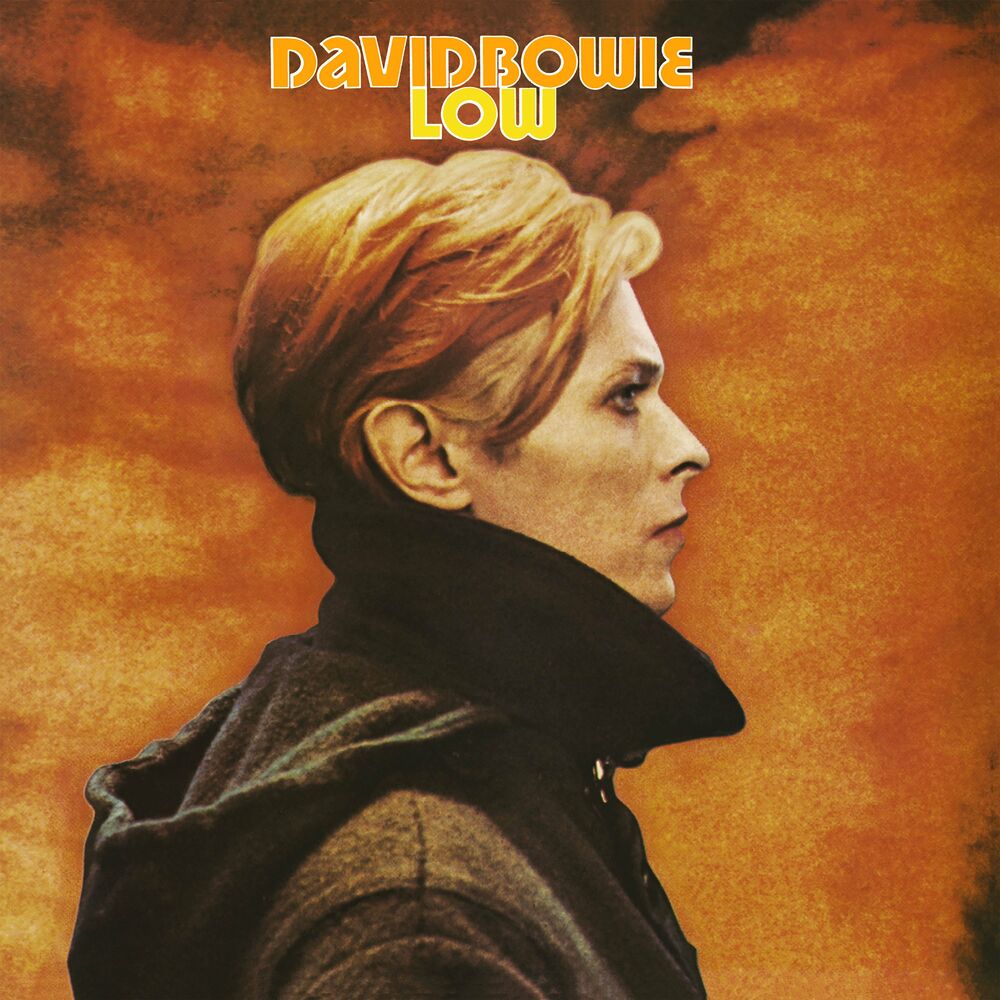
Low (2017 Remaster)
- Released29 September 2017
- UK peak No. 2
- Weeks on UK chart 30
- Entered UK chart 23 January 1977
- LabelParlophone UK
- Tracks11 · 39 min
2 tracks from it charted as singles. Press a flag to play it in the chart where it peaked.
Tracks
| 1 | Speed of Life (2017 Remaster) | 2:47 | |
| 2 | Breaking Glass (2017 Remaster) No. 54 · 1978 | 1:52 | |
| 3 | What in the World (2017 Remaster) | 2:24 | |
| 4 | 3:04 | ||
| 5 | Always Crashing in the Same Car (2017 Remaster) | 3:35 | |
| 6 | Be My Wife (2017 Remaster) | 2:56 | |
| 7 | A New Career in a New Town (2017 Remaster) | 2:55 | |
| 8 | Warszawa (2017 Remaster) | 6:27 | |
| 9 | Art Decade (2017 Remaster) | 3:48 | |
| 10 | Weeping Wall (2017 Remaster) | 3:29 | |
| 11 | Subterraneans (2017 Remaster) | 5:43 |
About the album
Low is the eleventh studio album by the English musician David Bowie, released on 14 January 1977 through RCA Records. The first of three collaborations with the producer Tony Visconti and the musician Brian Eno that became known as the Berlin Trilogy, the project originated following Bowie's move to France in 1976 with his friend Iggy Pop to rid themselves of their drug addictions. There, Bowie produced and co-wrote Pop's debut solo studio album, The Idiot, featuring sounds Bowie would explore on his next record. After completing The Idiot, sessions for Low began at Hérouville's Château d'Hérouville in September 1976 and ended in October at Hansa Studios in West Berlin, where Bowie and Pop had relocated.
An art rock record influenced by German bands such as Tangerine Dream, Neu!, Harmonia and Kraftwerk, Low features Bowie's first explorations in electronic and ambient styles. Side one consists primarily of short, direct avant-pop song-fragments, with mostly downbeat lyrics reflecting Bowie's state of mind, and side two comprises longer, mostly instrumental tracks, conveying musical observations of Berlin. Visconti created the distinctive drum sound using an Eventide H910 Harmonizer, a pitch-shifting device.
Background and inspiration
In 1974, David Bowie developed a cocaine addiction. It worsened over the next two years, affecting his physical and mental state. He recorded Young Americans (1975) and Station to Station (1976), and filmed The Man Who Fell to Earth (1976), while under the drug's influence. Bowie attributed his growing addiction to Los Angeles, where he moved from New York City in early 1975. His drug intake escalated to the point where, decades later, he recalled almost nothing of the recording of Station to Station.
After completing Station to Station in December 1975, Bowie began work on a soundtrack for The Man Who Fell to Earth with Paul Buckmaster, who worked with Bowie on the 1969 album Space Oddity. Bowie expected to be wholly responsible for the music, but withdrew his work when he was invited to submit it along with the work of other composers: "I just said, 'Shit, you're not getting any of it.' I was so furious, I'd put so much work into it." Station to Station's co-producer Harry Maslin argued Bowie was "burned out" and could not complete the work.
Artwork and release
George Underwood, Bowie's school friend, designed Low's cover artwork. Similar to the artwork for Station to Station, it features an altered still frame from The Man Who Fell to Earth. Bowie is seen in profile as his character from the film, Thomas Jerome Newton, wearing a duffel coat set against an orange background. His hair is the same colour as the background, which Wilcken says "underlines the solipsistic notion of place reflecting person, object and subject melding into one". Wilcken notes that as The Man Who Fell to Earth was out of theatres by the time of Low's release, the design choice was not to promote the film, but to show the connection between it and the album. Buckley writes that the cover was a visual pun, meaning 'low profile'; many did not understand the joke until Bowie pointed it out in a later interview.
Bowie's previous albums, Young Americans and Station to Station, were massive commercial successes. RCA Records was eager to have another best-seller from the artist but, on hearing Low, label staff were shocked.
Commercial performance
RCA eventually released Low on 14 January 1977—less than a week after Bowie's 30th birthday—with the catalogue number PL 12030. The album received little to no promotion from both RCA or Bowie, who felt it was his "least commercial" record to that point. He opted to tour as Iggy Pop's keyboardist instead. Low became a commercial success, entering the UK Albums Chart at number 37 before peaking at number two the following week; Slim Whitman's Red River Valley kept the album from the top spot. It remained on the chart for 30 weeks. In the US, Low entered the Billboard Top LPs & Tape chart at number 82, peaking at number 11 four weeks later and remaining on the chart for 20 weeks. Elsewhere,
Low reached number 6 in the Netherlands, 10 in Australia and Norway, 12 in New Zealand and Sweden, 17 in Austria, 30 in Finland, 35 in Japan and 56 in Canada.
Singles
"Sound and Vision" was released as the first single on 11 February 1977, with the instrumental "A New Career in a New Town" as the B-side. It reached number three on the UK Singles Chart, becoming Bowie's highest charting new single in the UK since "Sorrow" in 1973. The song did not fare so well in the US, peaking at number 69 on the Billboard Hot 100 and signalling Bowie's commercial downturn in the country until 1983. Although Bowie did not promote it, Pegg writes the single was an "instant turntable favourite" and was bolstered by the BBC's usage for television commercials. The single's UK success confused RCA executives. Bowie intimidated the label and persuaded RCA to release Pop's The Idiot in March 1977.
"Be My Wife" was released as the second single on 17 June 1977, backed by the instrumental "Speed of Life". It became Bowie's first single that failed to chart since his pre-Ziggy Stardust days (1972). Despite this, a music video—his first since 1973—promoted the song.
Critical reception
Upon release, Low divided critical opinion. Rolling Stone's John Milward said that "Bowie lacks the self-assured humour to pull off his avant-garde aspirations" and found the album's second side weaker than its first, due to the band inflicting "discipline into Bowie's writing and performance". Another reviewer, Dave Marsh, gave Low two stars out of five, finding a lack of "thought" and "real songs", calling the majority of side two "as limpid as the worst movie soundtrack". He ultimately found the record a new low point for the artist. A reviewer for Record Mirror found the album boring at first listen, and upon repeated listens, felt Bowie had hit an "all time low", releasing an album that lacks a "genuine vision" with incohesive music and few lyrics. NME's Charles Shaar Murray gave the album an extremely negative assessment, describing it as "a state of mind beyond desperation". He felt that the record encouraged the listener to feel down and offered no help in getting back up, stating, "It's an act of purest hatred and destructiveness.