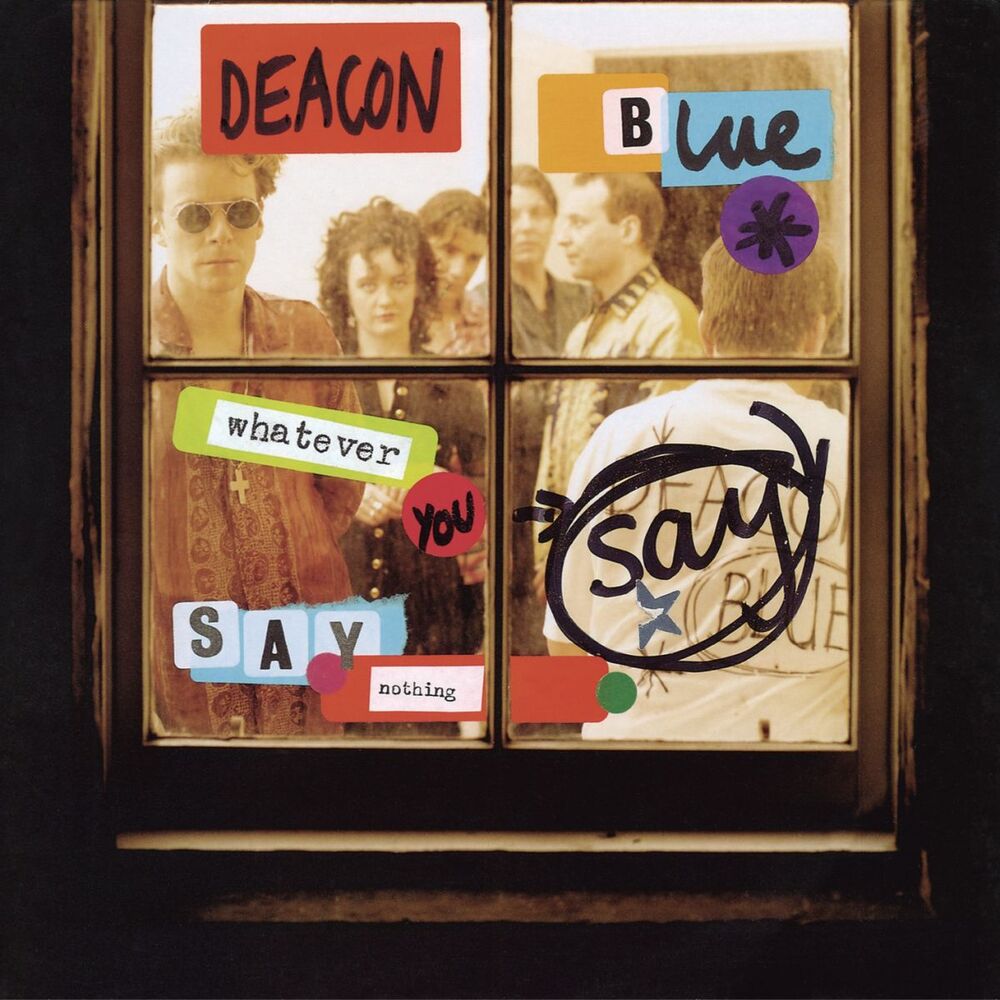
Whatever You Say, Say Nothing
- Released12 October 2012
- UK peak No. 4
- Weeks on UK chart 10
- Entered UK chart 7 March 1993
- LabelSony Music UK
- Tracks25 · 107 min
4 tracks from it charted as singles. Press a flag to play it in the chart where it peaked.
Tracks
| 1 | Your Town No. 14 · 1992 | 5:19 | |
| 2 | Only Tender Love No. 22 · 1993 | 5:10 | |
| 3 | Peace and Jobs and Freedom | 4:52 | |
| 4 | Hang Your Head No. 21 · 1993 | 4:13 | |
| 5 | Bethlehem's Gate | 4:45 | |
| 6 | Last Night I Dreamed of Henry Thomas | 3:44 | |
| 7 | Will We Be Lovers No. 31 · 1993 | 3:53 | |
| 8 | Fall so Freely Down | 4:17 | |
| 9 | Cut Lip | 3:33 | |
| 10 | All over the World | 3:30 | |
| 11 | Almost Beautiful | 4:14 | |
| 12 | I've Been Making Such A Fool | 2:22 | |
| 13 | Sleeper | 3:49 | |
| 14 | Paint It Red | 3:14 | |
| 15 | Pimp Talking | 2:48 | |
| 16 | Cracks You Up | 3:31 | |
| 17 | Freedom Train (Live) | 2:57 | |
| 18 | Here On The Wind | 5:04 | |
| 19 | Indigo Sky | 2:47 | |
| 20 | Your Town (Euro 7") No. 14 · 1992 | 3:44 | |
| 21 | Your Town (Perfecto Mix) No. 14 · 1992 | 6:27 | |
| 22 | Your Town (Barrio Mix Vocal) No. 14 · 1992 | 4:10 | |
| 23 | Your Town (Relaxation Dub) No. 14 · 1992 | 6:18 | |
| 24 | Your Town (Barrio Mix Instrumental) No. 14 · 1992 | 6:10 | |
| 25 | Will We Be Lovers (Norty 12") No. 31 · 1993 | 6:04 |
About the album
Whatever You Say, Say Nothing is the fourth studio album by Scottish rock band Deacon Blue, released in March 1993 by Columbia Records. It was the group's final original album before their initial dissolution in mid-1994.
Wishing to pursue a new musical direction, Deacon Blue recorded the album with the dance production team of Steve Osborne and Paul Oakenfold, hoping that the team's different background would provide a creative challenge. Oakenfold agreed to the project in hopes of changing the band's sound to something edgier, but recording sessions were fraught with disagreement and Oakenfold, who believed the group were uninterested in his ideas, lost interest in the project. Breaking with the band's earlier, more soulful and folky work, Whatever You Say is a visceral, guitar-driven alternative rock record with dance textures and driving rhythms. Lead singer Ricky Ross pens lyrics with more universal themes than on earlier records.
Promoted by the lead single and UK Top 20 hit "Your Town", Whatever You Say, Say Nothing reached number four in the UK Albums Chart, but was less successful than the band's earlier albums, and failed to chart in the United States. The album received an unenthusiastic response from music critics and the group's new direction baffled some of their fans.
Background
Deacon Blue's third album, Fellow Hoodlums (1991), sold half as many copies as its predecessor, When the World Knows Your Name (1989), and was critically panned, though it did receive a Platinum certification in the United Kingdom. Believing that they had firmly "established their sound" by the release of Fellow Hoodlums, lead singer Ricky Ross comments that the band wished to pursue a drastic change in direction for the follow-up album, Whatever You Say, Say Nothing. Craig Winn of M8 believed the band's "need to attract a new audience" was comparable to Wet Wet Wet, who – having been criticised for attracting a teenage audience – released the "mature" album High on the Happy Side (1992) and became fashionable, but writes that Deacon Blue "had the opposite problem" of having a mature audience and wanting younger fans.
On impetus for the band's new stylistic change, Ross commented that after the band achieved their original aim of recording an album and appearing on Top of the Pops, he realised that he is "actually quite ambitious and [wanted] to take it somewhere [he] hadn't imagined
Recording
Deacon Blue recorded Whatever You Say, Say Nothing in three English studios: London's AIR Studios, and Oxfordshire's The Manor Studio and Outside Studios. A fourth studio, Eden Studios in London, was used to mix the record. Paul Corkett recorded the album with assistance from Adrian Bushby, Danton Supple, Gorby and Steve Orchard. Vernal said the record was difficult to record, due to the band entering "territory which we'd never been in before'."
Music author Richard Norris writes that although recording with Oakenfold and Osborne was intended to "invigorate the band's creativity with a fresh new approach", the sessions were not wholly successful in this regard. Oakenfold said that Deacon Blue initially agreed to his ideas about moving their sound in an edgier direction, but that once he and Osborne entered the studio, the band changed their mind, having just released their best-selling single.
Release and promotion
As the lead single from Whatever You Say, Say Nothing, "Your Town" was released in November 1992 and debuted at number 14 on the UK Singles Chart, becoming the highest new entry that week. The song stayed on the chart four eight weeks. In their review of "Our Town", i-D wrote that "Oakenfold did with U2 and does it again here..." Reviewing the United States single release in May 1993, The Hard Report compared the song to the Beloved and praised it as a "great tune" which "has adult appeal written all over it", adding that it could attract both "the flannel wearing college kids and your corporate commercial radio guys". Further singles charted in the UK: "Will We Be Lovers" reached number 31 in February 1993, "Only Tender Love" reached number 22 in April, and the Hang Your Head EP reached number 21 in July. The latter contained the title track, "Freedom Train", "Here on the Wind" and "Indigo Sky".
Deacon Blue's fourth album, Whatever You Say, Say Nothing was released in the United Kingdom on 1 March 1993 through Columbia Records.
Critical reception
Whatever You Say, Say Nothing received unenthusiastic reviews from music critics, and the group's new direction baffled many of their fans. In his NME review, John Harris criticised the album for exuding "the wish to play the reinvention game à la U2, and suddenly become fashionable", believing that the band's A&R staff told them to "get trendy" in face of their failure to reach stadium-selling status. He added that "among all the cod-baggy wooliness", the band had "lost the knack of writing silly-but-hummable pop songs". Cross Rhythms critic Rupert Loydell noted how the band joined many other bands in "the reinvention game", adopting "the U2-esque semi-collage method of dance music, grandiose songs and sonic interruption/layering." He considered the approach to work effectively on songs like "Your Town" but believed the songs are otherwise "lost", feeling that Ross was "trying too hard to be hip" and not allowing his lyrics and melodies to "speak for themselves", resulting in a generally unmemorable album.
Andy Gill of The Independent described the album as "a belated jump onto a ba
Legacy
Working on Whatever You Say, Say Nothing discouraged Oakenfold from producing further albums for other artists, later commenting: "It's months out of your life. Three months in a studio with the band every day, six days a week does my head in." He credits the project as the start of him and Osborne beginning to work apart, "because I ain't gonna spend six months of my life working on a record if I'm not into it. But it was Steve's only source of income, so he would go and do it." Colin Larkin credits the album's poor reception, as well as Deacon Blue's lack of commercial success in the US, as contributing factors in the band's decision to split in mid-1994. McIntosh recalled that "there was a feeling that we weren't entirely sure where we were going. Musically, Whatever You Say, Say Nothing was brave and passionate in lots of ways. But it was quite a difficult record for us." The album was re-released on 29 October 2012 in a set of two CDs and a bonus DVD.