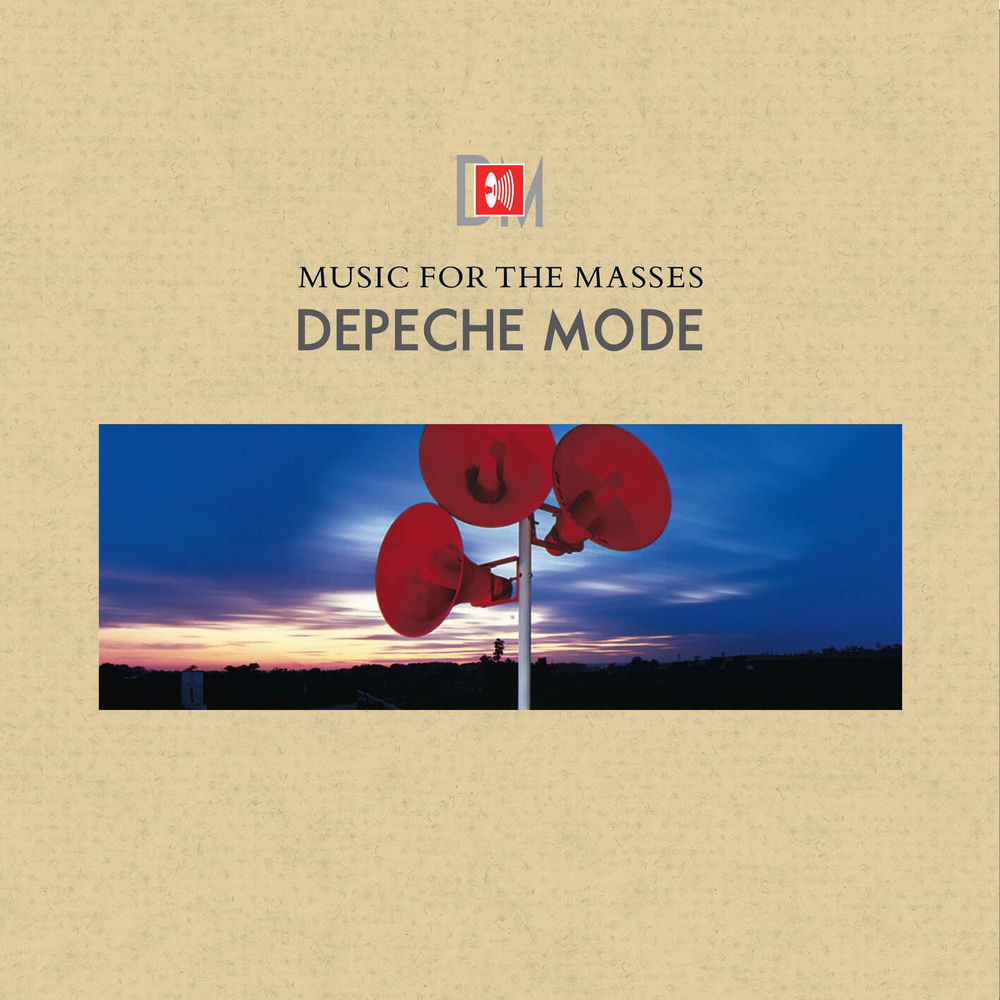
Music for the Masses
- Released3 July 2013
- UK peak No. 10
- Weeks on UK chart 4
- Entered UK chart 4 October 1987
- LabelVenusnote Ltd.
- Tracks14 · 62 min
4 tracks from it charted as singles. Press a flag to play it in the chart where it peaked.
Tracks
| 1 | 4:48 | ||
| 2 | The Things You Said | 3:55 | |
| 3 | 4:56 | ||
| 4 | Sacred | 4:44 | |
| 5 | Little 15 No. 60 · 1988 | 4:15 | |
| 6 | Behind The Wheel No. 21 · 1988 | 5:18 | |
| 7 | I Want You Now | 3:45 | |
| 8 | To Have And To Hold | 2:51 | |
| 9 | Nothing | 4:13 | |
| 10 | Pimpf | 4:57 | |
| 11 | Agent Orange | 5:04 | |
| 12 | 4:56 | ||
| 13 | To Have and to Hold (Spanish Taster) | 2:35 | |
| 14 | Pleasure, Little Treasure (Glitter Mix) | 5:35 |
About the album
Music for the Masses is the sixth studio album by the English electronic band Depeche Mode, released on 28 September 1987 by Mute Records in the United Kingdom and Sire Records in the United States. The follow-up to their successful album Black Celebration (1986), it was co-produced by Depeche Mode and David Bascombe. Recorded in Paris and London and mixed in Denmark, it was the first Depeche Mode album to see band member Alan Wilder take control of the production.
The album marked a turning point in the band's sound, blending dark, introspective themes with expansive production. Its release also marked a shift in visual identity, with Anton Corbijn's involvement in music videos and promotional materials helping to redefine the band's aesthetic. Music for the Masses was considered instrumental in helping the band achieve chart success and popularity in the US, which up until then had eluded them. It reached number 10 in the UK, number 35 in the US and number 2 in West Germany. Certified platinum in the US in 1991, it was estimated in 2023 that it had sold over 5.5 million copies globally.
Music for the Masses was included in the book 1001 Albums You Must Hear Before You Die (2006) and Slant Magazine's list of the 100 Best Albums of the 1980s.
Background
Depeche Mode had released their fifth album Black Celebration in early 1986, followed up with a supporting tour which lasted through the middle of that year, and contributed the song "But Not Tonight" to the soundtrack to the film Modern Girls (1986). While the album and tour were the band's most successful to date, they were still considered outsiders to mainstream music.
By the time the group entered the studio in late 1986 to record Music for the Masses, singer Dave Gahan and his wife Jo Fox Gahan were expecting their first child, and songwriter Martin Gore had moved back to London from West Berlin after ending his relationship with his girlfriend of four years, Christina Friedrich.
Production
Following the end of their Black Celebration Tour, Depeche Mode reconvened in the second half of 1986 to begin production of their new album. During previous recording sessions in 1985 for the single "Shake the Disease" and early 1986 for the album Black Celebration, tensions had grown between Daniel Miller, their long-time producer and label manager, and the band, due to interpersonal conflicts and the claustrophobic nature of the sessions. Citing those tensions and his own increased workload with Mute Records, Miller stepped away from the studio, and as such was not involved in the production of a Depeche Mode album for the first time since the Speak & Spell sessions in 1981. Similarly, Gareth Jones, who had worked with Depeche Mode as a producer on their previous two albums — and another source of tension over the previous two years — was also not involved in production for Music for the Masses.
Recording and mixing sessions
To force themselves to try new things, they decided to find a recording studio they had not yet recorded at, and chose Studio Guillaume Tell just outside of Paris, which they rented starting around September 1986.
As they had done on their previous several albums, the band immediately set out to find and record new sounds for use as samples on the album, which took three days. Wilder noted that, as they had on their previous albums, the band was always looking to make the album differently from their last, and did not want to repeat a formula. For Construction Time Again (1983), Some Great Reward (1984) and Black Celebration (1986), they had gathered most of their samples outside of the studio, so to avoid repetition, they created most of their new samples in the studio, although they did end up recording a few on the streets of Paris. Studio Guillaume Tell was converted from an old theater, and as such there were old instruments left there that the band used to sample and record with, including a grand piano and old orchestral bass drums and timpanis.
Title and artwork
Band members Fletcher and Gore both explained the album's title was conceived as a joke, after Gore found an old album called Music for the Millions. Fletcher said, "The title's ... a bit tongue-in-cheek, really. Everyone is telling us we should make more commercial music, so that's the reason we chose that title." According to Gore, the title "was a joke on the uncommerciality of [the album]. It was anything but music for the masses!" Miller agreed, saying that the name Music for the Masses was "about how Depeche Mode were forever destined to be a cult band who could never quite crack the mainstream," disproved by the success of Depeche Mode's subsequent tours and albums.
Release and promotion
Depeche Mode began a press circuit in mid-1987 to support the album, appearing on the magazine covers of Smash Hits, Underground, French Best, and Sounds. Gore said in the interview with Underground that they had been offered, but turned down, opportunities to score soundtracks for films, saying they were for "some dodgy sci-fi B movie stuff, where they've asked us to drop in words like 'Venus' and 'Jupiter' here and there."
Music for the Masses was released on 28 September 1987 by Mute Records in the United Kingdom, Sire Records in the United States, and Intercord Records in West Germany. In the UK, the album was assigned catalogue number STUMM47, and in West Germany, INT 146.833. Initial pressings of the German album were on blue vinyl, and to combat the public's interest in importing that version, Mute Records released early pressings of the UK album on transparent vinyl.
Singles
"Strangelove", the album's lead single, was released on 27 April 1987. The band appeared on the BBC's Top of the Pops on 7 May 1987 to promote the song. Instrumental "Pimpf" was the single's B-side.
Their second single, "Never Let Me Down Again", was released on 24 August 1987, with "Pleasure, Little Treasure" as its B-side. The album's third single, "Behind the Wheel", was released on 28 December 1987, and on 7 January 1988, Depeche Mode appeared on the Top of the Pops again to perform the song. The B-side, "Route 66", was included because Gore "thought it would be a good idea to record a driving song" on the release.
"Little 15" was released as the fourth and final official single in May 1988 in limited territories. The single had two B-sides, the instrumental "Stjarna" (Swedish for "star") and Wilder's performance of the "Moonlight Sonata" by Ludwig van Beethoven. Wilder performed the piano on both B-sides.
On 23 August 1988, Sire Records released the US-only "Strangelove '88" due to the strength of the US leg of their Music for the Masses Tour.