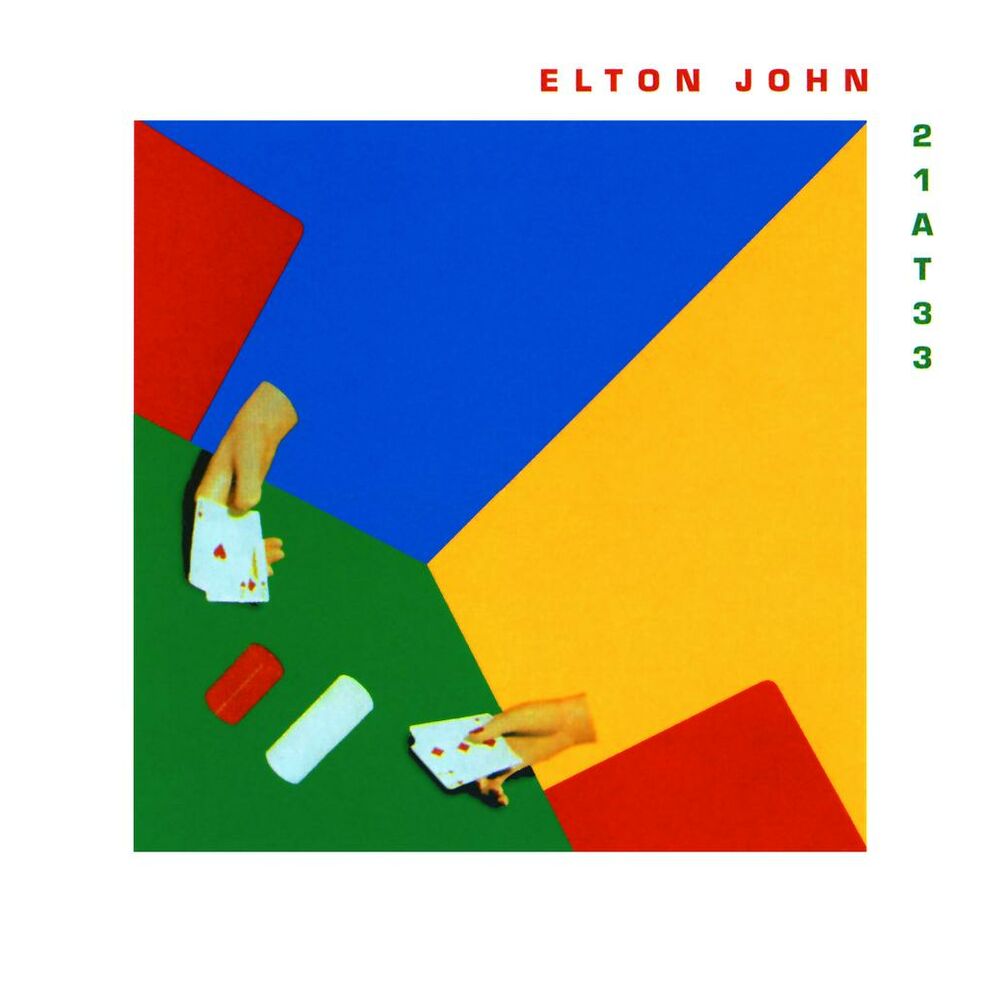
21 At 33
- Released1 January 1980
- UK peak No. 12
- Weeks on UK chart 11
- Entered UK chart 25 May 1980
- LabelUMC (Universal Music Catalogue)
- Tracks9 · 43 min
2 tracks from it charted as singles. Press a flag to play it in the chart where it peaked.
Tracks
| 1 | Chasing The Crown | 5:31 | |
| 2 | 5:13 | ||
| 3 | Sartorial Eloquence No. 44 · 1980 | 4:42 | |
| 4 | Two Rooms At The End Of The World | 5:39 | |
| 5 | White Lady White Powder | 4:31 | |
| 6 | Dear God | 3:44 | |
| 7 | Never Gonna Fall In Love Again | 4:07 | |
| 8 | Take Me Back | 3:51 | |
| 9 | Give Me The Love | 5:22 |
About the album
21 at 33 is the fourteenth studio album by British musician Elton John. It was released on 23 May 1980, through MCA Records in the US and The Rocket Record Company in all other territories. The album was co-produced by John and Clive Franks, and was primarily recorded in August 1979 at Super Bear Studios in Nice, France. The record was the first since Blue Moves (1976) to feature lyrics written by Bernie Taupin (who contributed to three songs), while John also continued to collaborate with other lyricists, including Gary Osborne and Tom Robinson. Contributors to the album include members of Toto and the Eagles, as well as Dee Murray and Nigel Olsson, marking their first appearance on an Elton John album since Captain Fantastic and the Brown Dirt Cowboy (1975).
The title 21 at 33 was chosen as it was John's 21st album release overall and came out when he was 33 years old. Upon release, the album was a moderate success, reaching the top 20 on both the US Billboard 200 and the UK Albums Chart and proving far more successful than his previous effort Victim of Love (1979). The record's lead single, "Little Jeannie", peaked at number three on the US Billboard Hot 100, while it stalled at number 33 on the UK singles chart. Critical reception was relatively warm, although some criticized the record as inconsistent and lacking cohesion.
Background
After the release of Blue Moves in 1976, Elton John and Bernie Taupin put their partnership on hold, with the both of them working with other acts. On A Single Man (1978), John would collaborate with lyricist Gary Osborne for the first time, while Taupin co-wrote Alice Cooper's 1978 album From the Inside. While John's albums still sold well, his new releases did not match the success of his early-1970s work, with A Single Man only reaching number 8 on the UK Albums Chart and number 15 on the US Billboard 200. In 1979, John would release the album Victim of Love, a move into disco on which he did not compose or play piano on any of the material, providing only vocals. The album was a flop, receiving the worst reviews of his career and stalling at number 35 in the US and number 41 in the UK. Also in 1979, John travelled to the Soviet Union to play a series of concerts with percussionist Ray Cooper.
Writing and recording
The writing of 21 at 33 marked the beginning of a tentative reunion between John and Taupin. The majority of the album's material was written in August 1979 in Grasse, France, to which John invited Taupin and his wife to join him. John and Taupin wrote ten songs together during this period, three of which would appear on the album. In addition to Taupin, John continued to write with Osborne, as well as with two new collaborators, Tom Robinson and Judie Tzuke. Robinson had already found success with his Tom Robinson Band and hits such as "2-4-6-8 Motorway" (1977) and the gay pride anthem "Glad to Be Gay" (1978), while Tzuke was a Rocket signee who had a UK top 20 hit with "Stay with Me till Dawn" in 1979. At one point, John considered making 21 at 33 a double album, though it was ultimately reduced to a single due to Clive Franks' belief that there was not a sufficient amount of quality material for a double.
Composition
In contrast with the previous year's Victim of Love, 21 at 33 sees John return to a more conventional pop and rock sound. Judy Parkinson, author of Elton: Made in England, describes the album as having a "contemporary electronic sound" due to its use of synthesizers and electric piano. The album opens with "Chasing the Crown", a John–Taupin composition. Elizabeth Rosenthal, author of His Song: The Musical Journey of Elton John, notes elements of gospel present within the song, combined with "the loud colors of rock aggression". Additionally, she describes John's piano part as a "scaled-down adaptation of some of the peppery chord patterns he had incorporated into "[I Heard It Through the] Grapevine" during his 1979 world tour", while "the melodious screeching of Steve Lukather's guitar sifts through the chords." Lyrically, Rosenthal considers the song to be a "close lyrical cousin" to "Sympathy for the Devil" (1968) by the Rolling Stones, with both songs being "engaging puzzles in which the listener is invited to identify a culprit who has caused conflict and misery." "Little Jeannie
Release and reception
"Little Jeannie" was released as the album's lead single in April 1980. The single debuted on the Billboard Hot 100 on 3 May 1980 at number 65 before moving into the top 40 within its second week. By 7 June, the song entered the top 10 and reached its peak of number three the week of 19 July. This made it the highest-charting Elton John song to be co-written by Osborne, as well as John's biggest American hit in years. Additionally, the song had a longer stay in the US top 10 than any of John's previous singles. "Little Jeannie" charted even higher on the Billboard Adult Contemporary chart, where it reached number one, making it his fifth chart-topper. It was less successful in the UK, where it stalled at number 33 on the UK singles chart. "Sartorial Eloquence" was chosen as the album's second single and was released in August 1980; it was given the subtitle of "Don't Ya Wanna Play This Game No More?" in the US. Contained on the flipside of the single were two previously unreleased tracks, "Cartier" and "White Man Danger".
Critical reception
21 at 33 received moderately positive reviews from critics. Writing for Smash Hits, Ian Cranna gave the album a 7 out of 10 rating and declared it John's best since Goodbye Yellow Brick Road (1973). While stating the album "never reach[es] jackpot status", he praised it as "melodically strong" and "musically light", complimenting Taupin's lyrics as "powerful", Robinson's as "personal", and calling Tzuke's contribution a "strong ballad". Cranna criticized Osborne's lyrics as "dreadful Song Contest efforts." In a review for Record Mirror, Robin Smith awarded the album four stars out of five, declaring it a comeback after the "lethargy of his last dire effort." Smith credited Taupin's return with "putting back the sharp lines that ha[d] been lacking" in John's recent albums. Billboard made 21 at 33 their "spotlight" album pick for the week ending 24 May 1980, calling it John's most "significant and pleasing" album since Blue Moves.