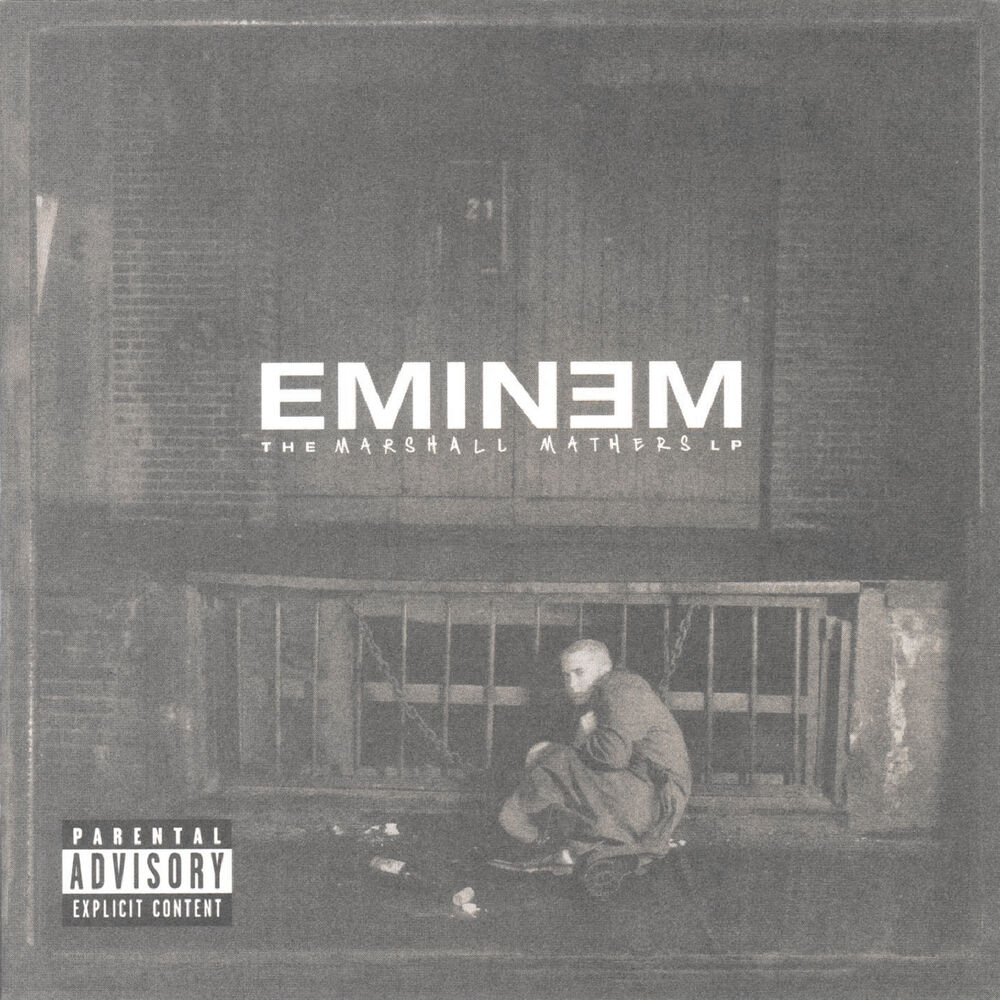
The Marshall Mathers LP
- Released16 May 2000
- UK peak No. 1
- Weeks on UK chart 95
- Entered UK chart 28 May 2000
- LabelEminem Catalog PS
- Tracks18 · 72 min
3 tracks from it charted as singles. Press a flag to play it in the chart where it peaked.
Tracks
| 1 | Public Service Announcement 2000 | 0:25 | |
| 2 | Kill You | 4:24 | |
| 3 | 6:43 | ||
| 4 | Paul (Skit) (Paul "Bunyan" Rosenberg) | 0:11 | |
| 5 | Who Knew | 3:48 | |
| 6 | Steve Berman | 0:54 | |
| 7 | 4:51 | ||
| 8 | 4:44 | ||
| 9 | Remember Me? | 3:39 | |
| 10 | I'm Back | 5:10 | |
| 11 | Marshall Mathers | 5:20 | |
| 12 | Ken Kaniff (Skit) | 1:02 | |
| 13 | Drug Ballad | 5:00 | |
| 14 | Amityville (Album Version Explicit) | 4:14 | |
| 15 | Bitch Please II | 4:48 | |
| 16 | Kim | 6:17 | |
| 17 | Under The Influence | 5:21 | |
| 18 | Criminal | 5:19 |
About the album
The Marshall Mathers LP (also referred to as the MMLP) is the third studio album by the American rapper Eminem, released on May 23, 2000, by Goliath Artists, Aftermath Entertainment, WEB Entertainment, and Interscope Records. Production on the album was handled by Dr. Dre, Mel-Man, F.B.T., Eminem, and the 45 King. The album features guest appearances from Dido, RBX, Sticky Fingaz, Dina Rae, Bizarre, Dr. Dre, Snoop Dogg, Xzibit, Nate Dogg, Paul Rosenberg and D12. Recorded over a 10-month period in several studios around Detroit, the album delivers introspective lyricism reflecting Eminem's thoughts on his rise to fame, criticism of his music, and estrangement from his family. As a transgressive work, it incorporates hardcore hip-hop, satirical hip-hop, and horrorcore.
The Marshall Mathers LP produced the singles "The Real Slim Shady", "The Way I Am", and "Stan", with "The Real Slim Shady" becoming Eminem's biggest hit up to that point. Like its predecessor, the album was surrounded by significant controversy upon release, while also propelling Eminem to the forefront of American pop culture. Criticism centered on lyrics that were considered violent, homophobic, and misogynistic, as well as references to the Columbine High School massacre in the songs "The Way I Am" and "I'm Back".
Background
Inspired by the disappointment and failure of his debut album, Infinite (1996), Eminem created the alter ego Slim Shady, whom he introduced on the Slim Shady EP (1997). After placing second in the annual Rap Olympics, Eminem was noticed by the staff at Interscope Records and eventually CEO Jimmy Iovine, who played the Slim Shady EP for hip-hop producer Dr. Dre. Eminem and Dr. Dre then met and recorded The Slim Shady LP (1999), which was noted for its over-the-top lyrical depictions of drugs and violence. The Slim Shady LP was a critical and commercial success, debuting at number 2 on the Billboard 200 chart and selling 283,000 copies in its first week. At the 42nd Grammy Awards in 2000, the record won Best Rap Album, while the album's lead single "My Name Is" won Best Rap Solo Performance.
The Slim Shady LP turned Eminem from an underground rapper into a high-profile celebrity. The rapper, who had previously struggled to provide for his daughter Hailie, noted a drastic change in his lifestyle.
Recording
The Marshall Mathers LP was recorded in a two-month-long "creative binge", which often involved 20-hour-long studio sessions. Eminem hoped to keep publicity down during the recording in order to stay focused on working and figuring out how to "map out" each song. He described himself as a "studio rat" who benefited creatively from the isolated environment of the studio. Much of the album was written spontaneously in the studio; Dr. Dre noted, "We don't wake up at two in the morning, call each other, and say, 'I have an idea. We gotta get to the studio.' We just wait and see what happens when we get there." Eminem observed that much of his favorite material on the album evolved from "fucking around" in the studio; "Marshall Mathers" developed from the rapper watching Jeff Bass casually strumming a guitar, while "Criminal" was based on a piano riff Eminem overheard Bass playing in studio next door. "Kill You" was written when Eminem heard the track playing in the background while talking to Dr. Dre on the phone and developed an interest in using it for a song.
Music and lyrics
Considered both a horrorcore and a hardcore hip-hop album, much of the album's first half was produced by Dr. Dre and Mel-Man, who employed their typical sparse, stripped-down beats, to put more focus on Eminem's vocals. The background music on the record employs "liquid basslines, stuttering rhythms, slight sound effects, and spacious soundscapes". Bass Brothers and Eminem produced most of the second half, which ranges from the laid-back guitars of "Marshall Mathers" to the atmosphere of "Amityville". The only outside producer on the album was The 45 King, who sampled a verse from Dido's song "Thank You" for "Stan", while adding a slow bass line.
The Marshall Mathers LP is considered a transgressive work, and contains more autobiographical themes in comparison to The Slim Shady LP. Much of the album is spent addressing his rise to fame and attacking those who criticized his previous album. Other themes include his relationship with his family, including his mother and Kim Mathers, his ex-wife.
Release
The Marshall Mathers LP was released on May 23, 2000, by Aftermath Entertainment, Interscope Records, in the United States, and on September 11, 2000, by Polydor Records in the United Kingdom. The Marshall Mathers LP was released with two different album covers. The original features Eminem sitting on the porch of the house he lived in during his teenage years. He reflected on the photo shoot by saying, "I had mixed feelings because I had a lot of good and bad memories in that house. But to go back to where I grew up and finally say, 'I've made it', is the greatest feeling in the world to me." The other cover features the rapper seated in a fetal position beneath a loading dock with alcohol and prescription pill bottles at his feet. Will Hermes of Entertainment Weekly likened Eminem's appearance on the cover to a "dysfunctional Little Rascal", viewing the image as indicative of the rapper's musical evolution: "Easy to read, right? The debut: a violent fantasy, the acting-out of a persona. The follow-up: the vulnerable artist unmasked."
Commercial performance
The Marshall Mathers LP sold 1.76 million copies in the United States its first week, at the time the second-highest single week sales for an album in the SoundScan era, behind only the 2.4 million copies sold by NSYNC's No Strings Attached earlier that year. The album sold more than twice as many copies as the previous record holder for the highest single week sales for a hip hop or rap album, Snoop Dogg's Doggystyle, which sold 806,000 copies in its first week in 1993. It sold over 800,000 copies in its second week, 600,000 copies in its third week, and 520,000 copies in its fourth week for a four-week total of 3.65 million. It also became one of the few albums to sell over 500,000 copies for four consecutive weeks. In total, the album spent eight weeks at number 1 on the US Billboard 200, ranking it fourth on the current all-time list of weeks spent at number 1 by a rap or hip-hop album. It was the second best-selling album of the year, behind No Strings Attached, with 7.9 million copies sold.