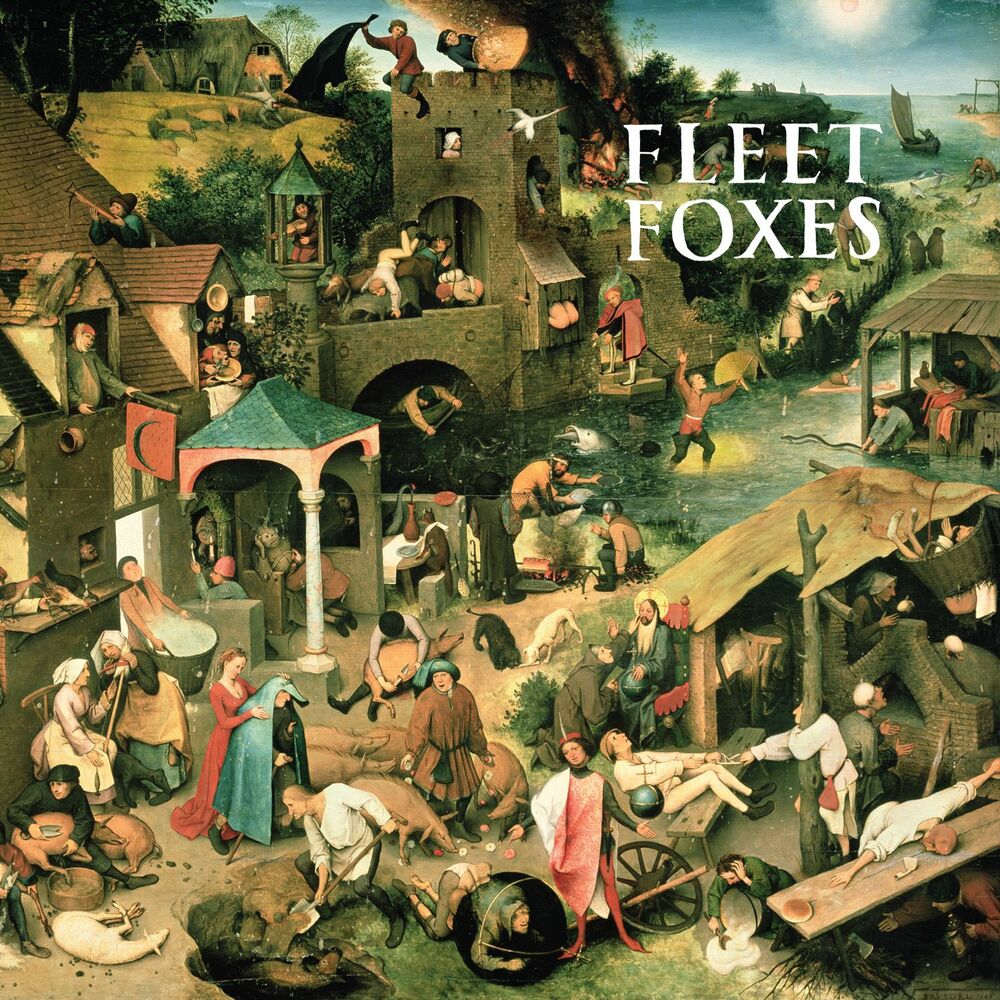
Fleet Foxes
- Released9 June 2008
- UK peak No. 3
- Weeks on UK chart 67
- Entered UK chart 22 June 2008
- LabelSub Pop Records
- Tracks11 · 40 min
One track from it charted as a single. Press a flag to play it in the chart where it peaked.
Tracks
| 1 | Sun It Rises | 3:13 | |
| 2 | White Winter Hymnal No. 77 · 2009 | 2:29 | |
| 3 | Ragged Wood | 5:09 | |
| 4 | Tiger Mountain Peasant Song | 3:30 | |
| 5 | Quiet Houses | 3:34 | |
| 6 | He Doesn't Know Why | 3:22 | |
| 7 | Heard Them Stirring | 3:04 | |
| 8 | Your Protector | 4:11 | |
| 9 | Meadowlarks | 3:13 | |
| 10 | Blue Ridge Mountains | 4:27 | |
| 11 | Oliver James | 3:23 |
About the album
Fleet Foxes is the debut studio album by American band Fleet Foxes, released on June 3, 2008, by Sub Pop and Bella Union. The album garnered wide praise from critics, many of whom named it one of the best albums of the 2000s and one of the greatest debut albums of all time.
Background
Fleet Foxes was formed in Seattle, Washington in 2006 by singer-songwriters Robin Pecknold and Skyler Skjelset. Pecknold grew up in nearby Kirkland, an affluent suburb. His parents gave him an acoustic guitar in middle school. He met Skjelset in high school, bonded over music and similar Norwegian roots. In his tenth grade year, Pecknold dropped out, completing his degree at a community college and immersing himself in music. He moved into the city and secured work at a restaurant, where he joined the local outfit Dolour and befriended other accomplished musicians. Further, Pecknold gained connections through a job at a burrito restaurant, where he discovered more contemporary indie rock.
The pair first settled on the name the Pineapples, but the name was taken by a local punk act. Instead, Pecknold thought of the name Fleet Foxes, which he felt brought to mind fox hunting.
Recording
The band began recording the album in 2007, in Pecknold's parents' basement and Wescott's home. The album was produced by veteran engineer Phil Ek, best-known for his work with other Pacific Northwest luminaries, such as Built to Spill. Ek had first met Pecknold four years prior. Ek had earlier helped Fleet Foxes record their first demo and used his influence to assist in shopping it to record labels. The resulting album was recorded with Ek over the course of a year. As labels had yet to get involved with the band at this point, the recording was funded by the group themselves.
For the album, the group aimed to rework their existing sound into something more simple, emphasizing harmonies and unconventional song structures. Pecknold described the sessions as constant and exhausting, with the album going through various phases and permutations before they settled on its final state. The album was completed at one point, but was entirely revised and re-recorded.
Themes
The album fuses folk music, gospel, psychedelic pop, and Sacred Harp styles. Rolling Stone columnist Austin Scaggs described the album's music as dense, singling out its usage of progressive countermelodies. The album's harmonious arrangements were interpreted as lush and textured. Though the music is audibly informed by gospel traditions, Pecknold was not brought up religious. Instead, he felt the devotional aspect proved more compelling from a songwriting standpoint. Its mood evokes bucolic images, yearning for easier times; Pecknold called it "uninformed nostalgia".
The album's pastoral music is primarily acoustic in nature, and its lyrics autobiographical and philosophic—much of the topics related to Pecknold's friends and family. "Blue Ridge Mountains" was originally named after Pecknold's grandfather, Bob Valaas. To write the album, Pecknold traveled to a rural log cabin built by his grandfather in the small community of Plain, Washington. He had just returned home after a long camping trip with his brother and sister, and the sights of nature factored into his lyricism.
Commercial performance
Though the band was courted by larger, major record labels, sparking a bidding war, they chose to sign with Sub Pop, a Seattle-based independent label. The news was first announced in January 2008. Pecknold was apprehensive about the move, perceiving that the recording quality of Fleet Foxes would be unrepresentative of the label's style. He confided in the label that he hoped for the album to fail, so they could begin writing their next one. Overseas distribution was handled by the hip British imprint Bella Union. Preceding the release of the album, Fleet Foxes also issued Sun Giant, an extended play later bundled with the vinyl edition of the LP. Sun Giant was recorded in only eight days, after the recording of Fleet Foxes, but was released first. It was intended to only be sold at concerts, but its popularity only served to bolster the group's burgeoning breakthrough.
In response to growing hype, Sub Pop adjusted its promotional plans to what they might suggest for the label's top artists.
Reception
Fleet Foxes received widespread acclaim from the music critics. At Metacritic, which assigns a normalized rating out of 100 to reviews from mainstream critics, the album has an average score of 87 out of 100 based on 31 reviews, indicating "universal acclaim". The Guardian described it to be "a landmark in American music, an instant classic". Similar praise was put upon the album by AllMusic, which stated that "Fleet Foxes is such a satisfying, self-assured debut".
Uncut magazine awarded the album their inaugural Uncut Award in 2008 for "the most rewarding album of the past 12 months". Q magazine voted it the second best album of 2008 while it topped The Times "100 best records of 2008" list. and captured the No. 3 slot on WERS Boston's Top 50 of 2008 list. The album was also reviewed on the 'In A Word' section of the weekly podcast EGGCAST, where it was described as 'cosy' and 'organic'. Mojo gave the debut the seldom-awarded "Instant Classic" label. Until Joanna Newsom's Have One On Me in the April 2010 issue, it was the last album to receive this honor.