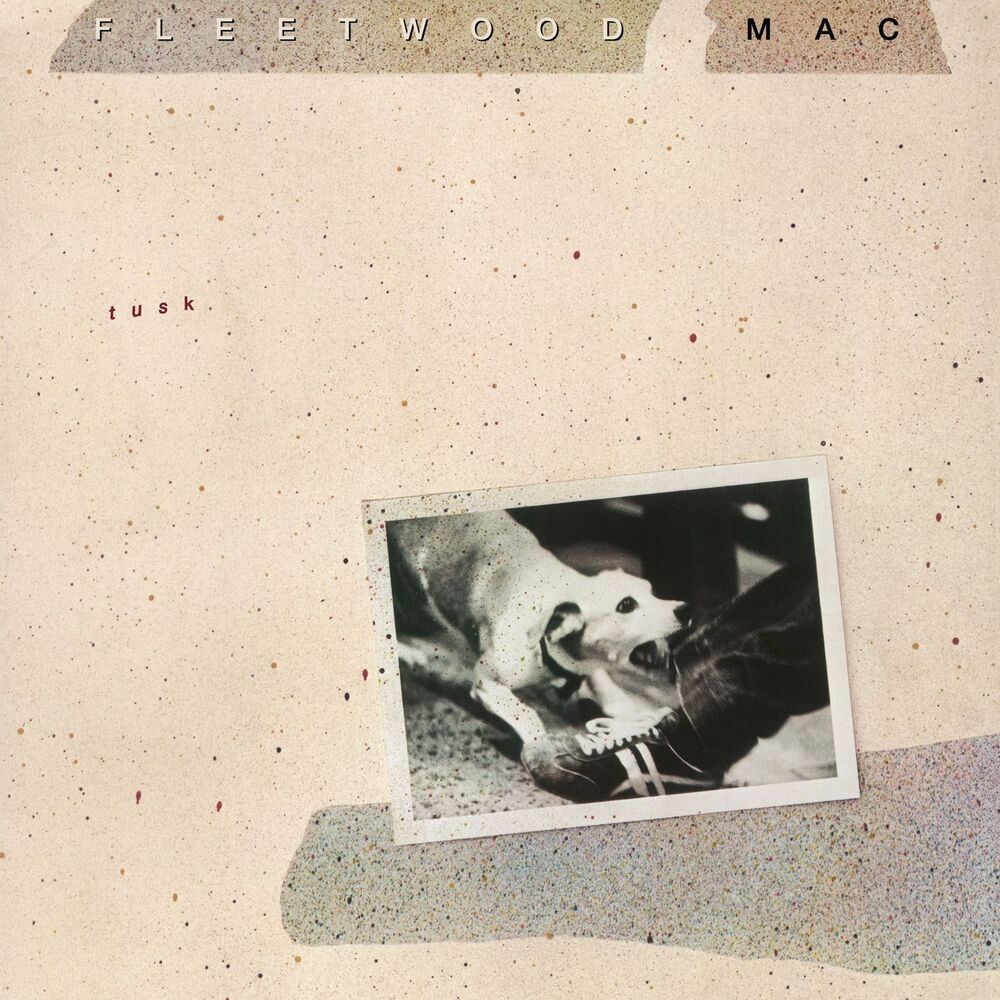
Tusk (2015 Remaster)
- Released4 December 2015
- UK peak No. 1
- Weeks on UK chart 27
- Entered UK chart 21 October 1979
- LabelRhino/Warner Records
- Tracks20 · 74 min
4 tracks from it charted as singles. Press a flag to play it in the chart where it peaked.
Tracks
| 1 | Over & Over (2015 Remaster) | 4:34 | |
| 2 | The Ledge (2015 Remaster) | 2:07 | |
| 3 | Think About Me (2015 Remaster) No. 20 · 1980 | 2:44 | |
| 4 | Save Me a Place (2015 Remaster) | 2:42 | |
| 5 | 6:30 | ||
| 6 | What Makes You Think You're the One (2015 Remaster) | 3:30 | |
| 7 | Storms (2015 Remaster) | 5:30 | |
| 8 | That's All for Everyone (2015 Remaster) | 3:01 | |
| 9 | Not That Funny (2015 Remaster) | 3:14 | |
| 10 | Sisters of the Moon (2015 Remaster) No. 86 · 1980 | 4:43 | |
| 11 | Angel (2015 Remaster) | 4:54 | |
| 12 | That's Enough for Me (2015 Remaster) | 1:50 | |
| 13 | Brown Eyes (2015 Remaster) | 4:27 | |
| 14 | Never Make Me Cry (2015 Remaster) | 2:18 | |
| 15 | I Know I'm Not Wrong (2015 Remaster) | 3:01 | |
| 16 | Honey Hi (2015 Remaster) | 2:45 | |
| 17 | Beautiful Child (2015 Remaster) | 5:21 | |
| 18 | Walk a Thin Line (2015 Remaster) | 3:44 | |
| 19 | 3:37 | ||
| 20 | Never Forget (2015 Remaster) | 3:38 |
About the album
Tusk is the twelfth studio album by the British-American rock band Fleetwood Mac, released as a double album on 12 October 1979 in the United States and on 19 October 1979 in the United Kingdom by Warner Bros. Records. It is considered more experimental than their previous albums, partly as a consequence of Lindsey Buckingham's sparser songwriting arrangements and the influence of post-punk. The production costs were initially estimated to be about $1 million but many years later were revealed to be about $1.4 million (equivalent to $6.21 million in 2025), making it the most expensive rock album recorded to that date.
The band embarked on a nine-month tour to promote Tusk. They travelled extensively across the world, including the US, Australia, New Zealand, Japan, France, Belgium, Germany, the Netherlands, and the UK. In Germany, they shared the bill with Bob Marley. On this world tour, the band recorded music for the Fleetwood Mac Live album, released in 1980.
Compared to 1977's Rumours, which sold ten million copies by February 1978, Tusk was regarded as a commercial failure by the label, selling four million copies. In 2013, NME ranked Tusk at number 445 in their list of "500 Greatest Albums of All Time". The album was also included in the book 1001 Albums You Must Hear Before You Die. In 2000, it was voted number 853 in Colin Larkin's All Time Top 1000 Albums.
Background
Going into Tusk, Lindsey Buckingham was adamant about creating an album that sounded nothing like Rumours. Buckingham commented that he intended for Tusk to subvert the expectations of creating a "Rumours 2 and Rumours 3, which is kind of the business model Warner Bros. would have liked us to follow." Mick Fleetwood decided early on that Tusk was to be a double album. Beach Boys drummer Dennis Wilson, who was dating Christine McVie at the time, offered to host the band at the Beach Boys' studio, which they were planning to renovate. While the band initially agreed to this idea, an attorney for the Beach Boys later told Fleetwood Mac that they would still have to pay for the facility even if they decided not to use it. Fleetwood Mac subsequently backed out of the deal and approached Geordie Hormel, who offered to construct a custom studio for the band at The Village Recorder. Hormel presented them with an option to either purchase the studio or rent it. Fleetwood Mac producer Ken Caillat suggested that the band purchase the studio, reckoning that this would be the cheaper option.
Recording
After the studio was built, Buckingham queried Fleetwood about recording some songs at his home studio. Fleetwood acquiesced, but told Buckingham that the other members of Fleetwood Mac would need to be integrated during the recording sessions. For certain songs, Buckingham played a Kleenex box as a snare drum and had Fleetwood overdub his own drums over Buckingham's demos. Several of Buckingham's songs were recorded at his home studio on a 24-track machine with him playing all of the instruments, including "The Ledge", "Save Me a Place", and "That's Enough for Me".
Caillat recalled that Buckingham's nature in the recording studio was the source of some tension: "He was a maniac. The first day, I set the studio up as usual. Then he said, 'Turn every knob 180 degrees from where it is now and see what happens.' He'd tape microphones to the studio floor and get into a sort of push-up position to sing. Early on, he came in and he'd freaked out in the shower and cut off all his hair with nail scissors.
Artwork
Rather than solicit the services of Herbert W. Worthington, who created the cover art for Rumours and the 1975 self-titled album, the band opted to select three photographers from different disciplines to design the album sleeve for Tusk. Larry Vigon, who served as the album's designer, reached out to Peter Beard after seeing some of his artwork in one of his journals, which included sundry items such as feathers, dried leaves, and newspaper headlines.
Beard, who specialised as a documentary photographer, was enlisted by Vigon to supply images for the album sleeve and spent two weeks in the recording studio taking Polaroids of the band and its inner circle. He also augmented this footage with images of elephant tusks. During one of those sessions, Beard took a photo of Caillat's dog Scooter biting his leg, which ultimately became the cover art for Tusk. Fleetwood had originally promised Nicks that the cover art would feature an image of her twirling and dancing; Nicks later told Caillat that she placed a curse on his dog for "stealing her cover".
Title
Varying accounts have been provided by Fleetwood Mac and their production team of naming the album Tusk. In Fleetwood's first memoir, he said that the title was in reference to male genitalia and claimed that Nicks threatened to quit the band after learning about the origin of the name. Nicks commented that "there was nothing beautiful or elegant about the word 'tusk'. All it really brought to mind was people stealing ivory. Even then, in 1979, you just thought about rhinos being poached, tusks being stolen, elephants being slaughtered and ivory being sold on the black market." She said that she "liked the title even less" when she was told about the meaning of the title and mentioned that the studio's mixing console was nicknamed "Tusk" due to the fake tusks that were mounted on the device.
Caillat said the band "thought that the tusk was a sign of male prowess" and remembered hearing the male members of the band making tusk jokes during the recording sessions.
Release
Tusk was one of the first albums to be digitally mixed, having occurred the same year as Ry Cooder's album Bop Till You Drop. Caillat remembered that their efforts of digitally mixing the album were marred by issues related to unwanted surface noise due to issues with the vinyl pressing process. Similar issues occurred when the initial batch of singles for the title track were recalled by Warner Bros in September due a scratch on the vinyl's B-side. Caillat commented that "after Tusk came out, we had a meeting, of literally all the vinyl manufacturers. We had [them] all come in and actually tell us why there were so many problems". According to Caillat, they generally attributed these issues to industry changes on how the vinyl formula was made. Cashbox reported that the number of initial copies pressed and shipped for Tusk had exceeded Rumours.
An advertisement campaign was arranged by Warner Bros Records that utilised aspects of the album package, including the polaroid photo of the dog and italicised font found on the cover, and Seef's photo found in the inner sleeve.