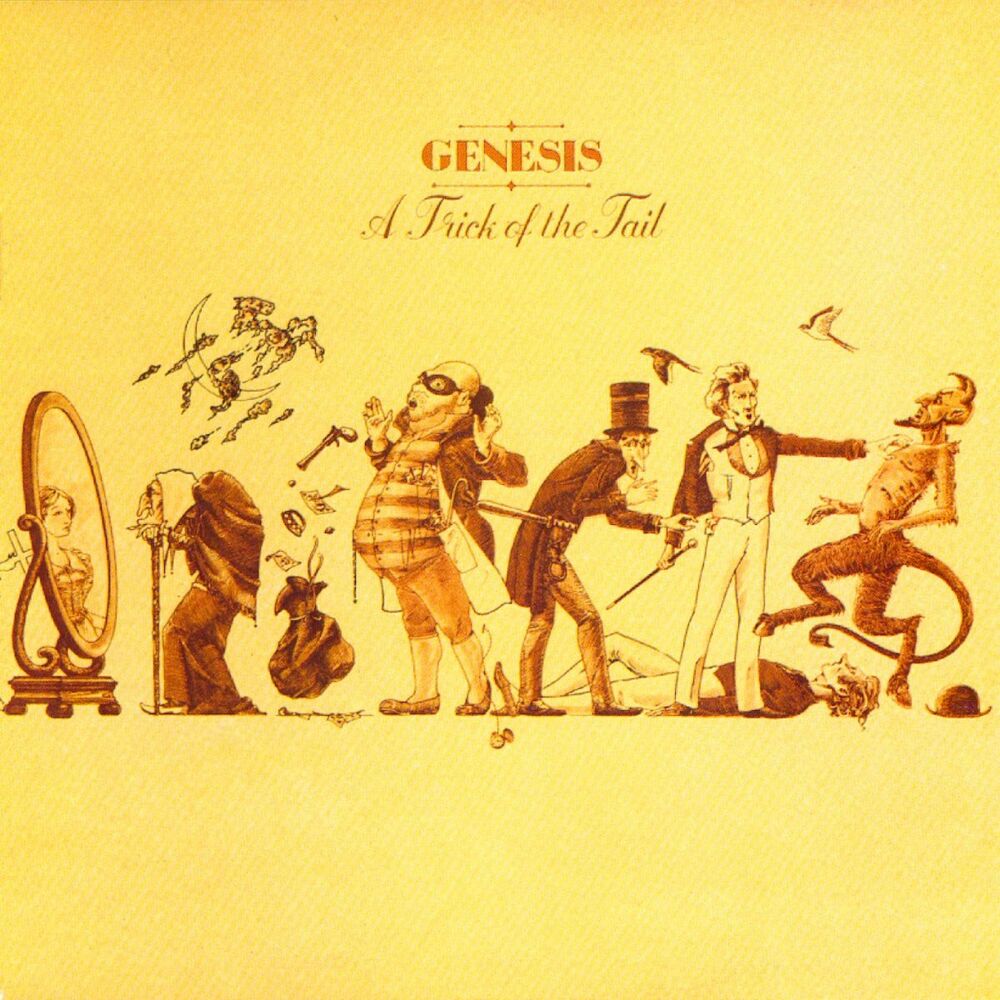
A Trick of the Tail
- Released8 November 1994
- UK peak No. 3
- Weeks on UK chart 39
- Entered UK chart 22 February 1976
- LabelAtlantic Records
- Tracks8 · 51 min
Tracks
| 1 | Dance on a Volcano | 5:54 | |
| 2 | Entangled | 6:26 | |
| 3 | Squonk | 6:29 | |
| 4 | Mad Man Moon | 7:35 | |
| 5 | Robbery, Assault and Battery | 6:16 | |
| 6 | Ripples | 8:06 | |
| 7 | A Trick of the Tail | 4:34 | |
| 8 | Los Endos | 5:46 |
About the album
A Trick of the Tail is the seventh studio album by the English progressive rock band Genesis. It was released on 13 February 1976 on Charisma Records and was the first album to feature drummer Phil Collins as lead vocalist following the departure of Peter Gabriel. It was a critical and commercial success in the UK and US, reaching No. 3 and No. 31 respectively.
Following Gabriel's decision to leave the band, the remaining members wanted to carry on to show they could still write and record successful material, as keyboardist Tony Banks and bassist/guitarist Mike Rutherford were the band's principal composers. The group wrote and rehearsed new songs during mid-1975, and listened to numerous audition tapes for a replacement frontman. They entered Trident Studios in London in October with producer David Hentschel to record the album without a definitive idea of who was going to perform lead vocals. After the search for a singer proved unfruitful, Collins was persuaded to sing "Squonk", and his performance was so strong that he became the band's new frontman.
Upon release, critics were impressed by the improved sound quality and the group's ability to survive the loss of Gabriel without sacrificing the quality of the music. The group toured the album with former Yes and King Crimson drummer Bill Bruford, and the resulting performances in the US raised their profile there.
Background
Founding member and lead singer Peter Gabriel decided in late 1974, early in the tour for the album The Lamb Lies Down on Broadway, to leave Genesis when the tour was over. His bandmates hoped he would reconsider, for they were still in debt and felt his departure could destroy the band's future, but ultimately accepted that he would leave. The remaining members wanted to continue to collaborate musically, and show journalists and critics they were primarily a songwriting team that could still produce good music. Banks had been close to Gabriel personally, and did not want the band to split up on top of seeing less of one of his best friends. He had written a number of songs for a possible solo project before deciding they should be used on the new Genesis album.
Following the end of the tour, guitarist Steve Hackett recorded a solo album, Voyage of the Acolyte, with guitarist/bassist Mike Rutherford and drummer Phil Collins, feeling unsure that Genesis would survive. He reconvened with the remaining group members in July 1975.
Recording and production
Recording began in Trident Studios in October 1975 with producer David Hentschel. On previous Genesis albums Hentschel had served as tape op and engineer; Collins had become a fan of his album Startling Music, a re-recording of Ringo Starr's album Ringo on an ARP 2500 synthesizer. Collins thought the group could carry on as an instrumental act, but the others felt that the music would suffer without vocals. The group had still not decided on a replacement singer, so they decided to begin recording backing tracks and to audition singers as they went along. Gabriel visited the band in the studio and listened to the album, and thought they had succeeded in proving to others that they still were "a whole, strong band without me".
Composition and music
The opening track, "Dance on a Volcano", was the first song written for the album. Rutherford felt that, in contrast to the material on The Lamb..., it was easy to write, and was intended to show how Genesis would move forward.
"Entangled" originated from a piece by Hackett that Banks particularly liked, and the latter went on to write the chorus and closing synthesiser solo for the song. Hackett also wrote the lyrics which Collins thought had a Mary Poppins feel to them. Rutherford recalled that Hackett "started writing verses which were very airy-fairy and then he came down with a bang".
"Squonk" is based on the North American myth of the Squonk which, when captured, dissolves into a pool of tears. The song combines a main theme written by Rutherford with a middle section written by Banks, and was designed to resemble Led Zeppelin's "Kashmir".
"Robbery, Assault and Battery" was mostly written by Banks, in an attempt to replicate the humour in some of Gabriel's lyrics.
Packaging and artwork
In an interview in July 2026 Steve Hackett claims that while working on an album cover for A Trick of the Tail, Hipgnosis presented them with the album cover that ended up being that of Led Zeppelin's Presence, and that Genesis rejected it, preferring an illustration over a photograph.
Critical reception
A Trick of the Tail had a positive reception from music critics, who were impressed that the group could survive the loss of Gabriel without their music suffering. The sound quality had improved from previous albums as a result of Hentschel's production skills. The album reached No. 3 in the UK and No. 31 in the US It was certified Gold in the UK by the British Phonographic Industry in June and in the US by the RIAA in March 1990. The album remained in the UK charts for 39 weeks and recouped a significant amount of the $400,000 worth of debt they had accumulated by the time Gabriel left.
For the first time in their career, Genesis filmed promotional videos for their songs. The first to be filmed was the title track, which features the band playing to the song together around a piano, including composite shots of a miniature Collins hopping around on a piano and a guitar. The group also produced promotional films of "Ripples..." and "Robbery, Assault and Battery".