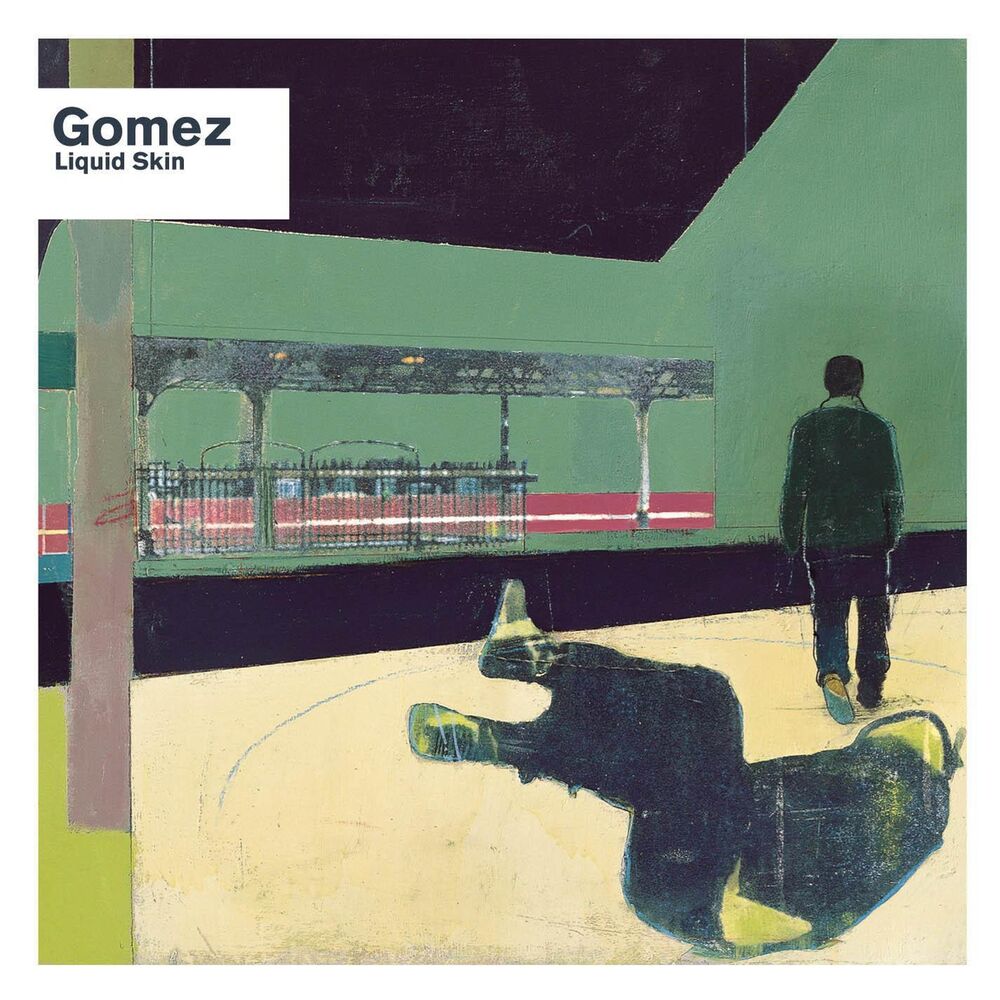
Liquid Skin
- Released21 September 1999
- UK peak No. 2
- Weeks on UK chart 36
- Entered UK chart 19 September 1999
- LabelHut
- Tracks11 · 55 min
3 tracks from it charted as singles. Press a flag to play it in the chart where it peaked.
Tracks
| 1 | Hangover | 3:27 | |
| 2 | Revolutionary Kind | 4:32 | |
| 3 | Bring It On No. 21 · 1999 | 4:10 | |
| 4 | Blue Moon Rising | 4:48 | |
| 5 | Las Vegas Dealer | 3:55 | |
| 6 | We Haven't Turned Around No. 38 · 1999 | 6:29 | |
| 7 | Fill My Cup | 4:39 | |
| 8 | Rhythm And Blues Alibi No. 18 · 1999 | 5:03 | |
| 9 | Rosalita | 4:05 | |
| 10 | California | 7:24 | |
| 11 | Devil Will Ride | 6:56 |
About the album
Liquid Skin is the second album by English rock group Gomez, released on 13 September 1999 by Hut Records. Following the release of their debut studio album Bring It On (1998), the band began recording their follow-up between August 1998 and June 1999 at Parr Street Studios in Liverpool, and Abbey Road Studios in London. Gomez were allowed to self-produce the sessions after their label heard the strength of their demos. Described as a blues rock album, Liquid Skin was compared to the work of Beck, the Grateful Dead, and Pearl Jam.
Liquid Skin received generally favourable reviews from critics, many of whom found it to be a retread of Bring It On with improved production. Preceded by a two-month tour of the United States, "Bring It On" was released as the lead single from Liquid Skin on 28 June 1999. Gomez appeared at a number of festivals, prior to the release of the album's second single "Rhythm & Blues Alibi" on 30 August 1999. Coinciding with the release of Liquid Skin, the band embarked on tours of the US and the UK, which were then followed by its third single "We Haven't Turned Around" on 8 November 1999. All three singles reached the top 40 of the UK Singles Chart, with "Rhythm & Blues Alibi" peaking the highest at number 18.
Background
Gomez released their debut studio album Bring It On in April 1998. It peaked at number 11 in the UK, where it won the Mercury Music Prize. All three of its singles charted on the UK Singles Chart, with "Whippin' Piccadilly" reaching the highest at number 35. It was promoted with a tour of the United States supporting Eagle-Eye Cherry.
Based on the strength of the demos the band had made, their label let them self-produce their next album. Sessions for it began at Parr Street Studios in Liverpool in August 1998. By November 1998, the band were working at Abbey Road Studios, where they recorded strings, before moving to a mansion near Hastings. Guitarist Ian Ball said they moved so that they would be able to "recreate the home-recorded sound of the first album, but in grander surroundings". They took a break to play a US tour with Mojave 3 in April and May 1999. Gomez had collectively recorded 32 songs during the recording sessions; they had finished in June 1999.
Composition and lyrics
Musically, the sound of Liquid Skin has been described as blues rock, rooted in American blues and folk, with elements of art rock and psychedelic music. It has been compared to the work of Pearl Jam (specifically their 1996 album No Code), Beck, and the Grateful Dead. Acoustic guitars lead the majority of the songs, which are accompanied by horns, strings, and keyboards. There is a bigger emphasis on vocals and harmonies; in contrast to Bring It On, which typically featured one singer per track, most of the songs on Liquid Skin had all three (Ball, guitarist Tom Gray, and guitarist Ben Ottewell). Ottewell theorised that the band's experience travelling in Australia, Europe and the United States influenced their writing. The album's title went through multiple names – God's Big Spaceship and Touching Up – before settling on Liquid Skin, which was inspired by a product they had found while in the United States.
Release
Gomez embarked on a tour of the US in April and May 1999, where they were supported by Mojave 3; they cancelled shows in Europe to focus on the US. On 20 June 1999, Liquid Skin was announced for release in three months' time. "Bring It On" was released as the lead single from the album on 28 June 1999. Two versions were released on CD: the first with "Dire Tribe" and "M57", while the second included "Chicken Bones" and "Step Inside". They then appeared at the Glastonbury, T in the Park and V Festivals over the next two months. "Rhythm & Blues Alibi" was released as a single on 30 August 1999. Two versions were released on CD: the first with "The Best in Town" and "So", while the second included a "pre-mellotron" version of "Rhythm & Blues Alibi", "ZYX", and a live version of "Tijuana Lady" (under the name "Tijuanalaska").
Liquid Skin was released through Hut Records on 13 September 1999; its US release occurred a week later. Coinciding with this, the band went on a tour of the US and then the UK in October and November 1999.
Reception
Liquid Skin was met with generally favourable reviews from music critics. Tom Sinclair of Entertainment Weekly noted that the band had been referred to as roots rock, "but one listen to their sophomore CD shows they’re twisting those roots into strange and marvelous shapes". AllMusic reviewer Stephen Thomas Erlewine saw the album as a "cleaner, more streamlined version" of Bring It On, adding that they perform music "that they believe to be experimental or rootsy, but not quite going far enough in either direction". NME Piers Martin also found it to be "very much like" their debut, "only bigger, even more confident and with far better production".
Los Angeles Times writer Richard Cromelin said Gomez had "a free-ranging imagination, twisting and distorting and juxtaposing [their songs] with an exhilarating sense of freedom". PopMatters editor Sarah Zupko wrote that band had "picked up a few new studio tricks or two and rounded out their sound with fuller textures and better-produced mixes".