Dookie
- Released28 January 1994
- UK peak No. 13
- Weeks on UK chart 114
- Entered UK chart 30 October 1994
- LabelReprise
- Tracks15 · 38 min
4 tracks from it charted as singles. Press a flag to play it in the chart where it peaked.
Tracks
| 1 | Burnout | 2:07 | |
| 2 | Having a Blast | 2:44 | |
| 3 | Chump | 2:54 | |
| 4 | Longview No. 30 · 1995 | 3:53 | |
| 5 | Welcome to Paradise No. 20 · 1994 | 3:44 | |
| 6 | Pulling Teeth | 2:30 | |
| 7 | Basket Case No. 7 · 1995 | 3:01 | |
| 8 | She | 2:14 | |
| 9 | Sassafras Roots | 2:37 | |
| 10 | When I Come Around No. 27 · 1995 | 2:58 | |
| 11 | Coming Clean | 1:34 | |
| 12 | Emenius Sleepus | 1:43 | |
| 13 | In the End | 1:46 | |
| 14 | F.O.D. | 2:50 | |
| 15 | All by Myself | 1:40 |
About the album
Dookie is the third studio album by the American rock band Green Day, released on February 1, 1994, by Reprise Records. The band's first collaboration with producer Rob Cavallo, it was recorded in 1993 at Fantasy Studios in Berkeley, California and Music Grinder Studio in Hollywood, California. Written mostly by the singer and guitarist Billie Joe Armstrong, the album is largely based on his personal experiences and includes themes such as boredom, anxiety, relationships, and sexuality. It was promoted with four singles: "Longview", "Basket Case", a re-recorded version of "Welcome to Paradise" (which originally appeared on the band's second studio album, 1991's Kerplunk), and "When I Come Around".
After several years of grunge's dominance in popular music, Dookie brought a livelier, more melodic rock sound to the mainstream and propelled Green Day to worldwide fame. Considered one of the defining albums of the 1990s and of punk rock in general, it was also pivotal in solidifying the genre's mainstream popularity. Its influence continued into the new millennium and beyond, being cited as an inspiration by many punk rock and pop-punk bands, as well as artists from other genres.
Dookie received critical acclaim upon its release, although some early fans accused the band of being sellouts for leaving its independent label (Lookout! Records) and embracing a more polished sound.
Background
With the success in the independent world of the band's first two albums, 39/Smooth (1990) and Kerplunk (1991), which sold 30,000 units each, a number of major record labels became interested in Green Day. Among them were Sony, Warner Bros., Geffen and Interscope. Representatives of these labels attempted to entice the band to sign by inviting them for meals to discuss a deal, with one manager even inviting the group to Disneyland. The band declined these advances; Armstrong believed that the labels were more than likely looking for something that resembled a grunge band, namely "second- and third-rate Nirvanas and Soundgardens", and they did not want to conform to a label's vision. That changed when they met the producer and A&R representative Rob Cavallo of Reprise, a subsidiary of Warner Bros. The band played Beatles covers for him for 40 minutes, then Cavallo picked up his own guitar and jammed with them.
Recording and production
Following the band's last Gilman Street performance, Green Day demoed the songs "She", "Sassafras Roots", "Pulling Teeth" and "F.O.D." on Armstrong's four-track tape recorder and sent it to Cavallo. After listening to it, Cavallo sensed that "[he] had stumbled on something big." However, he recognized that the band members were struggling to play their best; he reasoned that they were anxious because the most time they had previously spent recording an album was three days while recording Kerplunk. To lighten the mood, he invited them to a Mexican restaurant and bar down the street from Fantasy Studios, even though the drummer Tré Cool was not of legal drinking age at the time. Armstrong confirmed the band's anxiety in an interview years later, describing the group feeling "like little kids in a candy store" and fearing that the band would lose money on work being scrapped by the label for not meeting standards.
Composition
Stylistically, the album has been categorized primarily as punk rock, but also as pop-punk and as a "power pop take" on skate punk. Additionally, Loudwire stated that the album represented scene music in 2023.
NME characterized the album's sound by "crashing drums, razor-wire guitars, [and] a double helping of fuck you attitude", and Arielle Gordon of Pitchfork stated that the album "made apathy sound apoplectic". Influences from the Ramones and the Sex Pistols were noted in Armstrong's guitar technique throughout the album; he recorded the album almost entirely with his Fernandes Stratocaster, which he named "Blue", and incorporated frequent major chords and palm muting. Armstrong achieved the album's loud, crunchy guitar sound with a 100-watt Marshall Plexi 1959SLP amplifier.
Title and artwork
Dookie is American slang for feces. It is a reference to the diarrhea—"liquid dookie"—that the band members suffered while eating spoiled food on tour. Initially, the band aimed to name the album Liquid Dookie, but this was shortened to Dookie. Asked in 2014 if the choice was a mistake in hindsight, Armstrong said it had been an impulsive "stoner thing": "We were smoking a lot of weed [and said] 'Hey, man, wouldn't it be funny if...'"
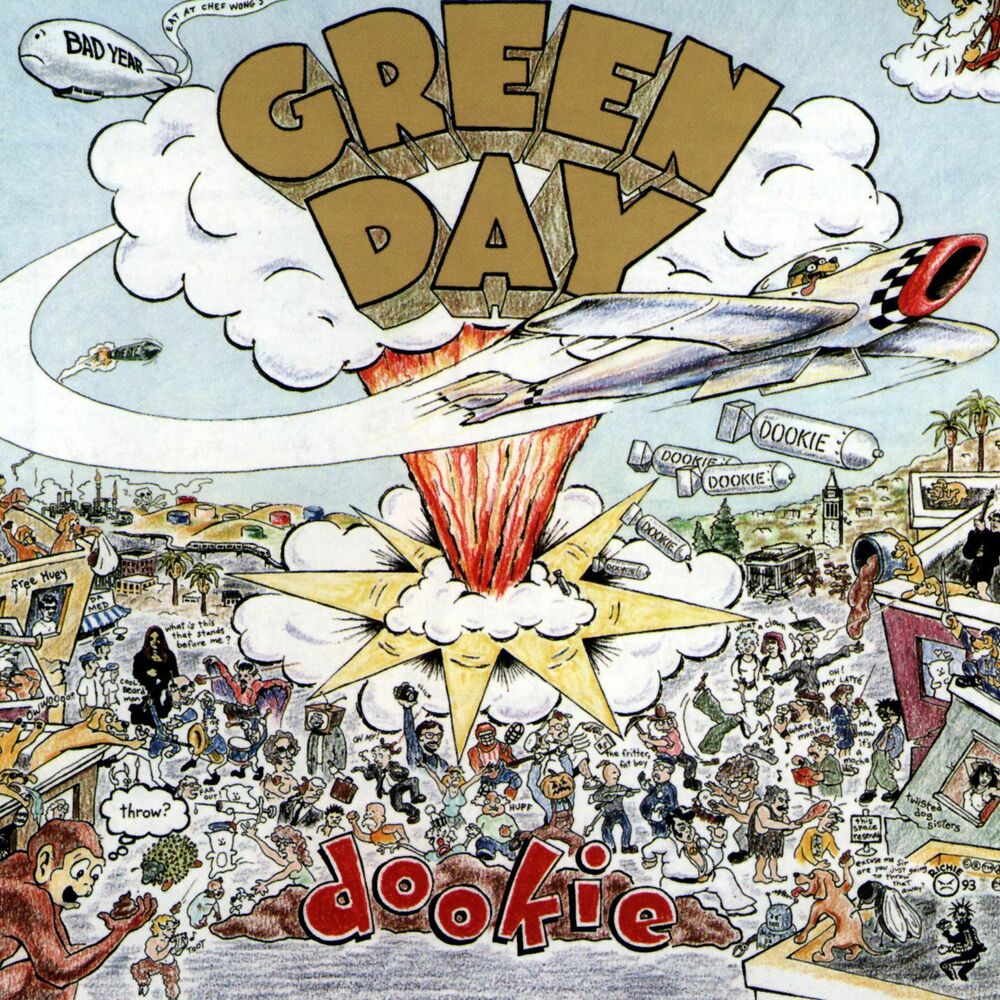
For its cover art, the band commissioned artist Richie Bucher, who created a cartoon-like work depicting bombs being dropped on people and buildings. Bucher says Armstrong only told him the album's title, so he worked around the theme of fecal matter. As a child, Bucher had associated feces with dogs and monkeys, both of which appear prominently on the album's cover.
The setting is a replica of Berkeley's Telegraph Avenue. In the center, there is an explosion with the band's name at the top.
Release and promotion
While rehearsing in the house they rented in Berkeley at the end of 1993 in anticipation of a tour for Dookie, the band was invited to the Warner offices in Los Angeles to discuss the marketing strategy around the album with Weiss. The latter expected to meet three scornful young men with reputations in punk music, when in reality the band members were intimidated to even be invited to the meeting. They discussed the first single, "Longview", as well as projected goals for the album's sales: Cavallo hoped to sell at least 200,000 units, while Cool looked higher toward 500,000. Demand was well underestimated; when Dookie was released on February 1, 1994, the album's first 9,000 produced copies quickly sold out. "Longview" was released as the album's lead single simultaneously with the album.
Critical reception
Dookie was released to critical acclaim. In early 1995, Jon Pareles of The New York Times wrote, "Punk turns into pop in fast, funny, catchy, high-powered songs about whining and channel-surfing; apathy has rarely sounded so passionate." Rolling Stone's Paul Evans described Green Day as "convincing mainly because they've got punk's snotty anti-values down cold: blame, self-pity, arrogant self-hatred, humor, narcissism, fun". Jesse Raub, writing for Alternative Press, praised "Burnout" for immediately opening with a "huge, polished production value without abandoning their scrappy, loose punk playing" which consistently shines through the rest of the album's tracks. In a 20th anniversary retrospective review for Billboard, Chris Payne highlighted how Armstrong's "sugary, almost bubblegum choruses" were unique for punk at the time, and forcefully brought mainstream attention to punk rock music.
The Chicago Tribune's Greg Kot was appreciative of the loudness and urgency in the album's sound, detecting influences from the Who and the Zombies.