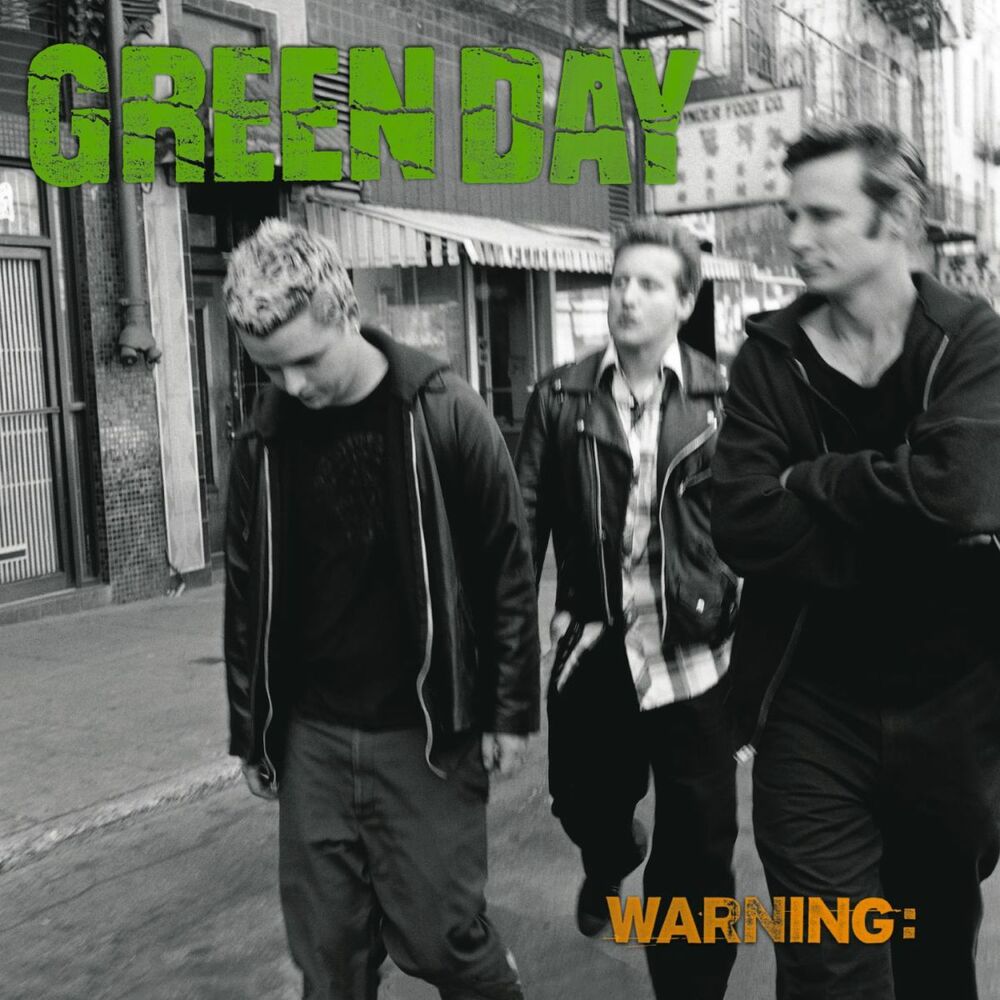
Warning
- Released19 September 2000
- UK peak No. 4
- Weeks on UK chart 21
- Entered UK chart 8 October 2000
- LabelReprise
- Tracks12 · 41 min
3 tracks from it charted as singles. Press a flag to play it in the chart where it peaked.
Tracks
| 1 | Warning No. 27 · 2000 | 3:41 | |
| 2 | Blood, Sex and Booze | 3:33 | |
| 3 | Church on Sunday | 3:18 | |
| 4 | Fashion Victim | 2:48 | |
| 5 | Castaway | 3:52 | |
| 6 | Misery | 5:05 | |
| 7 | Deadbeat Holiday | 3:35 | |
| 8 | Hold On | 2:56 | |
| 9 | Jackass | 2:43 | |
| 10 | Waiting No. 34 · 2001 | 3:12 | |
| 11 | Minority No. 18 · 2000 | 2:48 | |
| 12 | Macy's Day Parade | 3:33 |
About the album
Warning is the sixth studio album by the American rock band Green Day, released on October 3, 2000, by Reprise Records. Building upon its predecessor Nimrod (1997), it eschewed the band's trademark punk rock sound and incorporated acoustic elements and pop and folk styles. Lyrically, the album contains more optimistic and inspirational themes in comparison to the band's earlier releases. Warning was also Green Day's first album since Kerplunk (1991) not to be produced by Rob Cavallo, although he did have a hand in its production and was credited as executive producer.
Despite mixed opinions about the band's stylistic change, the album received mostly positive reviews from critics, who praised vocalist/guitarist Billie Joe Armstrong's songwriting. It peaked at number four on the US Billboard 200, and was certified gold by the Recording Industry Association of America, and has sold over 1.2 million copies as of 2012. Worldwide, it has sold 3.5 million copies.
Background
After taking a break from touring in promotion of the band's fourth album Insomniac (1995), Green Day recorded the more experimental Nimrod (1997). The record, which delved into a wider variety of genres including punk, folk, power pop, hardcore punk, ska, and surf, featured the unprecedented acoustic hit "Good Riddance (Time of Your Life)". Vocalist/guitarist Billie Joe Armstrong recalled that the song's stylistic departure from the group's earlier work made him anxious about the song's release: "I was scared for that song to come out...because it was such a vulnerable song, to put that song out and it was like which way will it end up going? It was really exciting and it kind of sparked more in us as songwriters to expand on that."
The band embarked on the Nimrod promotional tour, which largely featured more intimate shows with audiences of 1,500 to 3,000 people. By the end of the tour, the band noted that its audience had evolved.
Recording
For Warning, Green Day initially opted to work with a producer other than Rob Cavallo, who had handled the production of the band's previous three albums. The group selected Scott Litt, who had previously worked with Nirvana and R.E.M. However, the band had disagreements with Litt over the album's musical direction; vocalist/guitarist Billie Joe Armstrong recalled that "It just didn't work out. He was really cool, but for that particular project, it just wasn't the right chemistry." The group subsequently brought Cavallo back in, but this time the band handled most of the production duties, with Cavallo instead serving as "executive producer". During the album's writing and early recording sessions, Armstrong repeatedly listened to Bob Dylan's 1965 record Bringing It All Back Home, which had a major influence over both Warning's musical experimentation and socially conscious lyrics.
The band began work on the album two years before entering the studio to record on April 1, 2000.
Music and lyrics
With Warning, the band experimented with more acoustic guitars, and strove for a "not sappy acoustic... more aggressive, percussive acoustic" sound. Cool and bassist Mike Dirnt also emphasized "deeper" grooves on the record. The title track, a "densely produced blast of layered vocals [and] strummed acoustic guitars", features a "circling bass riff" similar to that of "Picture Book" by the Kinks. "Waiting", which has been categorized as a "retro-pop lament", is based on the riff from Petula Clark's 1964 song "Downtown". Its melody has also been stylistically compared to the Mamas & the Papas and Kiss. Ken Tucker of Entertainment Weekly felt that "Misery" is "probably Billie Joe's idea of a Brecht-Weill pop operetta." It features "mariachi brass" instrumentation, as well as strings, accordions, and acoustic guitar. The song's five-minute length has been called "an epic by Green Day standards". The use of a harmonica on "Hold On" has been compared to the Beatles' "Love Me Do" and "I Should Have Known Better".
Commercial performance
Warning peaked at number four on the Billboard 200, remaining on the chart for 25 weeks and it sold 156,000 copies on its first week according to Billboard. On December 1, 2000, the record was certified gold by Recording Industry Association of America (RIAA), for shipments of over 500,000 copies. In Canada, the record reached the number two position and stayed on the chart for five weeks. On August 1, 2001, the album was certified platinum by the Canadian Recording Industry Association for shipments of over 100,000 units. Warning also reached the top ten in multiple countries outside of North America, including Australia, Italy, and the United Kingdom. The album was later certified platinum by the Australian Recording Industry Association (ARIA) for shipments of over 70,000 copies. As of December 20, 2012, Warning has sold 1.2 million copies, according to Nielsen SoundScan.
Critical reception
Warning received generally positive reviews from music critics. At Metacritic, which assigns a normalised rating out of 100 to reviews from mainstream critics, the album received an average score of 72 based on 19 reviews, which indicates "generally favorable reviews". Entertainment Weekly's Ken Tucker perceived a maturity in the album's lyrical content and called its music "as peppy as any Green Day have recorded". Charlotte Robinson of PopMatters commended Billie Joe Armstrong's lyrics and noted the band for embracing "the pop bent that has always been a part of their sound". The A.V. Club's Stephen Thompson stated "Green Day has never made a record so slick and musically mature". Los Angeles Times writer Natalie Nichols wrote that the album "reveal[s] them shaking off the transitional aspects of 1997's 'Nimrod' to craft a more coherent, less aggressive but still rebellious collection that also draws on the even older pop traditions of Bob Dylan, the Beatles and the Who".
Promotion
While Green Day was nearing completion of Warning, the band announced it would be performing on the 2000 Vans Warped Tour during the summer before the album's October release. Although the group had been invited to perform on the tour before, they were unable to because of scheduling conflicts. Because of Green Day's new stylistic change displayed on Warning, the band was considered an unconventional choice for the tour. Jason White, guitarist for Armstrong's side project Pinhead Gunpowder, was recruited to perform with the band to add "more power" to the group's sound; White observed that "Even I was like, 'Why are Green Day on the Warped Tour?'". Fat Mike of NOFX recalled, "They were the biggest band on the tour but it wasn't by far. Green Day weren't super popular at that time. I think they did the Warped tour because they wanted to get popular again." He also went on to call Warning "probably their worst album, I think.