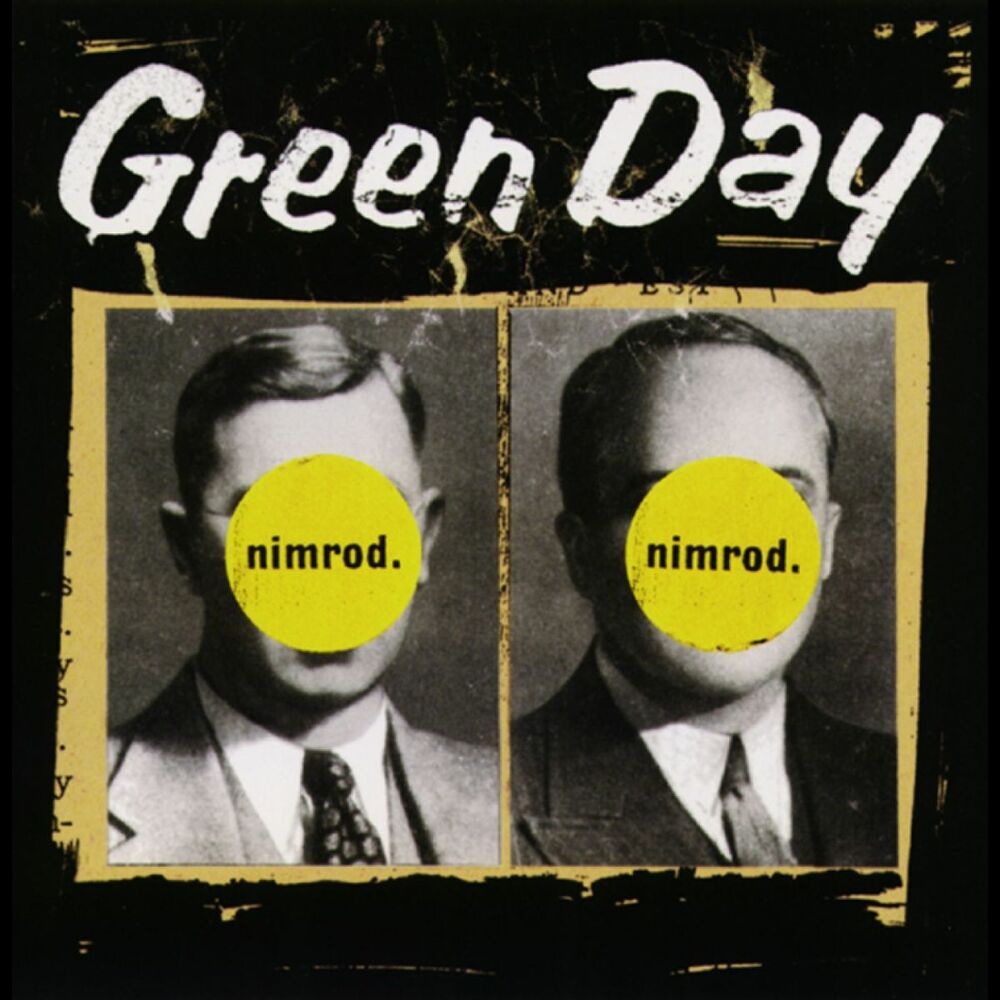
Nimrod
- Released14 October 1997
- UK peak No. 11
- Weeks on UK chart 21
- Entered UK chart 19 October 1997
- LabelReprise
- Tracks18 · 49 min
3 tracks from it charted as singles. Press a flag to play it in the chart where it peaked.
Tracks
| 1 | Nice Guys Finish Last | 2:48 | |
| 2 | Hitchin' a Ride No. 25 · 1997 | 2:51 | |
| 3 | The Grouch | 2:12 | |
| 4 | Redundant No. 27 · 1998 | 3:18 | |
| 5 | Scattered | 3:02 | |
| 6 | All the Time | 2:10 | |
| 7 | Worry Rock | 2:27 | |
| 8 | Platypus (I Hate You) | 2:21 | |
| 9 | Uptight | 3:04 | |
| 10 | Last Ride In | 3:47 | |
| 11 | Jinx | 2:12 | |
| 12 | Haushinka | 3:25 | |
| 13 | Walking Alone | 2:45 | |
| 14 | Reject | 2:05 | |
| 15 | Take Back | 1:09 | |
| 16 | King for a Day | 3:13 | |
| 17 | Good Riddance (Time of Your Life) No. 67 · 2007 | 2:33 | |
| 18 | Prosthetic Head | 3:38 |
About the album
Nimrod (stylized as nimrod.) is the fifth studio album by the American rock band Green Day, released on October 14, 1997, by Reprise Records. The band began work on the album in the wake of the cancellation of a European tour after the release of their previous album, Insomniac. Recorded at Conway Recording Studios in Los Angeles, the album was written with the intent of creating a set of standalone songs as opposed to a cohesive album. Retrospectively, Nimrod is noted for its musical diversity and experimentation, containing elements of folk, hardcore, surf rock, and ska. Lyrical themes discussed include maturity, personal reflection, and fatherhood.
The album peaked at number 10 on the Billboard U.S. charts and was certified double platinum by the Recording Industry Association of America (RIAA). The record was also certified triple platinum in Australia and double platinum in Canada. Upon release, Nimrod received generally positive reviews from critics, who praised the singer Billie Joe Armstrong's songwriting. The album yielded the acoustic single "Good Riddance (Time of Your Life)", which appeared in numerous popular culture events, including the penultimate episode of the sitcom Seinfeld. To promote the album, Green Day embarked on an extensive touring schedule.
Background
In 1995, Green Day released Insomniac, which did not perform as well commercially as the band's breakthrough major-label debut Dookie. Speaking of Insomniac, singer and guitarist Billie Joe Armstrong noted, "It did a lot better than I thought it was going to do...From the sound of it, we knew it wasn't going to sell as much as Dookie." The group embarked on an extensive world tour to promote Insomniac in early 1996, which saw the band performing in sports arenas that contrasted with the small clubs the group was accustomed to playing. The members became increasingly uncomfortable with the level of stardom they had attained; Armstrong recalled, "We were becoming the things we hated, playing those big arenas. It was beginning to be not fun anymore."
Green Day also became homesick because touring forced the members to leave behind their families. The band eventually decided to cancel the late 1996 European leg of the Insomniac tour to take time off to spend at home.
Recording and production
The album was recorded at Conway Recording Studios in Los Angeles, and the band stayed at the Sunset Marquis Hotel during the sessions. Nimrod took four months to record; Armstrong partially attributed the lengthy recording time to spending "a little too much time" playing pool and foosball during the sessions. The recording schedule, which lasted from noon to two in the morning every day, became frustrating for the group members, who began drinking heavily. The bassist Mike Dirnt recalled, "One night one of us was walking down the halls knocking on people's doors while naked." Another incident involved the drummer Tre Cool throwing his hotel room television set out of his window. Armstrong noted, "There was a lot of glass. You have to live that arrogant lifestyle every now and then." To keep the band focused, Cavallo enlisted his father, Pat Magnarella, to supervise and manage the group.
While working on Nimrod, Green Day explained to Cavallo their desire to create a more experimental album because the band had grown tired of its traditional three chord song structure.
Music
Nimrod is more musically diverse than previous Green Day albums. Armstrong noted that with the album, Green Day went down "different avenues", adding: "Each song has its own character and identity so we wanted to be able to bring that out as much as possible." "Nice Guys Finish Last" has been considered a song that "eases the transition" from Insomniac to Nimrod. Sandy Masuo of the Los Angeles Times likened "Worry Rock" to the music of Elvis Costello. "Good Riddance (Time of Your Life)" has been referred to as a "pop-punk campfire singalong ballad". After opening with Haden's violin solo, "Hitchin' a Ride" evolves into a bass-driven rock and roll song with a "Stray Cats vibe". Cool referred to "Take Back" (considered upfront hardcore punk, both musically and vocally) and "Platypus (I Hate You)" as "some of the most punk songs we've ever done". "Last Ride In" is a surf rock-influenced instrumental, and "King for a Day" is a song featuring a horn section.
Lyrics
Lyrically, Nimrod touches upon more reflective themes not present on earlier Green Day albums. Much of the album illustrates Armstrong's sentiments on growing up and his role as a husband and father. "The Grouch" centers on Armstrong's fears of "wasting away, getting fat, becoming impotent, and losing his ideals". On "Walking Alone", he reflects on old friends from his childhood, and notes that he is "too drunk to figure out they're fading away". Armstrong discusses the struggle to stay sober on "Hitchin' a Ride". "Good Riddance (Time of Your Life)" was inspired by Armstrong's failed relationship with a woman that ended when she joined the Peace Corps in 1993. The same woman is also the subject of "She" from Dookie, "Whatsername" from American Idiot (2004) and "Amanda" from ¡Tré!.
Release and promotion
The Nimrod promotional tour began that fall and opened with a performance and in-store record signing on November 11, 1997, at a Tower Records in Manhattan. The band was upset upon reading reviews that suggested the band had lost its punk edge, and despite the presence of security staff both inside and outside the building, started a riot during its scheduled eight-song set at the store. Armstrong then wrote the words "fuck" and "nimrod" in black spray paint on the storefront windows, and proceeded to moon the audience of approximately 1,400 people. After the riot settled down, Cool threw his bass drum into the crowd while Armstrong attempted the same with a monitor, which was wrestled away from him by a store manager. No charges were filed and no injuries were reported, but the store was closed for the day to repair damages caused.
On the tour in promotion of the album, Green Day aimed for simplicity and decided not to bring new instrumentalists to play for the new songs. Armstrong commented, "Right now we're refraining from pulling out a lot of that 'Nimrod' stuff.