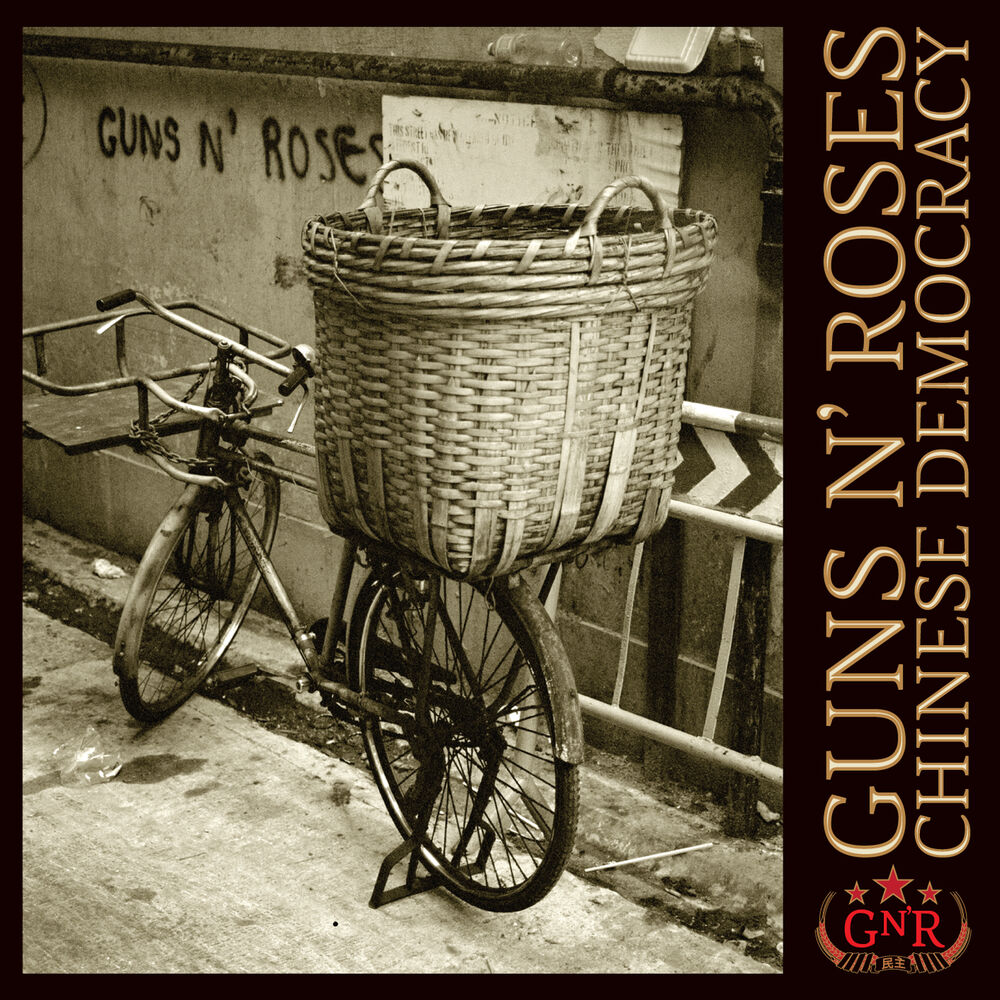
Chinese Democracy
- Released23 November 2008
- UK peak No. 2
- Weeks on UK chart 12
- Entered UK chart 30 November 2008
- LabelGeffen
- Tracks14 · 71 min
One track from it charted as a single. Press a flag to play it in the chart where it peaked.
Tracks
| 1 | 4:43 | ||
| 2 | Shackler's Revenge | 3:36 | |
| 3 | Better | 4:57 | |
| 4 | Street Of Dreams | 4:46 | |
| 5 | If The World | 4:53 | |
| 6 | There Was A Time | 6:40 | |
| 7 | Catcher In The Rye | 5:52 | |
| 8 | Scraped | 3:30 | |
| 9 | Riad N' The Bedouins | 4:10 | |
| 10 | Sorry | 6:14 | |
| 11 | I.R.S. | 4:27 | |
| 12 | Madagascar | 5:37 | |
| 13 | This I Love | 5:34 | |
| 14 | Prostitute | 6:15 |
About the album
Chinese Democracy is the sixth studio album by the American hard rock band Guns N' Roses, released on November 23, 2008, through Geffen Records and Black Frog. It was their first album of original material since Use Your Illusion I and II (1991), and the first to feature none of the classic members aside from vocalist Axl Rose. The album's development spanned over a decade, becoming one of the most protracted and expensive recording processes in history, with reported costs exceeding $13 million.
Recorded amid lineup upheavals, legal disputes, and leaks, Chinese Democracy saw Rose collaborate with a rotating cast of musicians and producers, including band members Dizzy Reed, Paul Tobias, Robin Finck, Josh Freese, Tommy Stinson, Chris Pitman, Buckethead, Richard Fortus, Ron "Bumblefoot" Thal, Brain and Frank Ferrer, and producers Youth, Sean Beavan, Roy Thomas Baker and Caram Costanzo. Recording began in 1998 with the intention of producing multiple albums; although more than 50 tracks were in development, Rose's inconsistent studio schedule and repeated re‑recordings caused substantial delays in the project's progress. It is the first Guns N' Roses album not produced by Mike Clink; instead, Rose and Costanzo handled production.
The album blends hard rock with industrial and electronic influences, a shift from the band's previous blues and punk-based music.
Background
In September 1991, Guns N' Roses released the albums Use Your Illusion I and II, selling a combined 35 million copies. That November, rhythm guitarist Izzy Stradlin left the band, citing exhaustion with the current tour and conflicts with bandmates. He was replaced by Gilby Clarke. In 1993, they released "The Spaghetti Incident?", an album of glam and punk rock cover songs. Though certified platinum in 1994, it sold far less than their previous releases, and the band did not tour to support it.
In 1994, the band began writing new material, but bassist Duff McKagan said "nothing got finished" due to drug use. Lead guitarist Slash accused Rose of running the band "like a dictatorship", while Rose claimed collaboration was impossible, leading to the material being scrapped.
In 1994, Rose replaced Clarke with his childhood friend Paul "Huge" Tobias, without consulting the band. He became "obsessed" with electronica and industrial rock, particularly Nine Inch Nails, and pushed for a more modern sound.
Release and promotion
In July 2002, Rose played several songs from the album at a Las Vegas strip club to gauge the crowd's reaction. In October 2006, Rose previewed ten songs at listening parties in New York bars.
On September 14, 2008, "Shackler's Revenge" debuted in Rock Band 2, marking the first official release of new Guns N' Roses material since 1999's "Oh My God". It was followed by "If the World", featured in the closing credits of Body of Lies.
On October 9, Billboard confirmed a November 23, 2008 release date for Chinese Democracy, sold exclusively through Best Buy in the U.S. Label head Jimmy Iovine stated of the deal, "...the labels [need] marketing partners to drive this music, whether it's a song, an album or a new configuration. In this case, Best Buy gave this album a great deal of marketing that we couldn't have gotten any other way". The title track premiered on October 22 via the Kevin & Bean show on KROQ-FM. Promotional ads referencing the 2008 United States presidential election aired in early November.
Artwork
The cover features a sepia photo of a bicycle with a wicker basket against a graffitied wall with the band's name, shot in Kowloon Walled City by Terry Hardin. Above the vertically written band name and the album title are three red communist stars and the letters "GNR". Artistic director Ryan Corey said Rose conceived the bike cover early in the album's development.
Rose initially approached Chinese artist Chen Zhuo to use a painting of Tiananmen Square as an amusement park, but Chen declined due to censorship concerns. Instead, Rose selected Shi Lifeng's "Controlling No. 3" for an alternate "art edition" cover. This version was used for the Rock Band 2 download and released in limited CD quantities. The alternate booklet includes Rose's essay "Fear N' Freedom: The Future of China and Western Society". The regular booklet features artwork by Shi, photos of the Hong Kong skyline, the Chinese military, and band members.
In December 2008, Rose said that two alternate booklets were planned but never released, criticizing the use of an "error-filled draft" instead of the final artwork.
Critical reception
According to the review aggregator Metacritic, Chinese Democracy received "generally favorable reviews" based on a weighted average score of 64 out of 100 from 28 critic scores. Ann Powers (Los Angeles Times) called it "a cyborgian blend of pop expressiveness, traditional rock bravado and Brian Wilson-style beautiful weirdness", describing the songs as "theatrical, with voicings and arrangements often taking precedence over riffs and grooves" and comparing it to a rock opera. Chuck Klosterman (The A.V. Club) praised the vocals and guitar work, saying "three songs are astonishing. Four or five others are very good" and noted the album as "the last Old media album... the last album that will matter more as a physical object than as an Internet sound file." David Fricke (Rolling Stone) described it as "audacious, unhinged and uncompromising," saying "You may debate whether any rock record is worth that extreme self-indulgence.
Legacy
The album's long-delayed release became its defining narrative. Spin noted that a "cottage industry" emerged around tracking its development, and suggested the only way it could have lived up to its legend was "to never come out at all". Steven Hyden (Grantland) called it "shorthand for the grandest of boondoggles", arguing that the delay overshadowed the music itself. He contrasted it with more modest and successful comeback albums by Daft Punk, David Bowie, Justin Timberlake, and My Bloody Valentine. Ultimate Classic Rock echoed this sentiment, stating the album was "fairly good" but eclipsed by its backstory. It cited artists like Bowie, Steve Perry, and Tool who avoided similar pitfalls by keeping a low profile and meeting fan expectations. The term Chinese Democracy has since become shorthand for long-delayed albums.
The New York Times described it as a "loud last gasp" of the indulgent pop star era, noting the shift to a "leaner and leakier" music industry. Jim DeRogatis likened it to The Godfather Part III, a long-awaited sequel that failed to match its predecessors.