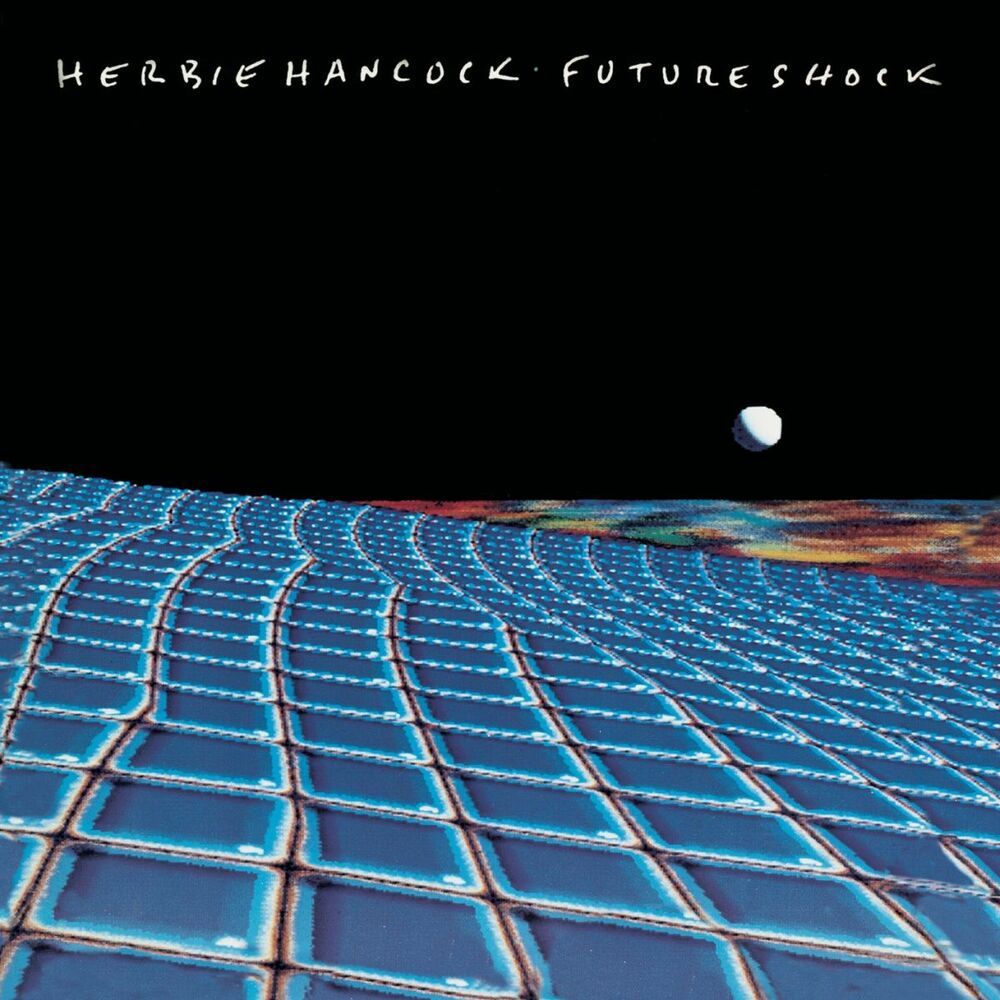
Future Shock
- Released26 March 1991
- UK peak No. 27
- Weeks on UK chart 10
- Entered UK chart 21 August 1983
- LabelColumbia/Legacy
- Tracks7 · 44 min
3 tracks from it charted as singles. Press a flag to play it in the chart where it peaked.
Tracks
| 1 | 5:24 | ||
| 2 | Future Shock No. 54 · 1984 | 8:02 | |
| 3 | TFS | 5:46 | |
| 4 | Earth Beat | 5:09 | |
| 5 | Autodrive No. 33 · 1983 | 6:25 | |
| 6 | Rough | 6:56 | |
| 7 | Mega Mix (Includes: Rockit, Autodrive, Future Shock, TFS, Rough, & Chameleon) | 6:18 |
About the album
Future Shock is the twenty-ninth album by American jazz pianist Herbie Hancock, released in August 1983 by Columbia Records. It was his first release from his electro-funk era and an early example of instrumental hip hop. Participating musicians include bass guitarist Bill Laswell (who co-produced), guitarist Pete Cosey and drummer Sly Dunbar.
Background
Much of the album was initially composed by the team of avant-garde bassist and record producer Bill Laswell, and keyboardist and producer Michael Beinhorn, and played on tour by their group Material in 1982, as a precursor to recording the follow-up album to Material's One Down album (on which Whitney Houston was the lead singer on a cover of the Soft Machine song "Memories"). Hancock was approached to collaborate on this recording that would go towards a postmodern direction, instead of his usual jazz-fusion. The result was a hip-hop influenced album, released under Hancock's name, which combined Hancock's keyboard playing with Laswell's arrangements and Grand Mixer DXT's turntablism.
According to 1999 re-issue's liner notes, when Laswell went to buy speakers at a music equipment store he would insist on testing them by playing the demos of "Rockit" and "Earth Beat". While those songs were played through the speakers, passing by customers apparently liked what they heard and danced to the music.
Reception
Giving the album a B+ rating, Robert Christgau commented that "As a guy who likes his funk obvious, I think those who esteem "Rockit" as highly as Head Hunters are too kind to Head Hunters. Small thanks to Herbie, lots to Material and Grand Mixer D.ST, it's the best novelty instrumental in years and the best pop of Hancock's life. Elsewhere various bright ideas, such as Pete Cosey, are obscured by the usual aura of set-piece dink — jumpy enough and often fun, but fusoid nevertheless." Richard S. Ginell of AllMusic wrote how "Herbie Hancock completely overhauled his sound and conquered MTV with his most radical step forward since the sextet days. He brought in Bill Laswell of Material as producer, along with Grand Mixer D.ST on turntables—and the immediate result was "Rockit," which makes quite a post-industrial metallic racket. Frankly, the whole record is an enigma; for all of its dehumanized, mechanized textures and rigid rhythms, it has a vitality and sense of humor that make it difficult to turn off.