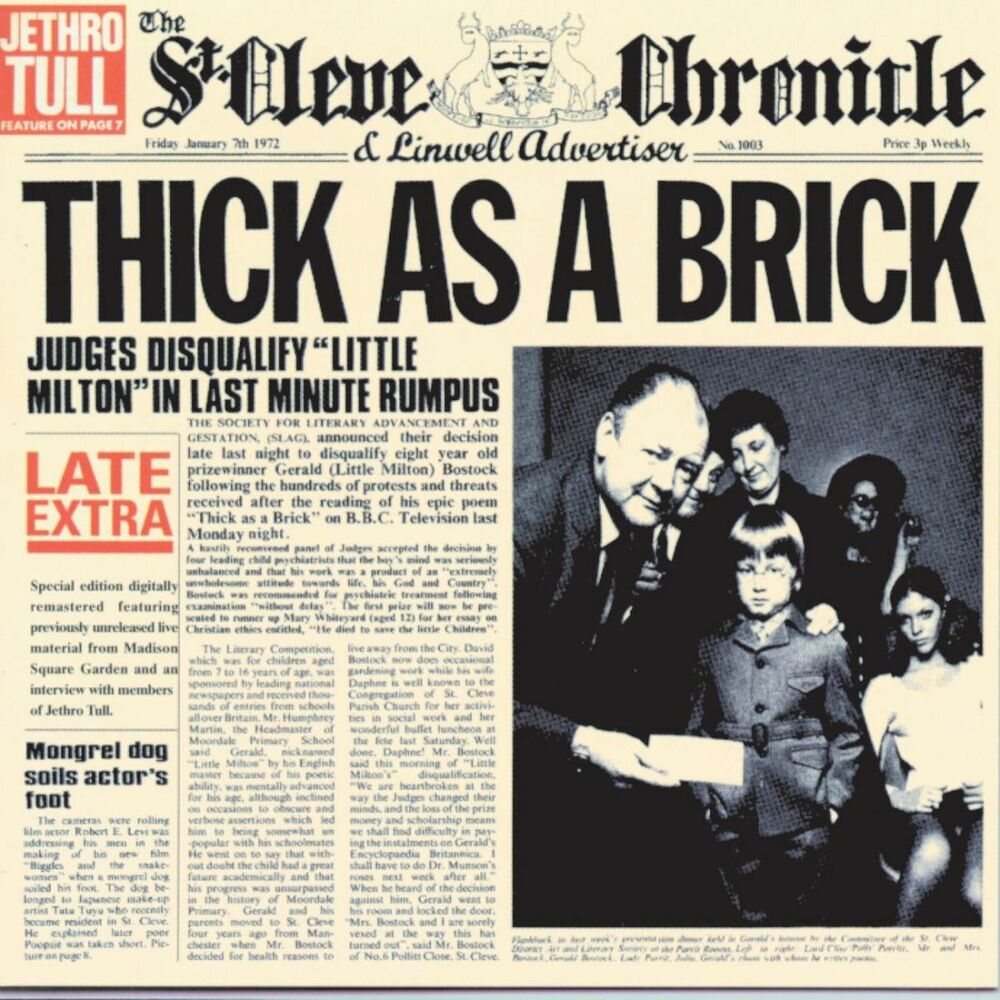
Thick as a Brick
- Released9 June 1997
- UK peak No. 5
- Weeks on UK chart 14
- Entered UK chart 12 March 1972
- LabelParlophone UK
- Tracks4 · 72 min
Tracks
| 1 | Thick as a Brick (Pt. I) (1997 Remaster) | 22:40 | |
| 2 | Thick as a Brick (Pt. II) (1997 Remaster) | 21:10 | |
| 3 | Thick as a Brick (Live at Madison Square Garden) | 11:50 | |
| 4 | Interview with Jethro Tull | 16:30 |
About the album
Thick as a Brick is the fifth studio album by the British rock band Jethro Tull, released on 3 March 1972 on Chrysalis Records. The album consists of a single continuous piece of music, split across the two sides of the original LP record, and was conceived as a parody of concept albums and the progressive rock genre. Its original packaging took the form of a 12-page newspaper, which presented the album as a musical adaptation of an epic poem by a fictional eight-year-old prodigy named Gerald Bostock, although the lyrics were actually written by the band's frontman Ian Anderson.
The album was recorded in late 1971, featuring music composed by Anderson and arranged with contributions from all band members. It marked the first appearance of drummer Barrie "Barriemore" Barlow, who replaced the band's previous drummer Clive Bunker. Musically, Thick as a Brick features an intricate suite of progressive rock, characterized by complex musical structures and frequent time signature changes, incorporating elements of art rock, folk and classical music. The album's lyrics draw partly on Anderson's childhood experiences and explore coming-of-age themes including conformity and intergenerational conflict, reflecting anti-establishment perspectives on institutions and authority.
Background
Jethro Tull's frontman and songwriter Ian Anderson was infuriated when critics called the band's previous album, Aqualung (1971), a "concept album". He rejected this, thinking it was simply a collection of songs, so in response decided to "come up with something that really is the mother of all concept albums". Taking the surreal British humour of Monty Python as an influence, he began to write a piece that would combine complex music with a sense of humour, with the idea it would poke light-hearted fun at the band, the audience, and the music critics. He also intended to satirise the progressive rock genre that was popular at the time. His wife Jennie was also an inspiration, to whom he credited having devised the character and lyrics of "Aqualung".
Recording
The group ran through two weeks of rehearsals using the Rolling Stones' basement studio in Bermondsey. They had not intended to record a single continuous piece; the band came up with individual song segments, then decided to write short pieces of music to link them together.
Recording started in December 1971 at Morgan Studios, London. Unlike previous albums, where Anderson had generally written songs in advance, only the initial section of the album had been worked out when the band went into the studio. The remainder of the suite was written during the recording sessions. To compensate for a lack of material, Anderson began work early each morning to prepare music for the rest of the band to learn during that day's session. The lyrics were written first, with the music constructed to fit around them. Anderson recalls the album took about two weeks to record and another two or three for overdubs and mixing.
Music
Thick as a Brick was viewed by some critics as Jethro Tull's first progressive rock album. The album has a variety of musical themes, time signature changes and tempo shifts – all of which were features of the progressive rock scene. Although the finished album runs as one continuous piece, it is made up of a medley of individual songs that run into each other, none of which individually lasts more than 3–5 minutes. Parts of the suite blend classical and folk music into the typical rock music framework.
The album prominently features flute, acoustic and electric guitars and Hammond organ, which had been used previously, but the instrumentation also includes harpsichord, glockenspiel, timpani, violin, lute, trumpet, saxophone, and a string section—all uncommon in the band's earlier blues-inspired rock. Anderson later said that the lyrics were partly derived from his own childhood experiences, though the overall theme was Bostock's attempt to make sense of life from his point of view.
Artwork
The original LP cover was designed as a spoof of a 12-by-16-inch (300 mm × 410 mm) 12-page small-town English newspaper, entitled The St. Cleve Chronicle and Linwell Advertiser, with articles, competitions and advertisements lampooning the typical parochial and amateurish journalism of the local English press. The band's record company, Chrysalis Records, complained that the sleeve would be too expensive to produce, but Anderson countered that if a real newspaper could be produced, a parody of one was also practicable.
The mock newspaper, dated 7 January 1972, also includes the entire lyrics to "Thick as a Brick" (printed on page 7), which is presented as a poem written by Bostock, whose disqualification from a poetry contest is the focus of the front-page story. This article claims that although Bostock initially won the contest, the judges' decision was repealed after protests and threats concerning the offensive nature of the poem, along with the boy's suspected psychological instability.
Critical reception
Thick as a Brick was originally scheduled for release on 25 February 1972. Following production problems relating to the 1972 miners' strike, it was held back a week to 3 March. The album reached the top 5 in the UK charts, and number one in Australia, Canada and the United States, where it was certified Gold.
Contemporary reviews were mixed. Chris Welch of Melody Maker praised the musicianship of the band and Anderson's flute playing, writing also that "the joke at the expense of a local newspaper wears thin rather rapidly, but should not detract from the obvious amount of thought and work that has gone into the production of Thick"; he described the music as a creative effort where "the ideas flow in super abundance" but that "needs time to absorb" and "heard out of context of their highly visual stage act ... does not have such immediate appeal". Tony Tyler in his review for New Musical Express generally appreciated the construction of the suites and the arrangements, but he had doubts about the album's possible success.