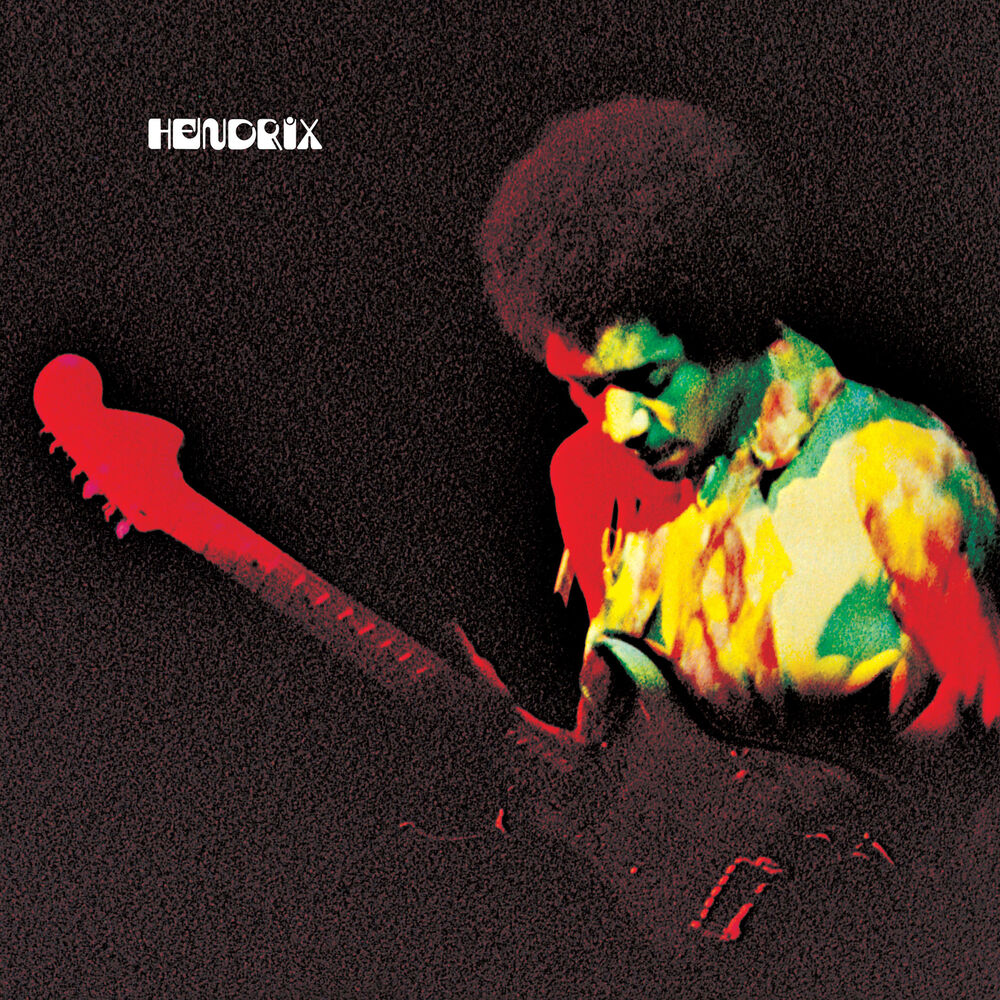
Band Of Gypsys (50th Anniversary / Live At Fillmore East, 1970)
- Released8 April 1997
- LabelCAPITOL CATALOG MKT (C92)
- Tracks6 · 46 min
Tracks
| 1 | Who Knows (Live) | 9:38 | |
| 2 | Machine Gun (Live) | 12:40 | |
| 3 | Changes (Live) | 5:14 | |
| 4 | Power To Love (Live) | 6:58 | |
| 5 | Message To Love (Live) | 5:25 | |
| 6 | We Gotta Live Together (Live) | 5:49 |
About the album
Band of Gypsys is a live album by Jimi Hendrix and the first without his original group, the Jimi Hendrix Experience. It was recorded on January 1, 1970, at the Fillmore East in New York City with R&B musicians Billy Cox on bass and Buddy Miles on drums, a grouping frequently referred to as the Band of Gypsys. The album mixes funk and R&B elements with Hendrix's psychedelic rock guitar and wah-wah pedal-based jamming, an approach which later became the basis of funk rock. It contains previously unreleased songs and was the last full-length Hendrix album released before his death six months later.
After his appearance at Woodstock with an interim group that included Cox, Hendrix began developing new songs and recording demos. When Miles became involved, he and Cox agreed to record a live album with Hendrix to be used to settle a contract dispute with a former manager. The new material signaled a new funk-influenced direction for Hendrix featuring more humanistic lyrical themes. The two songs written and sung by Miles bear the stylings of soul music. The anti-riot and anti-war "Machine Gun" draws on Hendrix's earlier blues aspirations, but incorporates new approaches to guitar improvisation and tonal effects.
As the album's producer, Hendrix struggled with the sometimes problematic recordings and expressed dissatisfaction with the final product.
Background
In 1969, Jimi Hendrix was under pressure from his manager and record company to record a follow-up to his hugely successful 1968 album Electric Ladyland. He was also required to produce an album's worth of new material for Capitol Records in order to satisfy a contract dispute with former manager Ed Chalpin and PPX Enterprises. Capitol had released two misleading Chalpin-produced Curtis Knight albums with Hendrix on guitar, which competed directly with his own Experience albums. Additionally, Hendrix was becoming increasingly dissatisfied with bassist Noel Redding and the Experience format. During the recording of Electric Ladyland, he and producer Chas Chandler parted ways and Hendrix began to explore recording with other musicians and different musical styles. By the middle of the year, he had not completed any promising material and Reprise Records resorted to issuing his April 1968 UK compilation album, Smash Hits, with some new tracks for the North American market.
Recording
The material for Band of Gypsys was recorded over two consecutive nights at the Fillmore East. The group was scheduled for two shows on December 31, 1969, and another two on January 1, 1970 (because the shows went beyond midnight, the actual dates were December 31 – January 1 and January 1–2; for ease of reference, these are referred as the first show, second show, third show, and fourth show). The recording was supervised by Wally Heider, an experienced sound engineer who ran a recording studio and had made several live recordings. He had already recorded Hendrix live several times, including at the Monterey Pop Festival in 1967 and Woodstock in 1969. Portable recording equipment was set up at the venue and the trio performed for a soundcheck in the afternoon.
Concert promoter Bill Graham billed the performances as "Jimi Hendrix: A Band of Gypsys", but Hendrix's new direction since the breakup of the Experience six months earlier had not been publicized.
Production
On January 12, 1970, Hendrix and recording engineer Eddie Kramer began the task of deciding which songs to include on the new album (Cox and Miles did not participate in the process). The review and subsequent audio mixing was undertaken at Juggy Sound Studios in New York, where the trio had started rehearsing in October. Excluding Experience and cover songs, there were multiple versions of thirteen new, previously unreleased songs from which to choose. Among those that received Kramer's and Hendrix's attention were "Machine Gun", "Earth Blues", "Burning Desire", "Ezy Ryder", "Who Knows", and "Hear My Train A Comin'". Early on, Hendrix chose to include the Buddy Miles songs "Changes" and "We Gotta Live Together". He also decided on "Power of Soul" and "Message to Love", studio versions of which had been considered for release as a single (these studio recordings were later included on South Saturn Delta and West Coast Seattle Boy: The Jimi Hendrix Anthology).
Release
On February 25, 1970, Michael Jeffery delivered the master tapes for Band of Gypsys to Capitol Records executives in Los Angeles. Capitol rush-released the album one month later on March 25, and it entered Billboard's Top LPs chart at number eighteen. It reached number five during a stay of 61 weeks on the chart and, at the time of his death, was Hendrix's best selling album in the US since Are You Experienced. Due to legal wrangling by Ed Chalpin and PPX, the album was not released in the UK for nearly two more months. When Track Records issued it on June 12, 1970, it quickly entered the British charts, where it remained for 30 weeks and reached number six.
For the album cover, Capitol Records used a grainy photograph of Hendrix taken during the Fillmore East shows illuminated by the multi-colored liquid light show projected by the Joshua Light Show. However, Track used album cover art which proved controversial, as they had done with Electric Ladyland.
Critical reception
Band of Gypsys has been viewed by some rock critics less favorably than Hendrix's three studio albums with the Experience. According to writer Jeremy Wells, "critics have usually seen the Band of Gypsys' one album as the least significant of the [four] recordings Hendrix released during his lifetime". Reviewing for Rolling Stone in 1970, music journalist Gary von Tersch said that the album was hampered by poorly recorded vocals and Miles' unpleasant drumming, and instead viewed it as a showcase for Hendrix's virtuosic guitar playing: "With just bass and drum support he is able to transfuse and transfix on the strength of his guitar-work alone." The magazine's David Wild was more enthusiastic in a retrospective review and felt that songs such as "Message of Love" and "Machine Gun" still sounded powerful in spite of the unclear recording quality.
According to Sean Westergaard of AllMusic, Band of Gypsys is one of the best live albums of all time and an important recording for Hendrix, who played with a remarkable degree of focus and precision on what were "perhaps his finest [live] per