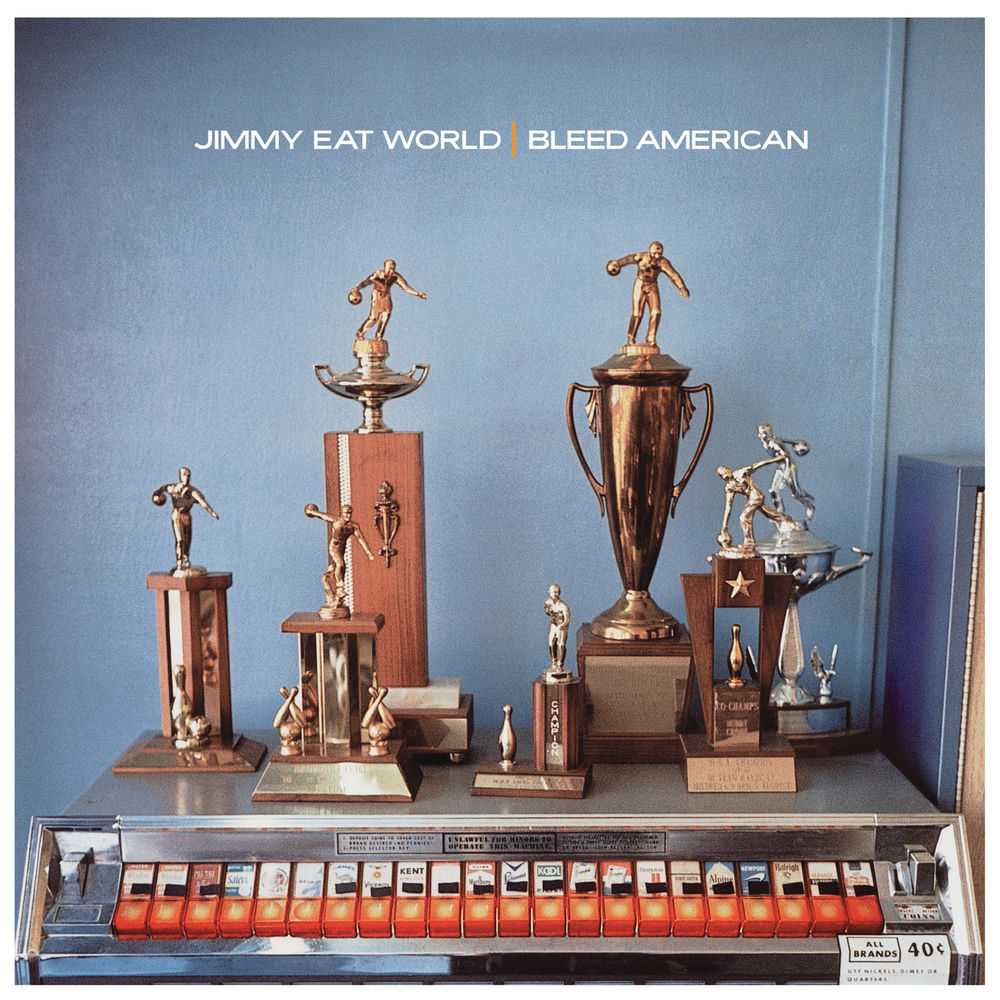
Bleed American
- Released23 July 2001
- UK peak No. 62
- Weeks on UK chart 6
- Entered UK chart 27 January 2002
- LabelInterscope
- Tracks11 · 47 min
2 tracks from it charted as singles. Press a flag to play it in the chart where it peaked.
Tracks
| 1 | Bleed American | 3:01 | |
| 2 | A Praise Chorus | 4:04 | |
| 3 | 2:46 | ||
| 4 | Your House | 4:48 | |
| 5 | 3:40 | ||
| 6 | Hear You Me | 4:44 | |
| 7 | If You Don't, Don't | 4:33 | |
| 8 | Get It Faster | 4:22 | |
| 9 | Cautioners | 5:21 | |
| 10 | The Authority Song | 3:37 | |
| 11 | My Sundown | 5:48 |
About the album
Bleed American is the fourth studio album by the American rock band Jimmy Eat World, released on July 24, 2001, by DreamWorks Records. The album was re-released as Jimmy Eat World following the September 11 attacks; that name remained until 2008, when it was re-released with its original title restored.
Following the commercial failure and lack of recognition for their third album Clarity (1999) from Capitol Records, Jimmy Eat World were dropped by the label in late 1999. Aside from working odd jobs, the band toured to raise money for their next album. It was recorded with Mark Trombino and the band served as producers in October and November 2000 at the Cherokee and Harddrive studios in Los Angeles, respectively. The musical style was more direct and accessible than its predecessor, with simpler chord structures.
"Bleed American" was released to radio on June 5, 2001, as the album's lead single, coinciding with Jimmy Eat World's tours of Australia and Japan (the latter supporting Eastern Youth). After appearing on the East Coast dates of the Warped Tour, the band supported Blink-182 and Weezer. "The Middle" was released as a single in October 2001. The band went on a headlining European tour in early 2002, followed by a Japanese tour, leading up to a two-month support slot for Blink-182 and Green Day on their Pop Disaster Tour.
Background
In February 1999, Jimmy Eat World released their third album, Clarity, through Capitol Records. Frontman Jim Adkins recalled that the label was disorganized at the time, having a new president and new people in charge of each department. As a result, any trust the band had within the company had dissipated. Capitol began to shelve the album until radio stations started playing the song "Lucky Denver Mint", which became its second track. The release of the album marked the end of their two-record deal with the label, which was made official in August 1999. Drummer Zach Lind recalled that the label "really didn't believe in us. But in a way, that was sort of a good thing, because it let us take control of what we needed to do. We learned we had to do it ourselves, because no one else would do it for us."
Amid a lack of funds, the members had taken up odd jobs: Adkins sold art supplies; Tom Linton did construction work; Rick Burch sold auto parts; and Lind worked at a car dealership.
Recording
Bleed American was produced by Mark Trombino and Jimmy Eat World. Trombino had already produced two of the band's previous albums: Static Prevails (1996) and Clarity (1999). He had struck up a brotherly relationship with the band; he reacted positively to the demos that Adkins had played him. The sales from Singles and the proceeds from Jimmy Eat World's European tour helped fund the album's recording sessions, but the money budgeted for the record was insufficient. Trombino offered to work for free until after the album's production, confident he would be reimbursed by the album's predicted commercial success. Recording sessions took place in Los Angeles, California in October 2000. Clark Robertson, who had been in a band that Linton saw live, rented equipment on the band's behalf.
The drums were recorded at Cherokee Studios in Los Angeles, which proved costly to the group. The band took a brief break to tour with Jebediah for two and a half weeks, including a performance at CMJ's New Music Marathon festival, before returning to Los Angeles.
Release
Following their departure from Capitol, Jimmy Eat World continued to build a grassroots following through extensive touring and independent promotion. As work progressed on what would become Bleed American, early demos began circulating informally, including through file-sharing platforms such as Napster. The songs generated significant interest within the music industry, aided by word-of-mouth and the band's growing reputation. Informal showcases held by the band attracted label representatives, leading to increased attention and a competitive environment among major labels. During this period, DreamWorks Records' A&R executive Luke Wood monitored the band's potential from when they became free agents and offered to help them. Wood had previously been in the band Sammy, who opened for Jimmy Eat World during the 1990s, and was adamant about signing them after hearing "A Praise Chorus". Jimmy Eat World considered Wood's help, but it was not until a year later when they returned to contact him.
Singles and EPs
"Bleed American" was released to radio on June 5, 2001, and released as a physical single on August 21, 2001. The US 7-inch vinyl version includes a demo of "Your House", while the German CD edition features demos of "Your House" and "The Authority Song", alongside "(Splash) Turn Twist" and the music video for "Bleed American" (directed by Ross Richardson).
"The Middle" was released as a single in October 2001. The UK 7-inch vinyl includes a radio session version of "A Praise Chorus" as its B-side, while the European CD features "No Sensitivity" and demos of "The Middle" and "My Sundown". Another CD version, which saw release in Europe and the US, features radio sessions versions of "If You Don't, Don't", and a Guided by Voices cover of "Game of Pricks", as well as the music video for "The Middle". The video was directed by Paul Fedor, who based it on The Brady Bunch episode "The Driver's Seat". The video features the band at a party performing in a living room to a crowd of people in their underwear.
Commercial performance
Bleed American was a commercial success, helping Jimmy Eat World gain mainstream popularity. It sold 30,000 copies in its first week of release. It peaked at number 54 on the Billboard 200 on August 11, 2001; the renamed version peaked at number 31 in July 2002. Outside the US, the album peaked at number 20 in Germany, number 43 in New Zealand, number 54 in Australia, and number 62 on the UK Albums Chart.
Bleed American became a bestseller; in its first four months on the US market, it sold 173,000 copies, making the album Jimmy Eat World's most successful release. Lind said that these sales were "definitely a big deal to the band because it shows how the fanbase is growing. [If you're] doing anything creative, you want more and more people to enjoy what you do." In July 2026, it was certified double platinum in the US by the Recording Industry Association of America (RIAA). Alongside this, the album was certified platinum in Canada by the Music Canada (MC) and New Zealand by Recorded Music NZ (RMNZ), and gold by the British Phonographic Industry (BPI) in the UK.