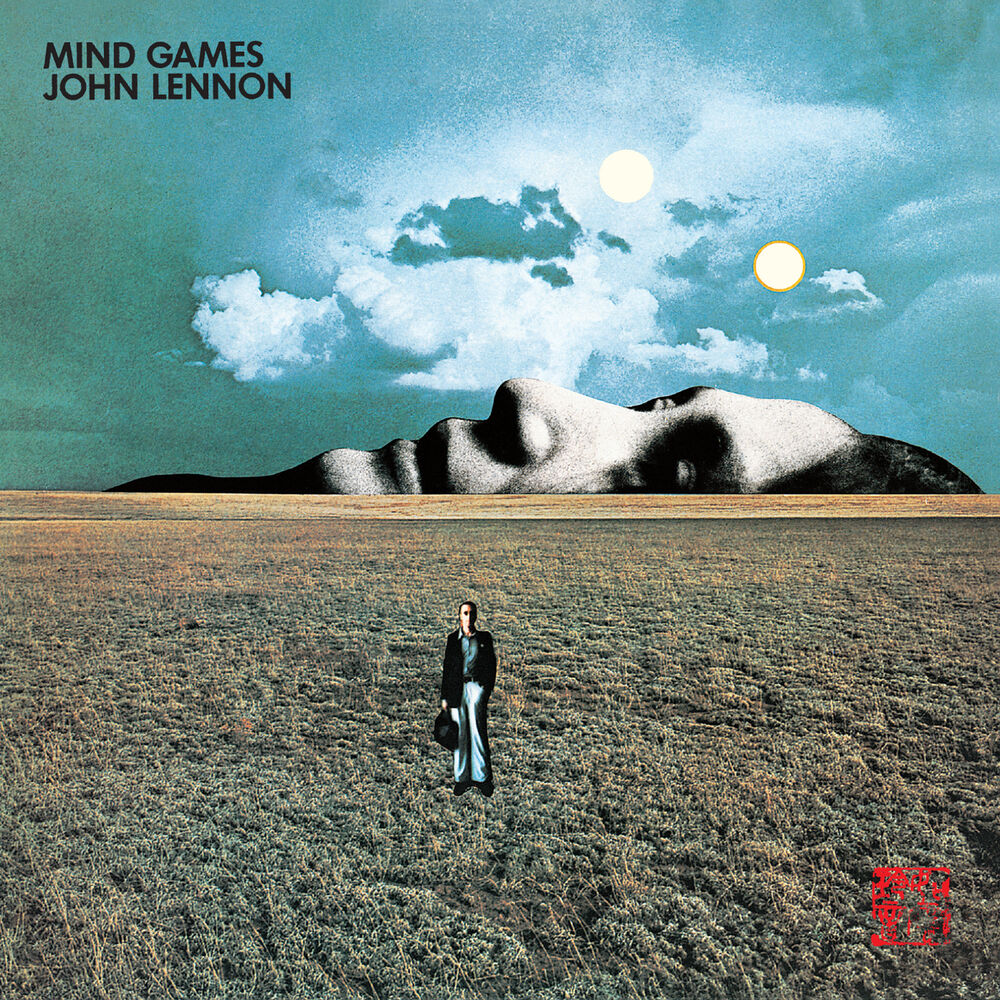
Mind Games
- Released1 October 2010
- UK peak No. 13
- Weeks on UK chart 13
- Entered UK chart 2 December 1973
- LabelEMI Catalogue
- Tracks12 · 40 min
One track from it charted as a single. Press a flag to play it in the chart where it peaked.
Tracks
| 1 | 4:12 | ||
| 2 | Tight A$ (Remastered 2010) | 3:39 | |
| 3 | Aisumasen (I'm Sorry) (Remastered 2010) | 4:42 | |
| 4 | One Day (At A Time) (Remastered 2010) | 3:07 | |
| 5 | Bring On The Lucie (Freda Peeple) (Remastered 2010) | 4:10 | |
| 6 | Nutopian International Anthem (Remastered 2010) | 0:03 | |
| 7 | Intuition (Remastered 2010) | 3:10 | |
| 8 | Out The Blue (Remastered 2010) | 3:19 | |
| 9 | Only People (Remastered 2010) | 3:20 | |
| 10 | I Know (I Know) (Remastered 2010) | 3:46 | |
| 11 | You Are Here (Remastered 2010) | 4:12 | |
| 12 | Meat City (Remastered 2010) | 2:47 |
About the album
Mind Games is the third solo studio album by the English musician John Lennon. It was recorded at Record Plant Studios in New York in mid-1973. The album was released in the US on 29 October 1973 and in the UK on 16 November 1973. It was Lennon's first self-produced recording without help from Phil Spector. Like his previous album, the politically topical and somewhat abrasive Some Time in New York City, Mind Games received mixed reviews upon release. It reached number 13 in the UK and number 9 in the US, where it was certified gold in both territories.
The album was recorded while Lennon was having difficulties with US immigration and at the beginning of his 18-month separation from Yoko Ono. The title track was released as a single at the same time as the album. The album itself was later reissued several times throughout the 1970s and 1980s, and as an expanded super deluxe box in 2024.
Background
By the start of 1973, John Lennon began distancing himself from the political and social issues he had embraced in the previous 18 months. It was also around this time that he and his wife, Yoko Ono, were going through marital problems. As Ono was completing her fourth album, Feeling the Space, Lennon decided he also wanted to record a new album, and liked the studio musicians that their assistant and production coordinator May Pang had assembled for Ono's album. Shortly thereafter, he asked Pang to book them for his sessions. Wanting to produce an album that would be more accepted than his previous politically charged commercial flop Some Time in New York City, Lennon began writing and demoing a few songs for Mind Games in his Greenwich Village apartment. He began composing after a period of almost a year of not writing any material.
Amid frequent court appearances battling to stay in the United States, Lennon became stressed, a situation that was only worsened by constant surveillance by the FBI, due to his political activism.
Recording and content
Mind Games was recorded between July and August 1973 in Lennon's characteristic quick fashion, and was mixed over a two-week period. Lennon produced the album by himself, following his previous three-year partnership with Phil Spector. When the album was remixed in 2002, many audio anomalies hidden in the original mixing were uncovered. Some rough mixes appear on bootlegs and on 1998's John Lennon Anthology.
The album continued Lennon's previous attempts to chronicle his life through his songs, the tone of which displays a range of mixed feelings. Among the sombre and melodic songs directed to Ono, "Aisumasen (I'm Sorry)" was originally titled "Call My Name", a song in which Lennon was offering to comfort someone, whereas the final version sees him asking for forgiveness. In "One Day (At a Time)", Lennon sings about his devotion to Ono. "Out the Blue" also reflects Lennon's devotion to his wife, and reflects its author's self-doubt as a result of their separation.
Release and promotion
Tony King, vice-president of Apple Records in Los Angeles at the time, convinced Lennon to promote Mind Games, arranging interviews for Lennon with Billboard and Record World. He also persuaded Lennon to do a television commercial in which King dressed up as the Queen of the United Kingdom and waltzed with Lennon (the commercial session can be seen in the 1988 film Imagine: John Lennon). King reprised his role as the Queen for two radio spots promoting the album.
Lennon created the Mind Games album cover himself, hand-cutting the photos. The front and back covers are similar; on the back sleeve Lennon is more toward the foreground, representing his symbolic walking away from Ono and her apparent mountainous influence on him.
Mind Games was released on 29 October in America and 16 November in Britain, around the same time as Ono's Feeling the Space. Apple Records issued the title track as a single, with the release dates matching those of the album in the US and UK. The single reached number 26 in the UK, and peaked at number 18 on the Billboard Hot 100 in the US.
Critical reception
Jon Landau of Rolling Stone magazine assessed the songs on Mind Games as "his worst writing yet" and considered that Lennon was "helplessly trying to impose his own gargantuan ego upon an audience ... [that] is waiting hopefully for him to chart a new course". While finding the music "listenable", Landau identified the album's lyrics as "misguided in so underrating his audience's intelligence" and added: "But then, perhaps Lennon's didacticism, preaching and banality are part of the mind game of the album's title ..." More impressed, Melody Maker's Ray Coleman found that "The raw nerves of a Lennon battered by America's curious logic and sheer hard-heartedness seem to have spurred him to write incisively ..." Coleman concluded of Mind Games: "Musically or melodically this may not be a stand-out album, but if you warm to the rasping voice of Lennon and, like me, regard him as the true fulcrum of much of what came from his old group, then like any new Lennon album, it will be enjoyable and even important." In Creem magazine, Robert Christgau described the album as "a step in the right
Reissues
The album was reissued in the US on Capitol Records in 1978 and 1980, with the latter being a budget reissue. In the UK, the album was reissued on EMI's budget label, Music for Pleasure (MFP), on 28 November 1980, featuring a different album cover. After Lennon's death in December 1980, the album, along with seven other Lennon albums, was reissued by EMI as part of a box set, which was released in the UK on 15 June 1981. It was first issued on CD on 3 August 1987, this time on the Parlophone label, and several months later on 22 March 1988 in the US on the Capitol label.
In 2002, a remixing of Mind Games for its remastered reissue, containing three previously unreleased demo recordings, was overseen by Allan Rouse, which was released on 21 October 2002 in the UK, and on 5 November 2002 in the US. It was reissued again by Mobile Fidelity Sound Lab in 2004 on CD and LP. In 2010, the original mix was remastered as part of the re-release of Lennon's entire catalogue, the album was available separately or as part of the John Lennon Signature Box.