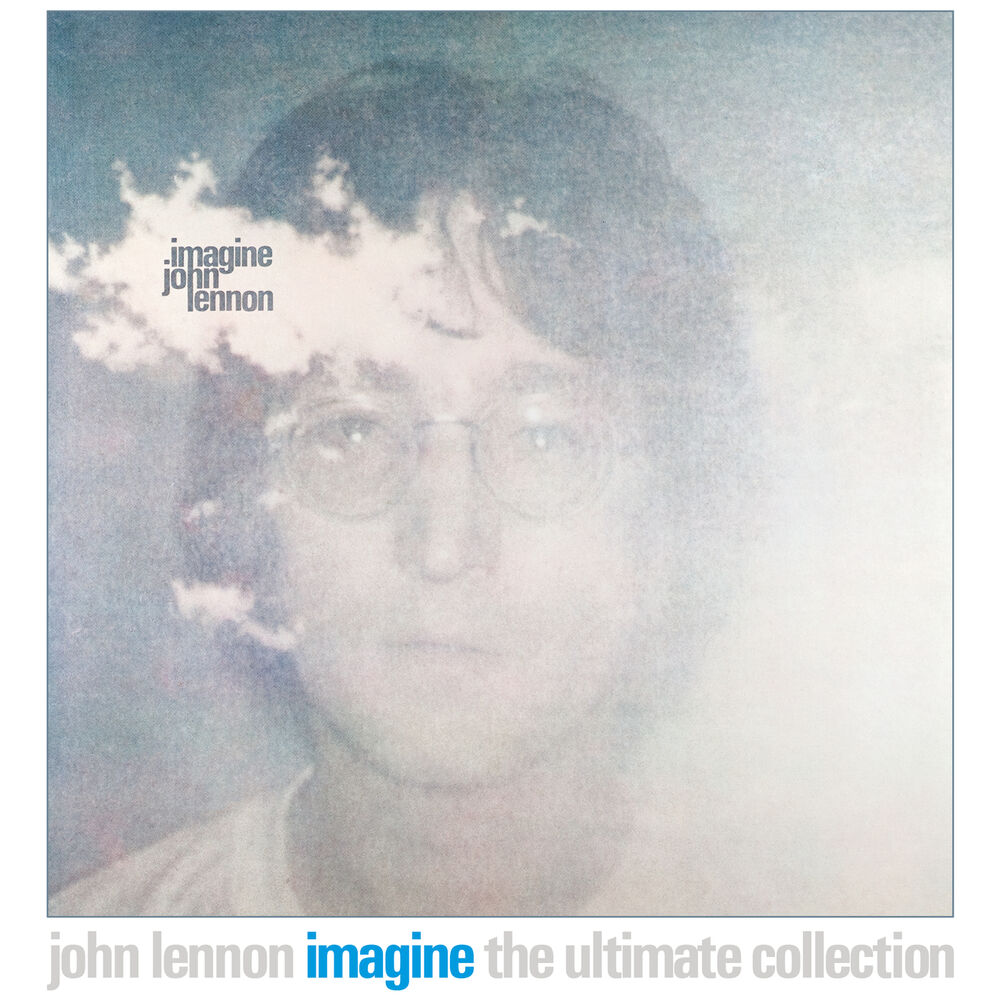
Imagine (The Ultimate Collection)
- Released5 October 2018
- UK peak No. 1
- Weeks on UK chart 101
- Entered UK chart 24 October 1971
- LabelUMC (Universal Music Catalogue)
- Tracks25 · 89 min
3 tracks from it charted as singles. Press a flag to play it in the chart where it peaked.
Tracks
| 1 | 3:06 | ||
| 2 | Crippled Inside (Ultimate Mix) | 3:51 | |
| 3 | 4:14 | ||
| 4 | It's So Hard (Ultimate Mix) | 2:29 | |
| 5 | I Don’t Wanna Be A Soldier Mama I Don’t Wanna Die (Ultimate Mix) | 6:08 | |
| 6 | Gimme Some Truth (Ultimate Mix) | 3:18 | |
| 7 | Oh My Love (Ultimate Mix) | 2:47 | |
| 8 | How Do You Sleep? (Ultimate Mix) | 5:39 | |
| 9 | How? (Ultimate Mix) | 3:36 | |
| 10 | Oh Yoko! (Ultimate Mix) | 4:21 | |
| 11 | 3:24 | ||
| 12 | Well (Baby Please Don't Go) (Ultimate Mix) | 4:08 | |
| 13 | God Save Us (Ultimate Mix) | 3:15 | |
| 14 | Do The Oz (Ultimate Mix) | 3:09 | |
| 15 | God Save Oz (Ultimate Mix) | 3:27 | |
| 16 | Happy Xmas (War Is Over) (Ultimate Mix) | 3:35 | |
| 17 | 2:13 | ||
| 18 | 4:12 | ||
| 19 | Oh My Love (Elements Mix) | 1:56 | |
| 20 | How? (Elements Mix) | 3:36 | |
| 21 | 3:17 | ||
| 22 | 3:05 | ||
| 23 | Crippled Inside (Take 3) | 3:50 | |
| 24 | Crippled Inside (Take 6 / Alternate Guitar Solo) | 3:47 | |
| 25 | 2:16 |
About the album
Imagine is the second solo studio album by the English musician John Lennon, released on 9 September 1971 by Apple Records. Co-produced by Lennon, his wife Yoko Ono and Phil Spector, the album's elaborate sound contrasts the basic, small-group arrangements of his first album, John Lennon/Plastic Ono Band (1970). The opening title track is widely considered to be his signature song.
Lennon recorded the album from early to mid-1971 at his Ascot Sound Studios, EMI Recording Studios and the Record Plant in New York City, with musicians that included his ex-Beatles bandmate George Harrison, keyboardist Nicky Hopkins, bassist Klaus Voormann and drummers Alan White and Jim Keltner. The lyrics reflect peace, love, politics, Lennon's experience with primal scream therapy and, following a period of high personal tensions, an attack on his former writing partner Paul McCartney in "How Do You Sleep?". Extensive footage from the sessions was recorded for a scrapped documentary; parts were released on the documentary film Imagine: John Lennon (1988). The documentary John & Yoko: Above Us Only Sky, based on that footage, was released in 2018.
Imagine was a critical and commercial success, reaching number one on both the UK Albums Chart and US Billboard 200. Along with John Lennon/Plastic Ono Band, it is considered one of Lennon's finest solo albums.
Background
While in New York, former Beatles John Lennon and George Harrison had a short jam session, during which Lennon asked Harrison to perform on Lennon's next album. Recording was scheduled to begin in a week's time at Lennon's Ascot Sound Studios, at his Tittenhurst Park residence. Harrison agreed, and invited their friend, bassist Klaus Voormann.
Recording and structure
Recording for the album started on 24 May at Ascot Sound Studios. The first songs recorded were "It's So Hard" and "I Don't Want to Be a Soldier" in February 1971 at Ascot Sound Studios, during sessions for Lennon's single "Power to the People". A cover of the Olympics' 1958 song "Well (Baby Please Don't Go)", later released on John Lennon Anthology, was recorded on 16 February. Lennon chose to remake "I Don't Want to Be a Soldier" on 24 May 1971, the opening day of the main album sessions.
Lennon enlisted help from Nicky Hopkins, members of the Apple band Badfinger, Alan White and Jim Keltner. Harrison contributed lead guitar parts on various songs. Lennon showed the musicians a song that he had recently written, "Imagine". Also recorded was a demo of the future Lennon track "Aisumasen (I'm Sorry)", the unreleased song "San Francisco Bay Blues", and a demo of "I'm the Greatest".
Lennon and his wife Yoko Ono flew to New York on 3 July to continue sessions for the album the next day, at the Record Plant.
Music and lyrics
Musically, Rob Sheffield said that Imagine "is an experiment [Lennon] only tried once, making a state-of-the-art professional rock album with a rotating cast of top-notch studio hired guns. But because he's John Lennon, it's also weird and raw." It's also considered by American Songwriter to be the album with which Lennon returned to pop.
Imagine was written and recorded during a period of particularly bad feelings between Lennon and former bandmate Paul McCartney, following the Beatles' break-up the year before and McCartney winning his case in the High Court to have their legal partnership dissolved. Harrison guested on half of Imagine's ten tracks, including "How Do You Sleep?" – a song written in retaliation against McCartney's alleged personal attacks on Lennon and Ono, on his recent Ram album. Lennon said in 1980: "I used my resentment against Paul ... to create a song ... not a terrible vicious horrible vendetta ... I used my resentment and withdrawing from Paul and The Beatles, and the relationship with Paul, to write 'How Do You Sleep?'.
Packaging
The photographs on the front and back covers were taken by Ono, using a Polaroid camera. It was previously believed that the front cover photo was taken by Andy Warhol. The back cover includes a quote ("Imagine the clouds dripping. Dig a hole in your garden to put them in.") from Ono's book Grapefruit, which UK re-release the Lennons were promoting at the time. The album's original release also included a poster of Lennon at the piano and two postcards. In lieu of sporting the typical full green apple picture on most Apple record labels, a black and white photograph of Lennon's face was presented on Side A instead.
Release
Apple Records issued Imagine on 9 September 1971 in the United States and a month later, on 8 October, in the UK. Early editions of the LP record included a postcard featuring a photo of Lennon holding a pig, in mockery of McCartney's similar pose with a sheep on the cover of Ram.
Even though Spector championed a "Back to Mono" aesthetic starting in the 1980s, monophonic sound was out of style in the 1970s. Instead, the album was released in stereo and in the then new four channel quadraphonic technology. In the US, the four channel mix was only available on a quad 8-track tape with some copies marketed as "Quadrasonic". In the UK and Australia, the quad mix was issued on LP record using CBS's SQ matrix system along with a quad 8-track version in the UK. In Japan, the quad mix was issued on LP using the QS Regular Matrix system; and also, a discrete quad reel-to-reel tape.
"Imagine", backed with "It's So Hard", was released as a single in the US on 11 October 1971.
Critical reception
Reviewing the album for Rolling Stone in 1971, Ben Gerson said it "contains a substantial portion of good music" but considered Lennon's previous LP to be superior. He also warned of the possibility that Lennon's "posturings will soon seem not merely dull but irrelevant". Alan Smith of the NME lauded the album as "superb", "beautiful" and "one step away from the chill of his recent total self-revelation, and yet a giant leap towards commerciality without compromise". He said it was Lennon "showing McCartney how to tighten up the flab in his music, and its worth", and concluded: "Lennon rides high!" In Melody Maker, Roy Hollingworth named Imagine the best album of the year and Lennon's finest work up to that point.
Imagine was voted the fifth best record of 1971 in The Village Voice's Pazz & Jop, an annual poll of American critics nationwide.