Tracks
| 1 | Ocean Song | 3:05 | |
| 2 | Meeting (Garden of Geda) / Sound out the Galleon | 3:34 | |
| 3 | Dance of Ranyart / Olias (Build the Moorglade) | 4:19 | |
| 4 | Qoquaq Ën Transic / Naon / Taransic Cö | 7:08 | |
| 5 | Flight of the Moorglade | 3:24 | |
| 6 | Solid Space | 5:21 | |
| 7 | Moon Ra / Chords / Song of Search | 12:48 | |
| 8 | To the Runner | 4:29 |
About the album
Olias of Sunhillow is the debut studio album by English singer-songwriter Jon Anderson, released in the United Kingdom on 9 July 1976 by Atlantic Records. When the progressive rock band Yes took a break in activity in August 1975 for each member to record a solo album, Anderson, having established himself as their frontman, decided upon a concept album that tells the story of four tribes of an alien race and their journey to a new planet after their home is threatened by a volcanic eruption. Olias, a magician, builds a spacecraft named the Moorglade Mover and is helped by fellow magicians Ranyart and Qoquaq to gather and carry the population to their new home.
The album was recorded using a mobile studio situated at Anderson's country home in Seer Green, Buckinghamshire, with himself as the sole producer and Mike Dunne as the engineer. Musically, the album features elements of progressive rock with psychedelic folk, experimental electronics, and world music, and features Anderson playing every instrument, which includes a variety of keyboards, guitars, and percussion. The track "Ocean Song" was performed live at select shows during Yes's 1976 North American tour.
Olias of Sunhillow peaked at number eight on the UK Album Charts, the best performing chart position of the solo albums released by the band at the time. It reached number forty-seven on the US Billboard 200.
Background and writing
By mid-1975, Anderson had been the lead vocalist in the progressive rock band Yes for seven years. In August of that year the band, which was then a line-up of Anderson, bassist Chris Squire, guitarist Steve Howe, drummer Alan White, and keyboardist Patrick Moraz, completed the 1974–1975 tour in support of their seventh album, Relayer. The group, who had been recording and touring consistently for the past five years, felt a break was necessary and agreed to take time off for each member to make their own solo album.
For his solo effort, Anderson wished to present a concept album which told a "semi-science fiction" story inspired by the artwork that Roger Dean had designed for Yes's fourth album, Fragile (1971). Dean's first piece of work for the group, the front cover depicts a tiny planet breaking apart and a glider escaping into space, which Anderson adapted into the story with additional inspiration from the novels The Finding of the Third Eye and The Initiation of the World by writer, painter, and mystic Vera Stanley Alder and The Lord of the Rings trilogy by J.R.R. Tolkien.
Recording
The album was recorded in approximately four months in Anderson's then home at Long Grove in Seer Green, Buckinghamshire, which housed a garage that housed a mobile recording studio named the Mobile Mobile. Anderson performed all of the vocals and instruments himself, playing over thirty instruments (amongst them different types of keyboards, guitars, lutes, percussion, harp, wooden flute, Asian bells, sitar, Moog synthesiser and Turkish saz). He still considered his voice his primary instrument and used layered vocals to create impressions of a new language on "Sound Out the Galleon". He chose the words particularly for his voice as he was technically unable to play a dedicated solo on an instrument and called them "a vocal exercise [...] I sang it until we created twenty voices and finished up with this tangible energy."
Two-thirds of the album was initially recorded in demo form onto 8-track tape, which Anderson used as a guide to write the complete arrangements that were then re-recorded onto 24-track.
Release
The album was originally set for a release around Christmas of 1975, but it was pushed back some months so Anderson could complete it. In early 1976 he was pressured by his Yes band mates to complete the album before a proposed Japanese tour, but the plan was cancelled due to Anderson's exhaustion from working on Olias. The album was released in July 1976 on Atlantic Records. The album peaked at number 8 on the UK and number 47 in the United States. "Ocean Song" was performed by Yes on their 1976 tour, but as with the other songs they performed from other members' solo albums, it was dropped after the first few weeks.
Artwork
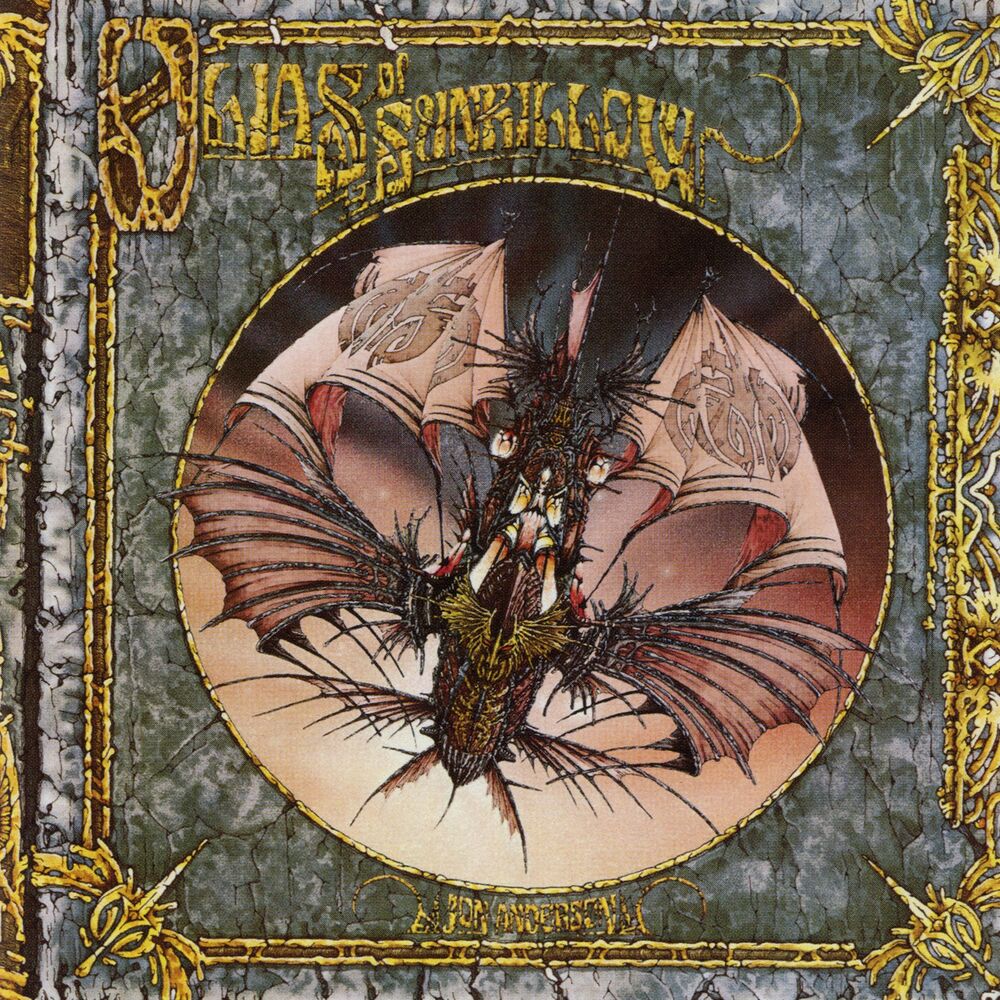
Despite repeated requests from Anderson, Roger Dean was too busy to commit to designing the cover, so Anderson decided upon a series of designs by artist David Fairbrother-Roe, who was suggested by a friend.
Reception
Writing in RAM in July 1976, Bob Edmunds described the album as being "as impressive as anything Yes have produced collectively... Musicians with greater skills (e.g. Mike Oldfield) have created instrumental works on this scale but have always been denied access to the wonderful instrument of Jon Anderson's voice. Endless tours have done nothing to detract from one of the richest, purest voices in rock … . Olias has a continuity of intensity rarely found on any album, let alone one this ambitious. It won't go down too well with those who reject anything except full-tilt rock'n'roll. But there's no way you can deny the sheer grandeur of Jon Anderson's music, no matter what opinions you hold about rock."
Paul Stump's 1997 History of Progressive Rock called the album "probably the most complete manifesto to Progressive ideology (infinitely more so than [Tales from] Topographic [Oceans])." Stump praised the album's divergence from the normally accepted practices and language of mainstream rock, while noting that it is also very accessible to a mainstream rock audience.
Reissues
The album has been released several times. Wounded Bird Records in the US released the album on 28 February 2006. Contrary to some earlier releases it presents all the artwork, but very small. Some earlier CD releases include only part of the original artwork and story, omitting pages 3–6 of the original vinyl album. The Japanese pressing on MMG Inc/Atlantic AMCY-18 presents the complete artwork in a booklet, like the vinyl version with eight pages (including frontcover and backcover).
The album was reissued in January 2014 on SACD by Audio Fidelity Records.
In 2021 the album was reissued in a CD+DVD package from Cherry Red Records. The CD contains a remastered version of the album in stereo. The DVD contains the remastered audio in 96/24 stereo LPCM, as well as a 5.1 surround mix in both DTS 96/24 and Dolby AC3 formats; the 5.1 audio is upmixed from the stereo masters because the original 24-track tapes could not be located. The packaging includes reproductions of the original album art and story, although again with small reproduction that may make the lettering hard to read.