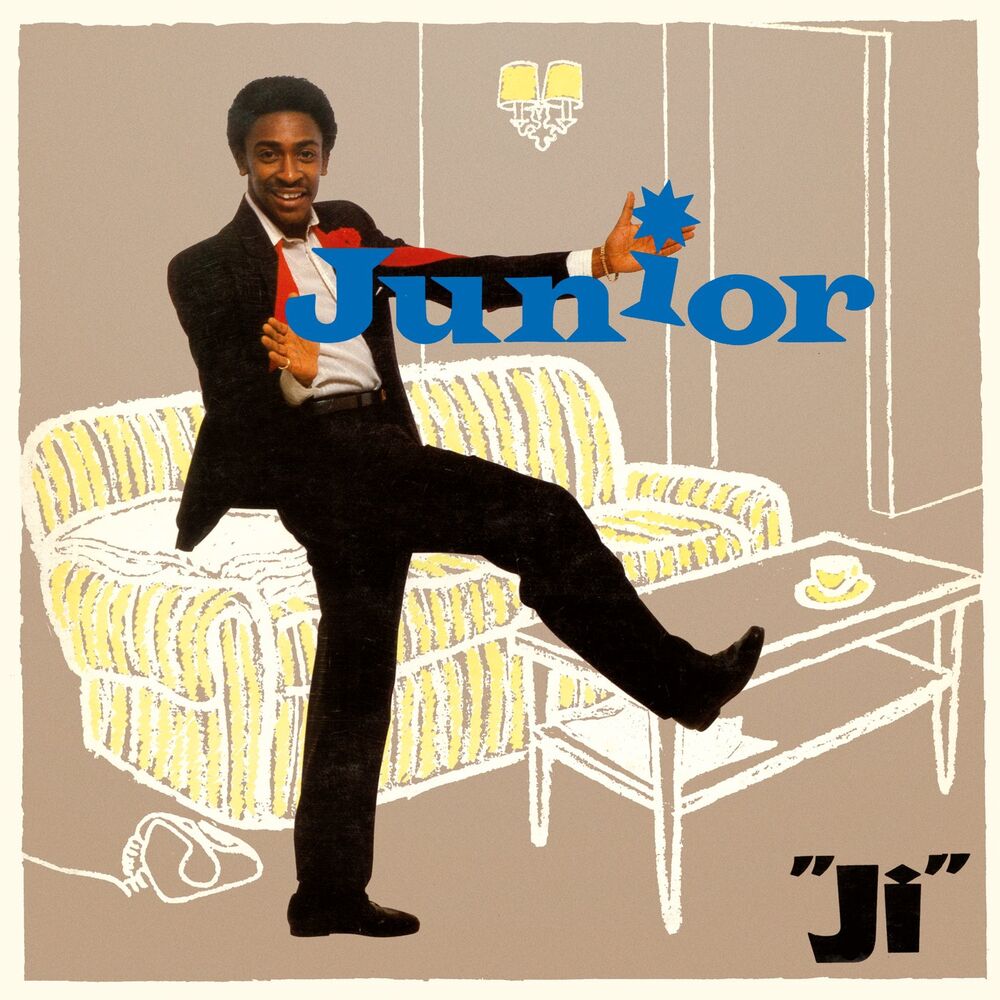
JI (Bonus Tracks Edition)
- Released17 September 2012
- UK peak No. 28
- Weeks on UK chart 14
- Entered UK chart 30 May 1982
- LabelUMC (Universal Music Catalogue)
- Tracks15 · 74 min
3 tracks from it charted as singles. Press a flag to play it in the chart where it peaked.
Tracks
| 1 | 6:43 | ||
| 2 | Love Dies | 4:25 | |
| 3 | Too Late (UK Album Version) No. 20 · 1982 | 7:17 | |
| 4 | Is This Love | 4:29 | |
| 5 | Let Me Know | 5:48 | |
| 6 | Down Down | 4:45 | |
| 7 | I Can't Help It No. 53 · 1982 | 4:27 | |
| 8 | Darling You (Don't You Know) | 5:33 | |
| 9 | Fame | 4:55 | |
| 10 | 4:58 | ||
| 11 | 3:35 | ||
| 12 | 4:35 | ||
| 13 | Too Late (UK Single) No. 20 · 1982 | 3:34 | |
| 14 | Too Late (Alternate Version) No. 20 · 1982 | 5:33 | |
| 15 | In Words | 3:45 |
About the album
Ji is the debut studio album by English singer Junior (Junior Giscombe), released in April 1982 by Mercury Records. The album was recorded with producer Bob Carter after the pair initiated their collaboration with the single "Mama Used to Say" (1981), which was remixed for Ji and became a transatlantic hit. A Britfunk record, the album mixes styles of soul and funk, with expansive synthesised production and a funk backing group. Giscombe and Carter's lyrics were based on realist stories. Music critics compared the singer's voice and melodic style to Stevie Wonder.
Upon release, the album was a commercial success, reaching number 28 in the UK Albums Chart and number 71 on the US Billboard Top LPs & Tape chart. A further single from the record, "Too Late", made the UK Top 20. The album was generally praised by music critics, with attention given to its soulful style and inventive dance rhythms. Ji was re-released in 2012 by Soul Music in a deluxe edition.
Background and recording
Born and raised in Clapham South, London, Junior Giscombe left school as a fan of reggae and frequented sound systems. In this period, he was a pickpocket, but began making music as a way of moving past his crimes, forming an eleven-piece vocal group with his friends with similarly dubious operations; he explained: "I started it in the sense that I wanted to keep them off the streets, so that I wouldn't end up inside." While working as shoemaker, Giscombe would tire of the job and spend time writing songs. He moved away from the reggae scene because of what he perceived as widespread "anti-white" attitudes, and moved into soul music, taking inspiration from Philly soul writers Gene McFadden, John Whitehead, Thom Bell and Linda Creed as he turned music into a full-time career after finishing college. Wanting to form a rock-leaning R&B band, he formed the band Atlantis as an outlet for his songs.
Composition
Ji is a Britfunk album that fuses funk and soul music, applying musical versatility to the format of dance music, according to critic Geoffrey Himes. Carter's production features synthesizers, which reveal a new wave influence, and Mellotrons, as well as incorporating accents to contrast the chunky rhythm section, including "glowing bass slides, ringing guitar tones and short horn phrases." "My inspiration comes from what's happening on the street," Giscombe explained, "whereas Bob Carter comes from a middle-class white set-up. Because of that, we're able to teach one another a lot." The singer felt the album had "enough different rhythms and a distinctive sound" to make him unique. While Ji is characterised by dance beats and foreground melodies, each song features what Himes describes as "odd harmonies," counter-rhythms and variations. Bassist Keith Wilkinson reveals influences of Motown.
Critics compared Giscombe's singing to Stevie Wonder.
Release and promotion
By the release of Ji, the success of "Mama Used to Stay" in the US afforded Giscombe stardom there, and became the first British singer to appear on Soul Train since David Bowie. While pleased with his US breakthrough, he was disappointed with his relative lack of success in England, especially given the successes of Linx and Imagination, nonetheless hoping that second single "Too Late" would "be easier for the kids to latch onto at home." Released by Mercury Records in May 1982, Ji proved to be a transatlantic commercial success. The album reached number 28 on the UK Albums Chart, spending fourteen weeks in total, while "Mama Used to Say" eventually peaked at number seven on the UK Singles Chart in June. The album also peaked at number 71 on the Billboard Top LPs & Tape chart, staying on the chart for sixteen weeks. "Too Late" peaked at number 20 in the UK in July, while a double A-side of "I Can't Help It" and "Let Me Know" reached number 53 in September.
Critical reception and legacy
In a contemporary review, Ian Birch of Smash Hits described Ji as "a delicious mix of well meaning words, ferocious dance rhythms and soaring vocals," further praising it for its "ideal summer sound," while Newsweek described the album as "one of the year's brightest recording debuts" on which the "splendid cacophony" of "Mama Used to Say" is the highlight. In The Washington Post, Geoffrey Himes praised the "British funkster" for matching Stevie Wonder's "intoxicating melodic gift", hailing the warmth and "credibility" of Giscombe's singing for equalling the ambitions of the music and concluding that Ji ranks with Prince's Controversy and Wonder's Hotter Than July as "the most progressive soul albums of this young decade."
Robert Christgau of The Village Voice said that while Giscombe, a "Stevie Wonder surrogate", is clearly England's "most impressive recent export," Ji forgoes the effervescence and spaciousness of Wonder's lyrics, with only the two hits showing "the gift for the ordinary bewitching." While praising several songs, particularly "Mama Used to Say," Barney Hoskyns of NM