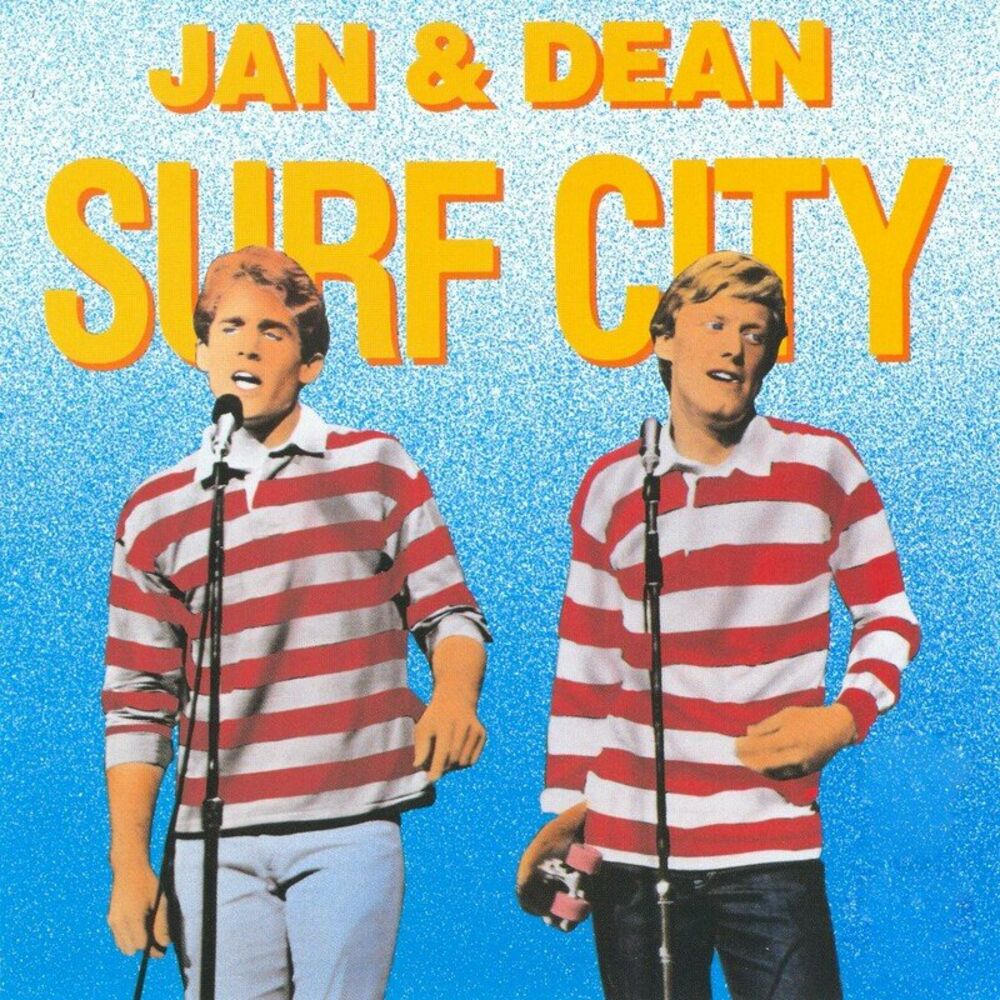
6 tracks from it charted as singles. Press a flag to play it in the chart where it peaked.
Tracks
| 1 | 2:28 | ||
| 2 | Fun, Fun, Fun | 2:07 | |
| 3 | The Little Old Lady (From Pasadena) (Rerecorded) No. 3 · 1964 | 2:26 | |
| 4 | Ride the Wild Surf (Rerecorded) No. 16 · 1964 | 2:12 | |
| 5 | Dead Man's Curve (Rerecorded) No. 8 · 1964 | 2:25 | |
| 6 | Help Me Rhonda | 2:53 | |
| 7 | Drag City No. 10 · 1964 | 2:15 | |
| 8 | Little Deuce Coupe | 1:57 | |
| 9 | I Get Around | 2:03 | |
| 10 | Sidewalk Surfin' No. 25 · 1964 | 2:07 |
About the album
Surf City and Other Swingin' Cities is the second studio album by the American surf rock and pop duo Jan and Dean. It was released on July 22, 1963 by Liberty Records.
Background
"Surf City" was released as a single on May 17, 1963, with "She's My Summer Girl" as the B-side. "She's My Summer Girl" later appeared on Jan and Dean's 1964 album Ride the Wild Surf. On July 20, the single topped the Billboard Hot 100 and peaked at number 3 on Billboard's Hot R&B Singles chart.
On June 12, 1963, "Detroit City" and "I Left My Heart in San Francisco" were tracked at Radio Recorders. On June 13, two tracking sessions were held at Western Recorders. "Soul City" and "Kansas City" were tracked during the first session, while "Memphis, Tennessee", "Tallahassee Lassie", and "Honolulu Lulu" were tracked during the second. On June 19, "Manhattan", "Way Down Yonder in New Orleans", and "You Came a Long Way from St. Louis" were tracked at Western. On June 23, "Philadelphia, PA" was tracked at Radio Recorders. Strings were overdubbed at an unknown date.
Release and reception
Liberty released Surf City and Other Swingin' Cities in mono and stereo on July 22, 1963. The album reached number 32 on the Billboard Top LPs chart. "Honolulu Lulu" was released as a single on August 9 with "Someday (You'll Go Walking By)" as the B-side. The single reached number 11 on the Billboard Hot 100.
Writing for AllMusic, Bruce Eder called Surf City and Other Swingin' Cities a "musical travelogue of the United States that didn't seem too inspired as a concept even in 1963", noting that "there is something to recommend almost all of it". Cashbox wrote in their review that "The musical bill-of-fare here includes a melodic amalgam of evergreens and newies", noting that "The arrangements are first-rate and the boys handle them with ease." The writers of Billboard gave it a positive review.