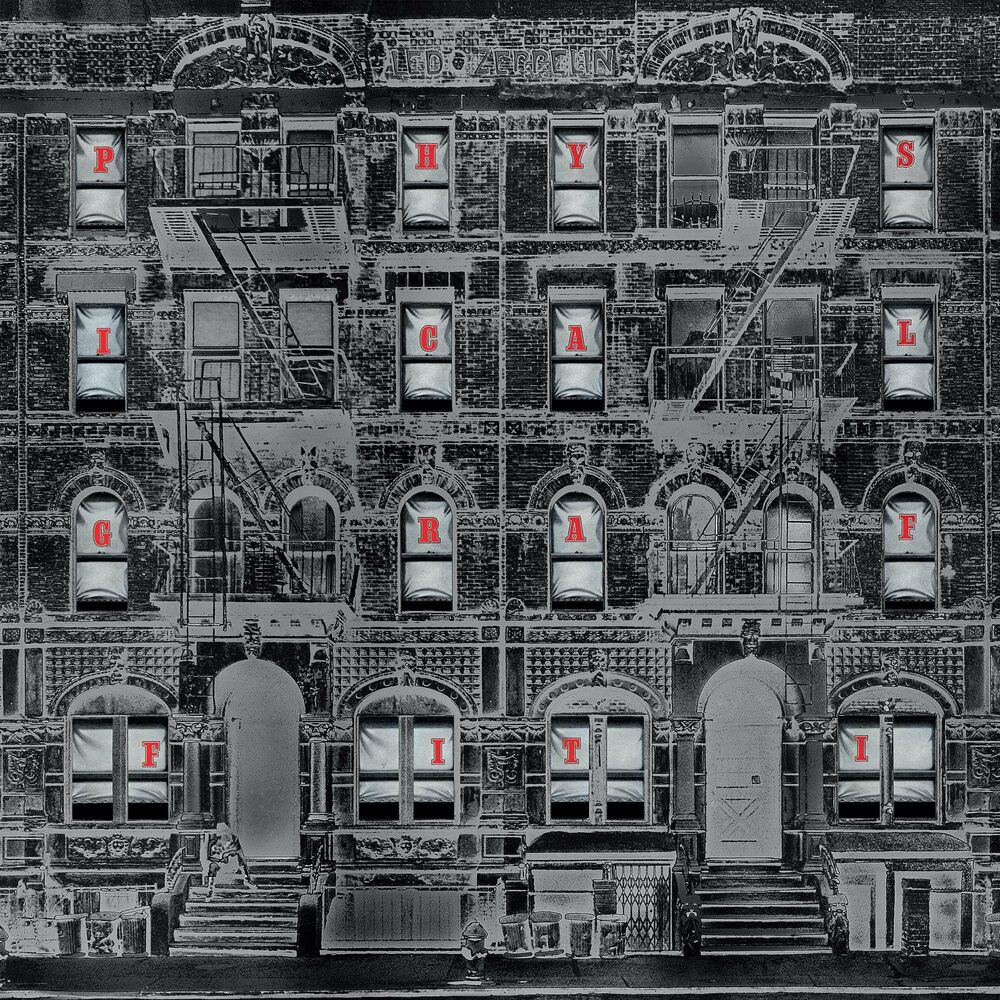
Physical Graffiti (Deluxe Edition)
- Released24 February 2015
- UK peak No. 1
- Weeks on UK chart 36
- Entered UK chart 9 March 1975
- LabelAtlantic Records
- Tracks22 · 124 min
2 tracks from it charted as singles. Press a flag to play it in the chart where it peaked.
Tracks
| 1 | Custard Pie (Remaster) | 4:15 | |
| 2 | The Rover (Remaster) | 5:39 | |
| 3 | In My Time of Dying (Remaster) | 11:08 | |
| 4 | Houses of the Holy (Remaster) | 4:04 | |
| 5 | Trampled Under Foot (Remaster) No. 38 · 1975 | 5:36 | |
| 6 | Kashmir (Remaster) No. 80 · 2007 | 8:37 | |
| 7 | In the Light (Remaster) | 8:47 | |
| 8 | Bron-Yr-Aur (Remaster) | 2:06 | |
| 9 | Down by the Seaside (Remaster) | 5:15 | |
| 10 | Ten Years Gone (Remaster) | 6:34 | |
| 11 | Night Flight (Remaster) | 3:38 | |
| 12 | The Wanton Song (Remaster) | 4:08 | |
| 13 | Boogie with Stu (Remaster) | 3:52 | |
| 14 | Black Country Woman (Remaster) | 4:24 | |
| 15 | Sick Again (Remaster) | 4:42 | |
| 16 | Brandy & Coke (Trampled Under Foot; Initial / Rough Mix) | 5:39 | |
| 17 | Sick Again (Early Version) | 2:22 | |
| 18 | In My Time of Dying (Initial / Rough Mix) | 10:48 | |
| 19 | Houses of the Holy (Rough Mix with Overdubs) | 3:51 | |
| 20 | Everybody Makes It Through (In the Light; Early Version / In Transit) | 6:29 | |
| 21 | Boogie with Stu (Sunset Sound Mix) | 3:39 | |
| 22 | Driving Through Kashmir (Kashmir Rough Orchestra Mix) | 8:41 |
About the album
Physical Graffiti is the sixth studio album by the English rock band Led Zeppelin. Released as a double album on 24 February 1975 in the United States and on 28 February 1975 in the United Kingdom, it was the group's first album to be released under their new label, Swan Song Records. The band wrote and recorded eight new songs for the album in early 1974 at Headley Grange, a country house in Hampshire, which gave them ample time to improvise arrangements and experiment with recording. The total playing time covered just under three sides of an LP, so they decided to expand it into a double album by including seven previously unreleased tracks from the sessions for the band's earlier albums Led Zeppelin III (1970), Led Zeppelin IV (1971) and Houses of the Holy (1973). The album covered a range of styles including hard rock, progressive rock, rock 'n' roll and folk. The album was then mixed over summer 1974 and planned for an end-of-year release; however, its release was delayed because the Peter Corriston–designed die-cut album cover proved difficult to manufacture.
Physical Graffiti was commercially and critically successful upon its release and debuted at number one on album charts in the UK and number three in the United States. It was promoted by a successful US tour and a five-night residency at Earl's Court, London.
Recording
The first attempt by Led Zeppelin to record songs for Physical Graffiti took place in November 1973 at Headley Grange in Hampshire, England, where they had previously recorded their untitled fourth album. The recording equipment consisted of Ronnie Lane's Mobile Studio. Guitarist and producer Jimmy Page and drummer John Bonham recorded an instrumental which was later reworked as "Kashmir" during this visit. However, these sessions quickly came to a halt, and the studio time was turned over to Bad Company, who used it to record songs for their debut album. The press reported that bassist/keyboardist John Paul Jones was ill and unable to record. However, he had become disillusioned with the group and tired of touring, and told manager Peter Grant he was considering quitting. Grant asked him to reconsider and to take the rest of the year off to recuperate.
The group reconvened at Headley Grange in January and February 1974, where they recorded eight tracks engineered by Ron Nevison.
Artwork and packaging
The album was originally released with a die-cut sleeve design depicting a New York City tenement block, through whose windows various cultural icons could be interchangeably viewed. Art director Mike Doud and album designer Peter Corriston were looking for a symmetrical building with interesting details that wasn't obstructed by other objects and would fit the square album cover. They then developed the rest of the cover around the idea of people moving in and out of the tenement, with various sleeves that could be placed under the main cover and fill the windows with different pieces of information.
The two 5-storey buildings photographed for the album cover are located at 96 and 98 St. Mark's Place in New York City. The original photograph underwent a number of tweaks to arrive at the final image. The fourth floor had to be cropped out to fit the square album cover format. (The front doorway and stoop at 96 St.
Release and critical reception
Physical Graffiti was Led Zeppelin's first release on their own Swan Song Records label, launched in May 1974. Until this point, all of Led Zeppelin's albums had been released on Atlantic Records, which would distribute Swan Song. The album was first announced to the press on 6 November with a planned release date of 29 November and an accompanying US tour (the band's tenth) starting in January. Delays in producing the album's sleeve design prevented its release before the tour began. It was finally released on 24 February 1975.
The album was a commercial and critical success, building a huge advance order after the delayed release date; when it was eventually issued, it reached No. 1 in the UK charts. In the US, it debuted at No. 3 on the Billboard Pop Albums chart, rising to No. 1 the following week and staying there for six weeks. Physical Graffiti has since proven to be one of the most popular releases by the group, shipping 8 million copies in the United States. It was the first album to go platinum on advance orders alone.
Reissues
Physical Graffiti was first issued on CD as a double-disc set in 1987. However, it was done without input from the band, and the first pressing accidentally edited off the studio banter at the end of "In My Time of Dying" (later fixed on repressings). Page was unhappy with his lack of input over the CDs and decided he would produce new versions himself. He booked a week in May 1990 with engineer George Marino to remaster the entire back catalogue. Eight tracks from Physical Graffiti appeared on the four-disc Boxed Set and three on Remasters, both in 1990; the remainder appeared on Boxed Set 2 in 1993, while the album was properly reissued in 1994.
An extended remastered version of Physical Graffiti was reissued on 23 February 2015, almost exactly forty years after the original album was released. The reissue comes in six formats: a standard two-CD edition, a deluxe three-CD edition, a standard two-LP version, a deluxe three-LP version, a super deluxe three-CD plus three-LP version with a hardback book, and as high resolution 24-bit/96k digital downloads.