Houses of the Holy (Remaster)
- Released27 October 2014
- UK peak No. 1
- Weeks on UK chart 16
- Entered UK chart 8 April 1973
- LabelAtlantic Records
- Tracks8 · 41 min
2 tracks from it charted as singles. Press a flag to play it in the chart where it peaked.
Tracks
| 1 | The Song Remains the Same (Remaster) | 5:29 | |
| 2 | The Rain Song (Remaster) | 7:39 | |
| 3 | Over the Hills and Far Away (Remaster) No. 51 · 1973 | 4:50 | |
| 4 | The Crunge (Remaster) | 3:17 | |
| 5 | Dancing Days (Remaster) | 3:43 | |
| 6 | D'yer Mak'er (Remaster) No. 20 · 1973 | 4:22 | |
| 7 | No Quarter (Remaster) | 7:02 | |
| 8 | The Ocean (Remaster) | 4:31 |
About the album
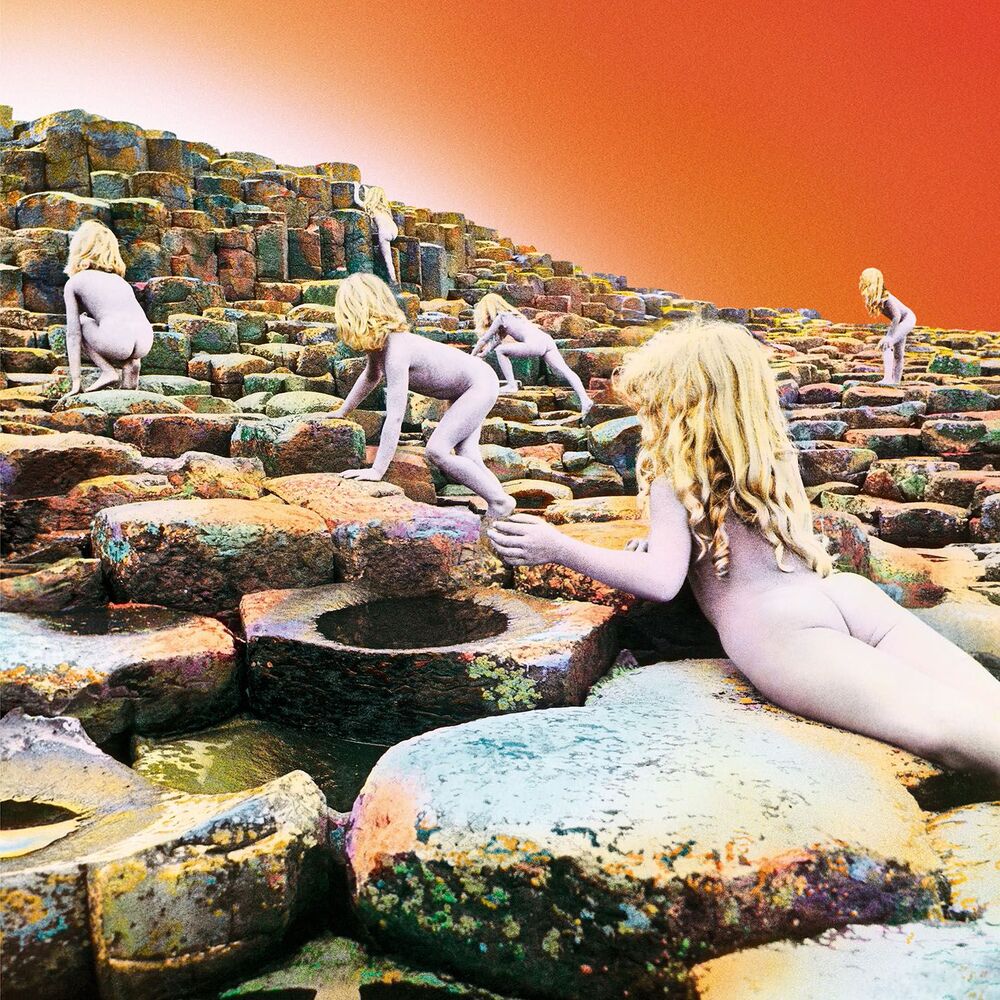
Houses of the Holy is the fifth studio album by the English rock band Led Zeppelin, released on 28 March 1973 in the United States and on 30 March 1973 in the United Kingdom by Atlantic Records. The album benefited from two band members installing studios at home, which allowed them to develop more sophisticated songs and arrangements and expand their musical style. Several songs subsequently became fixtures in the group's live set, including "The Song Remains the Same", "The Rain Song" and "No Quarter". Other material recorded at the sessions, including the title track, was shelved and released on the later albums Physical Graffiti (1975) and Coda (1982). All instruments and vocals were provided by the band members Robert Plant (vocals), Jimmy Page (guitar), John Paul Jones (bass, keyboards), and John Bonham (drums). The album was produced by Page and mixed by Eddie Kramer. The cover was the first for the band to be designed by Hipgnosis and was based on a photograph taken at Giant's Causeway in Northern Ireland.
Although critical response was mixed, Houses of the Holy became a commercial success, later receiving a Diamond certification by the Recording Industry Association of America (RIAA) in 1999 for at least 10 million copies sold in the US. In 2020, the album was ranked at number 278 on Rolling Stone's 2020 list of the "500 Greatest Albums of All Time".
Recording
By 1972, Led Zeppelin had achieved sustained commercial and critical success from both their studio albums and live shows. They were keen to record on location using the Rolling Stones Mobile Studio as it had been an enjoyable experience for their untitled fourth album, released the previous year. After touring Australia, in April 1972 the group decided to take the mobile studio to Mick Jagger's home, Stargroves, a manor house and country estate in Hampshire. Eddie Kramer returned as recording engineer.
Some songs from the album had initially been tried out in earlier sessions, such as "No Quarter", which was first attempted during a session at Headley Grange Estate, in East Hampshire. Both guitarist and producer Jimmy Page and bassist and keyboardist John Paul Jones had installed home studios, which allowed them to arrive at Stargroves with complete compositions and arrangements.
Page's home studio used some of the equipment from Pye Mobile Studios, which had been used to record the Who's 1970 live album Live at Leeds.
Composition
The album was a stylistic turning point for the band. The composition and production laid foundations for subsequent releases. According to the band's biographer Dave Lewis, "while the barnstorming effect of the early era was now levelling off, and though devoid of the electricity of Zeppelin I and II, the sheer diversity of the third album, and lacking the classic status of the fourth, Houses of the Holy nevertheless found its rightful niche." The album largely abandoned their previous music's weighty, dark blues rock distortion in favor of a clean, expansive rock sound—as evinced by Page's sharper, brighter guitar tone. It was also likely the most eclectic musically of their albums, in the opinion of Consequence of Sound writer Kristofer Lenz, who observed swing rhythms on "Dancing Days", and experiments with reggae and psychedelic music on "D'yer Mak'er" and "No Quarter", respectively. Pete Prown and HP Newquist have called it "a diverse collection of rockers, ballads, reggae, funk, and fifties-style rock 'n' roll".
Packaging
Houses of the Holy was the first album by the group to have an explicit title that was not eponymous, but like the previous one, neither the band's name nor the album title was printed on the sleeve. However, manager Peter Grant did allow Atlantic Records to add a wrap-around paper title band to US copies of the sleeve that had to be broken or slid off to access the record. The first CD release of the album in the 1980s had the title logos printed on the cover itself.
The cover art for Houses of the Holy was inspired by Arthur C. Clarke's novel Childhood's End (1953). The cover is a collage of several photographs which were taken at the Giant's Causeway, Northern Ireland, by Aubrey Powell of Hipgnosis. This location was chosen ahead of an alternative one in Peru which had also been considered.
The photo shoot featured two naked child models, Stefan and Samantha Gates, aged five and seven. It was a frustrating affair over the course of 10 days.
Release and reception
This was Led Zeppelin's final studio release on Atlantic Records before forming their own label, Swan Song Records, in 1974, which would be distributed by Atlantic. It was also the only Led Zeppelin album that contained complete printed lyrics for each song.
Although intended for release in January 1973, delays in producing the album cover meant that it was not released until March, when the band was on its 1973 European tour. The album was promoted heavily before the commencement of Led Zeppelin's subsequent North American Tour, ensuring that it had ascended the top of the American chart by the beginning of the tour. Because much of the album had been recorded almost a year previously, many of the songs which are featured on the album had already been played live by Led Zeppelin on their concert tours of North America, Japan, Europe and the UK in 1972–73.
Houses of the Holy originally received mixed reviews, with much criticism from the music press being directed at the off-beat nature of tracks such as "The Crunge" and "D'yer Mak'er".