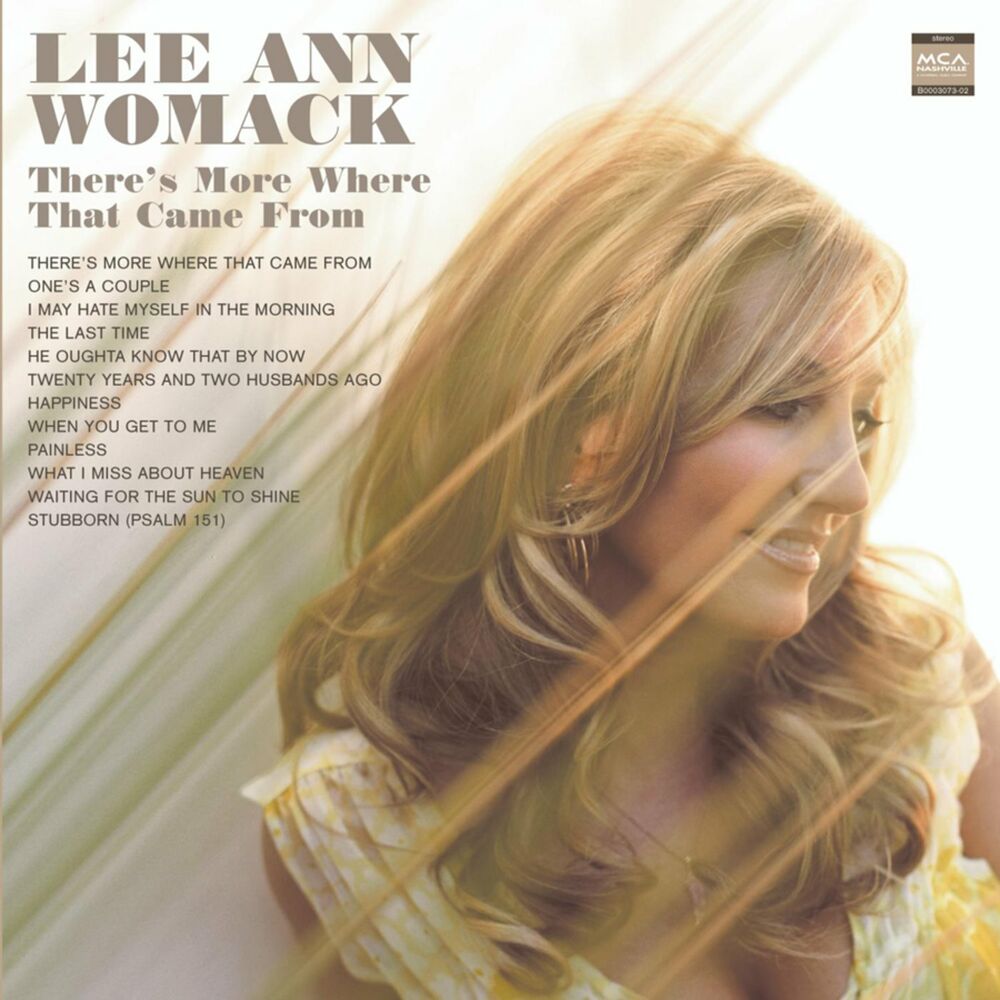
There's More Where That Came From
- Released8 February 2005
- LabelMCA Nashville
- Tracks13 · 54 min
One track from it charted as a single. Press a flag to play it in the chart where it peaked.
Tracks
| 1 | There's More Where That Came From (Album Version) | 3:53 | |
| 2 | One's A Couple (Album Version) | 4:10 | |
| 3 | I May Hate Myself In The Morning (Album Version) No. 66 · 2005 | 4:34 | |
| 4 | The Last Time (Album Version) | 4:23 | |
| 5 | He Oughta Know That By Now (Album Version) | 3:43 | |
| 6 | Twenty Years And Two Husbands Ago | 3:49 | |
| 7 | Happiness (Album Version) | 4:10 | |
| 8 | When You Get To Me (Album Version) | 4:04 | |
| 9 | Painless (Album Version) | 4:34 | |
| 10 | What I Miss About Heaven (Album Version) | 2:55 | |
| 11 | Waiting For The Sun To Shine (Album Version) | 4:31 | |
| 12 | Stubborn (Psalms 151)/Someone I Used To Know (Album Version) | 6:54 | |
| 13 | Someone I Used To Know | 2:26 |
About the album
There's More Where That Came From is the sixth studio album by American country music artist Lee Ann Womack, released on February 8, 2005, via MCA Nashville; it was initially her last album with the label before moving to Mercury Records, in which she recorded one single before returning back to MCA Nashville. It was her first studio album since Something Worth Leaving Behind (2002), which was much less successful both critically and commercially compared to her previous efforts. It was a return to the neotraditional country sound of her first two albums, from her last album's more pop-infused sound. The album had a more 70's aesthetic and sound in the vain to older contemporaries such as Dolly Parton and Barbara Mandrell.
The album was critically acclaimed by music critics, some even calling it Womack's best studio album. It was her highest-selling effort since I Hope You Dance (2000), debuting at number 3 on the Top Country Albums chart with first week sales of 83,000 copies. It has been certified Gold for sales of 500,000 copies in the United States alone.
Three official singles were released. "I May Hate Myself in the Morning" was released on October 25, 2004. It peaked at number ten on the US Hot Country Songs chart, becoming Womack's first top ten hit since 2001's "Ashes by Now" and also won the CMA Award for Single of the Year at the 2005 CMA Awards.
Background
Womack told The Dallas Morning News that MCA Nashville inspired her to record another album and said "I was sitting at home after Something Worth Leaving Behind thinking, 'Gosh, I thought this is what people wanted. And they didn't want it so obviously I don't know.' And they were the ones who came to me and said, 'When are you going to give us a record?' That's when I started thinking, 'Well, if they want a record, I'll make 'em one.'" She also said, "When I started making this record, I said I'm gonna have fun, and that's it. I'm not going to worry about does this sound right coming from a woman, or is this too country, or is this intro too long? I wanted this record to sound like where I came from."
Womack told Billboard, "I thought so much, harder than I've ever worked before on a record on 'Something Worth Leaving Behind,' and it just didn't work. I promised myself with this record I wouldn't think at all. I would just totally follow my heart and not my head." Womack told The Mirror, "These are songs that aren't afraid to tell the truth.
Critical reception
Rhapsody ranked the album #6 on its "Country’s Best Albums of the Decade" list. "Lee Ann Womack's There's More... is an album steeped in an old-school country tradition: tales of dead-end relationships, cheating and broken hearts abound. The traditional-sounding arrangements – featuring steel guitar, piano, harmonica and fiddle, – help color a page from a bygone era, leaning heavily on the sepia-toned '70s for a classic, "old country" sound. Case in point: the stunning "I May Hate Myself in the Morning" sounds like a long-lost country gem from the 1970s and is one of the CD's many highlights. This release is a classic in every sense of the word." CMT ranked it on its "A Dozen Favorite Country Albums of the Decade" list.
Engine 145 country music blog list it #2 on the "Top Country Albums of the Decade" list.
Kelefa Sanneh of the New York Times gave the album a positive review and wrote, "There's no denying that There's More Where That Came From works: it's a strikingly handsome album, with tunes so sweet you might almost miss the unexpectedly bleak lyrics.
Production
Byron Gallimore – producer (1–7, 9–12)
Greg Droman – producer (8)
Ann Callis – production coordinator (1–7, 9–12)
Mike "Frog" Griffith – production coordinator (8)
Craig Allen – art direction, design
Timothy Priano – artist
James Minchin III – photography
Keith Carpenter – hair
Mally Roncal – make-up
Seble Mazza – wardrobe
Erv Woolsey – management
Cathy Robinson – management
Technical credits
Hank Williams – mastering at MasterMix (Nashville, Tennessee)
Julian King – recording (1–7, 9–12)
Byron Gallimore – mixing (1, 9, 10)
Chuck Ainlay – mixing (2, 4)
Greg Droman – mixing (3, 5–8, 11, 12), recording (8)
David Bryant – recording assistant, mix assistant (8)
Todd Gunnerson – recording assistant (8), mix assistant (8)
Julie Brakey – additional recording (1–7, 9–12)
Jesse Chrisman – additional recording (1–7, 9–12)
Jason Gantt – additional recording (1–7, 9–12)
Sara Lesher – additional recording (1–7, 9–12)
Erik Lutkins – additional recording (1–7, 9–12)