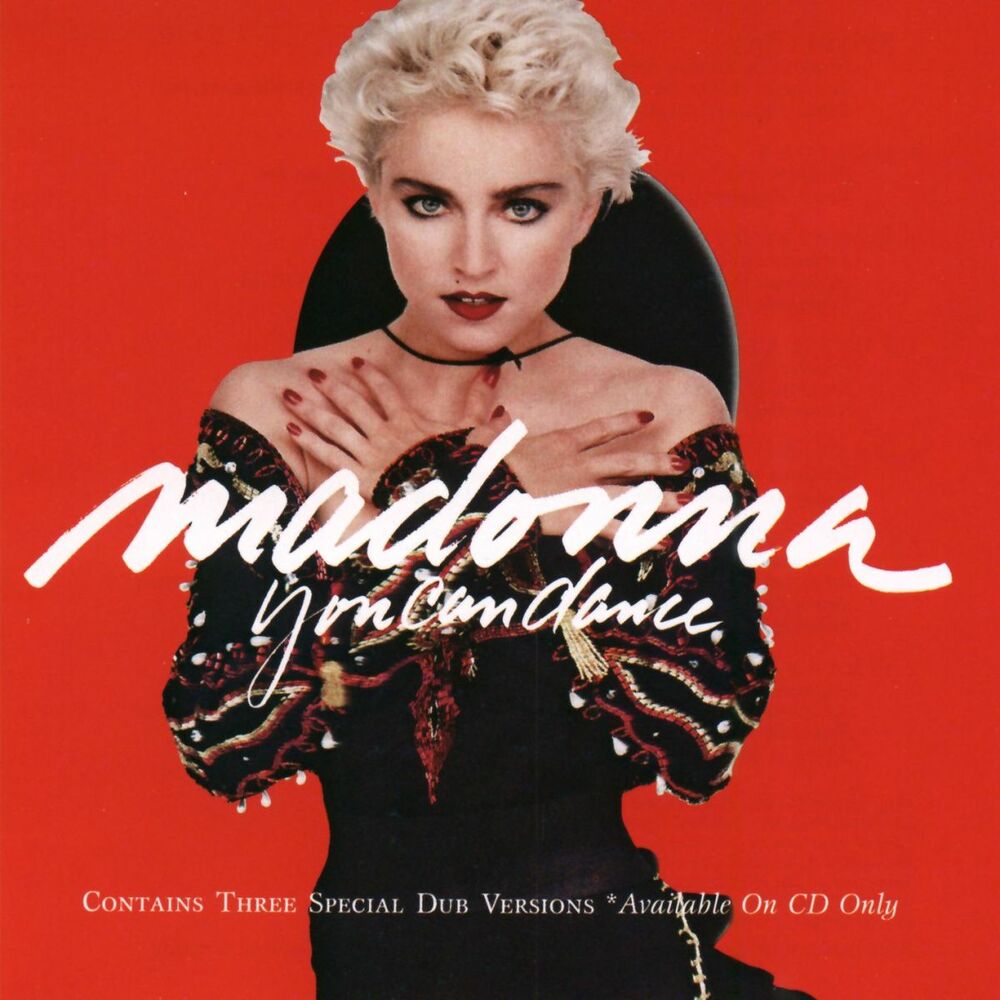
You Can Dance
- Released15 November 1987
- UK peak No. 5
- Weeks on UK chart 18
- Entered UK chart 22 November 1987
- LabelSire/Warner Records
- Tracks10 · 69 min
2 tracks from it charted as singles. Press a flag to play it in the chart where it peaked.
Tracks
| 1 | Spotlight | 6:23 | |
| 2 | 6:32 | ||
| 3 | Everybody | 6:43 | |
| 4 | Physical Attraction | 6:39 | |
| 5 | Over and Over (Extended Version) | 7:11 | |
| 6 | 8:26 | ||
| 7 | Where's the Party | 7:16 | |
| 8 | 6:56 | ||
| 9 | 6:23 | ||
| 10 | Where's the Party (Dub Version) | 6:21 |
About the album
You Can Dance is the first remix album by American singer and songwriter Madonna. It was released on November 16, 1987, in the UK and November 17, 1987, in the US by Sire Records. The album contains remixes of tracks from her first three studio albums—Madonna (1983), Like a Virgin (1984) and True Blue (1986)—and a new track, "Spotlight". In the 1980s, remixing was still a new concept. The mixes on You Can Dance exhibited a number of typical mixing techniques. Instrumental passages were lengthened to increase the time for dancing and vocal phrases were repeated and subjected to multiple echoes. The album cover denoted Madonna's continuous fascination with Hispanic culture.
After its release, You Can Dance received generally positive reviews from critics, some of whom noted how the already known songs appeared to them in a complete new structure, calling it an essential album to be played at parties. You Can Dance was a commercial success, earning a platinum certification from the Recording Industry Association of America (RIAA) for shipment of a million copies, and reaching the top twenty of the Billboard 200. It reached the top ten of the album charts of France, Japan, Netherlands, New Zealand, Norway and the United Kingdom.
Background
In October 1986, Sire Records announced that a 6-track EP called You Can Dance would be released a month or so before Christmas of that year, and would feature the new track "Spotlight" alongside remixes of five other previously released songs. However, the following month, the release was postponed, with Sire opting to continue promotion of Madonna's third studio album True Blue (1986). Billboard reported that the release was "still in the production stages" and that it would likely see a release in the spring of 1987. Billboard also confirmed which remixes would be featured on the release and added that a non-remixed song from Madonna (1983) would also be included, which was "likely" to be "Physical Attraction". The album was finally released in November 1987 by Warner Bros. Records and Sire Records.
You Can Dance was Madonna's first retrospective release and was aimed at the dance segment of her audience. By the mid-eighties, post-disco dance music was extremely popular and the concept of remix was widely regarded as a new direction of music.
Composition
According to Rikky Rooksby, author of The Complete Guide to the Music of Madonna, "Improvements in studio technology meant that possibilities for shaping the sound after it has been recorded are almost limitless." The mixes on You Can Dance exhibited a number of typical mixing techniques. Instrumental passages were lengthened to increase the time for dancing, which undermined the tighter structure of the original pop song. Vocal phrases were repeated and subjected to multiple echoes, panned across the stereophonic sound outlets. At certain points, almost no music is heard except the drums and at others, the drums are removed with only the hi-hat left to keep time. The first song on the album is "Spotlight" which begins with the sound of drums, bass synths and handclaps, followed by Madonna uttering the words "Spotlight, shine bright". After the first verse, the sound of keyboard is heard during the chorus. It continues like this through the second verse, which is followed by an interlude featuring vocal echoes, a piano segment and violin phrases.
Promotion
Compared to her previous releases, Madonna did not heavily promote You Can Dance. Radio-friendly edits of each song were issued promotionally on a release titled You Can Dance (Single Edits of Album Remixes). This release remained promotional-only until it received a commercial digital release in 2022. "Spotlight" was released as the album's only commercial single on April 25, 1988, exclusively in Japan. "Spotlight" peaked at number 68 on the Oricon weekly singles chart, remaining on the chart for five weeks. It also charted on the Oricon international singles chart, reaching a peak of three on May 19, 1988, staying on the chart for ten weeks.
"Spotlight" was not released as a commercial single in the United States, therefore it was not eligible at the time to appear on Billboard's Hot 100. However, it was released as a promotional single, paired with "Where's The Party". "Spotlight" managed to garner enough airplay to appear on the publication's Hot 100 Airplay chart in early 1988. It debuted on the chart at 37 on the issue dated January 16, 1988.
Critical reception
You Can Dance received generally positive reviews from music critics. In The Village Voice, Robert Christgau considered that "the effects, repeats, breaks, and segues added by a star crew of remixers [...] amount to new music—this time the songs don't surface, they reach out and grab you". He also argued that You Can Dance reminded the audience that before MTV, they "loved the way she sounded". Many reviewers described the compilation as a being a good fit for playing at parties. Author J. Randy Taraborrelli noted that "You Can Dance made one point clear about Madonna.
Commercial performance
In the United States, the album was released on November 18, 1987, and reached a peak of number 14 on the Billboard 200. The LP cuts debuted at number 41 on the Dance Music/Club Play chart, and moved up to number 17 the next week. The LP cuts ultimately topped the Dance chart, becoming Madonna's seventh number one entry. The album was certified Platinum by the Recording Industry Association of America (RIAA) for shipment of one million copies across the United States.
In Canada, the album debuted at number 55 on the RPM Albums Chart on December 5, 1987. After five weeks, it reached a peak of number 11 on the chart. It was present for a total of 21 weeks on the chart. In Australia, You Can Dance debuted at number 15 on the Kent Music Report albums chart, and peaked at number 13. It was certified platinum by the Australian Recording Industry Association (ARIA) for shipment of 70,000 copies of the album.
Legacy
Shortly after its release, Madonna was called "the most important dance artist" by a number of media outlets, and described by pan-European magazine Music & Media as "the world's most successful artist in bridging the dance and pop audiences".
Jon O'Brien from Billboard noted Madonna became "the first major pop artist" to release a hits collection with its extended 12" versions. You Can Dance is one of the first sets of remixes to be conceived as a full-length album. Matthew Rettenmund, author of Encyclopedia Madonnica (1995), complimented rather releasing a greatest-hits album, her first compilation was a "groundbreaking remix album". The entire concept of copying, repeating, pasting and playing was still in its "infancy" when Madonna released this project. Writing for Reader's Digest, Jon O'Brien stated "Madge was the first genuine superstar to realise the power of the DJ". Biographer David James commented that "Madonna broke fresh ground".