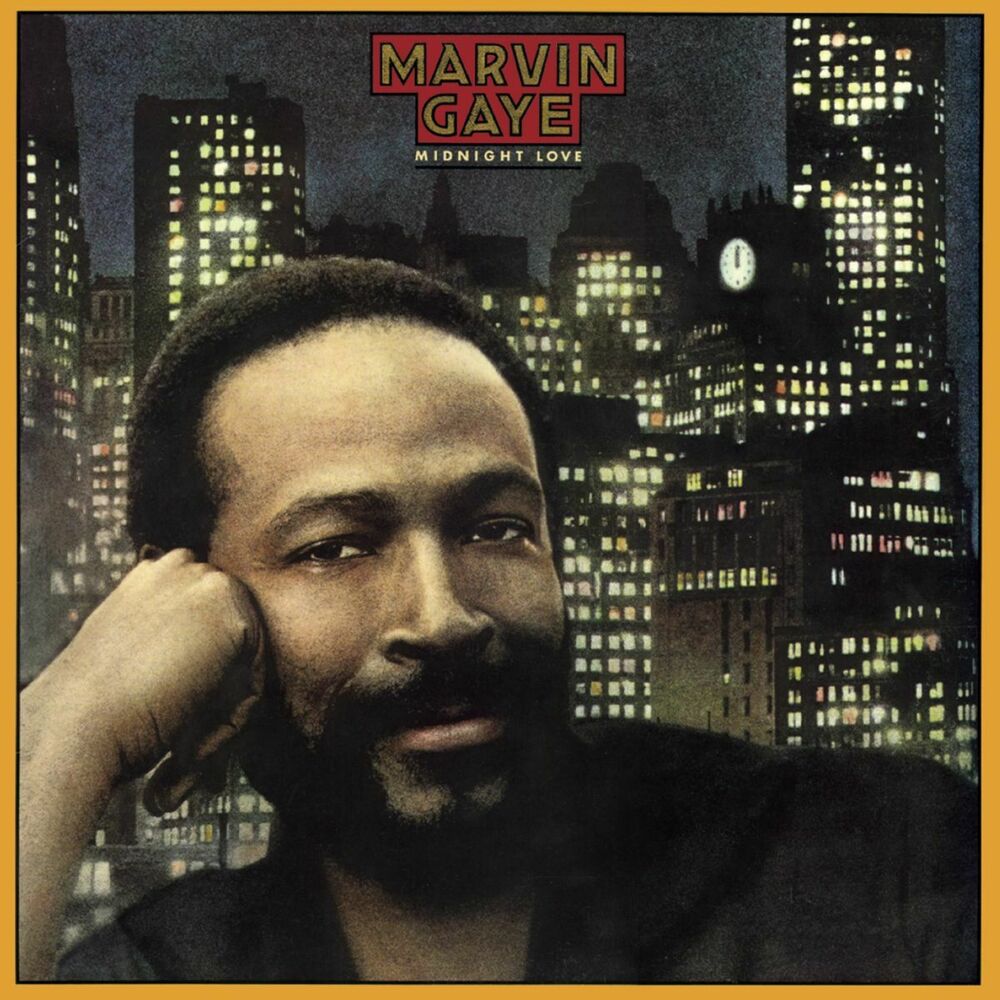
Midnight Love
- Released1 October 1982
- UK peak No. 10
- Weeks on UK chart 16
- Entered UK chart 14 November 1982
- LabelColumbia/Legacy
- Tracks9 · 47 min
2 tracks from it charted as singles. Press a flag to play it in the chart where it peaked.
Tracks
| 1 | Midnight Lady | 5:17 | |
| 2 | Sexual Healing No. 3 · 1983 | 3:59 | |
| 3 | Rockin' After Midnight | 6:04 | |
| 4 | 'Til Tomorrow | 4:58 | |
| 5 | Turn on Some Music | 5:08 | |
| 6 | Third World Girl | 4:36 | |
| 7 | Joy | 4:23 | |
| 8 | My Love Is Waiting No. 34 · 1983 | 5:07 | |
| 9 | Rockin' After Midnight (Instrumental) | 7:00 |
About the album
Midnight Love is the sixteenth studio album by American soul singer and songwriter Marvin Gaye and the final album to be released during his lifetime, released on November 8, 1982. He signed with the label Columbia in March 1982 following his exit from Motown.
The disc was certified triple platinum in the United States. It was an immediate international success selling over six million records worldwide. It was nominated for a 1984 Grammy for Best Male R&B Vocal Performance, spawning the two-time Grammy Award-winning hit "Sexual Healing". It was ranked number 37 on the Rolling Stone list of the best albums of the 1980s decade and the NME named the album as its Album of the Year in 1982.
Background
In January 1981, Gaye's final Motown album, In Our Lifetime, was released on Motown's Tamla label. Gaye was angry over its release and Motown's edit of the album, comparing it to an unfinished Picasso painting and having others finish the painting for him. Gaye vowed afterwards never to record for Motown again. The following month, a Belgian concert promoter and a longtime fan of Gaye's music, Freddy Cousaert, visited a visibly shaken and depressed Gaye, who was struggling with drug addiction, in London, following the end of a European tour. Concerned for Gaye's health and state, Cousaert offered Gaye a place in his pension in Ostend. Gaye, who was traveling with his younger brother Frankie and then-girlfriend, Dutch model Eugenie Vis, agreed to go on the trip, though he later admitted to Frankie that he did not know where Ostend was and that he "left that to the hands of God."
Gaye arrived at Ostend on February 14, 1981. Gaye cut down on his drug use while in Ostend and began exercising and attending the local church. He recovered well enough to begin talks of a musical comeback.
Recording
One of the first songs Gaye had worked on with musician Odell Brown was a reggae-influenced track that Gaye and Brown had recorded around October 1981. The then-Rolling Stone reviewer David Ritz had arrived to Belgium in April 1982 after he had been tipped off about where Gaye was. Despite Gaye's pleas to not meet up with him, Ritz eventually located Gaye in his Ostend apartment not too far from Cousaert's pension, where he and Gaye reluctantly continued their interviews that led to the 1985 book Divided Soul.
According to Ritz, he had seen several S&M comicbook-type publications on Gaye's bookshelf. Said to have been disgusted with this, Ritz told Gaye "you need some sexual healing". Ritz then alleged Gaye told him to write a poem.
When Cousaert was told of this story, he denied Ritz ever having anything to do with the song except for its title. Musicians Odell Brown and Gordon Banks also flatly denied Ritz's accounts, with Brown stating: "I never met the guy.
Composition
Midnight Love contains elements of funk, boogie, Caribbean music, reggae, new wave and synthpop, as well as older genres such as soul, R&B and doo-wop. The reason for these many genres was because, according to Banks, Gaye's music was "progressing" and that it was "changing and it had to change because he didn't want any more ties to Motown".
As Larkin Arnold later explained, "Marvin had been living in Europe, and was influenced by both reggae and the synthesizer work of groups like Kraftwerk" and that he "took the rhythm of reggae, the new technology and American soul and came up with something fresh and unique".
"Midnight Lady" starts off with assorted percussion, provided by Gaye and other musicians, before its beat is delivered by a drum machine and overdubbed handclaps provided by the singer, followed by keyboard riffs (also played by Gaye), guitar lines by Banks and a horn section. It is almost two minutes before Gaye began singing the song's first lines.
Critical reception
In his review of Midnight Love, Rolling Stone reviewer Dave Marsh called the album in terms of it being viewed as a comeback as "remarkably arrogant", stating "it simply picks up from 1973's Let's Get It On as if only ten minutes had elapsed since Gaye hit his commercial peak", though he did state the album was a successful comeback. After its rank on the magazine's list of best eighties albums, the album was described as "an inspired, mature work from one of the greatest soul singers, and is certainly one of the best solo albums of the eighties."
Village Voice critic Robert Christgau explained that the album's "concentration on the carnal is one reason it's his best ever". Mike Freedberg of The Boston Phoenix said "There's not a trace of old Motown in the best of Midnight Love, and more's the power." In its Picks and Pans Reviews, People cited "too long gone, the Soulful One shows he can still sizzle". At the 1984 Grammy Awards, the album was nominated for a Best Male R&B Vocal Performance Grammy, losing out to Michael Jackson's "Billie Jean".
Commercial performance
Midnight Love was released to record retail stores on November 8, 1982, in the US and on November 12 in the UK. In response to "Sexual Healing", the album was bought out in droves. By that December, the album had already hit No. 1 on the Top Black Albums chart and the Top 10 of the Pop albums chart, making it Gaye's eighth album to accomplish this. "Sexual Healing" crossed over to No. 3 on the Billboard Hot 100. By the end of 1982, it had already sold over a million copies.
Upon Gaye's return to the United States, Gaye attended a party in celebration of the album's accomplishment with a new polished look, reuniting with his ex- Anna Gordy Gaye and their son, Marvin III. Worldwide, the album also performed extremely well, hitting No. 1 in Canada and No. 7 in the United Kingdom. The album's biggest hit single, "Sexual Healing", sold over two million US copies and earned an RIAA Platinum certification. It hit the top of the charts in several countries and stayed at No. 1 on the Top Black Singles chart for ten consecutive weeks, making it the most successful R&B single of the 1980s.