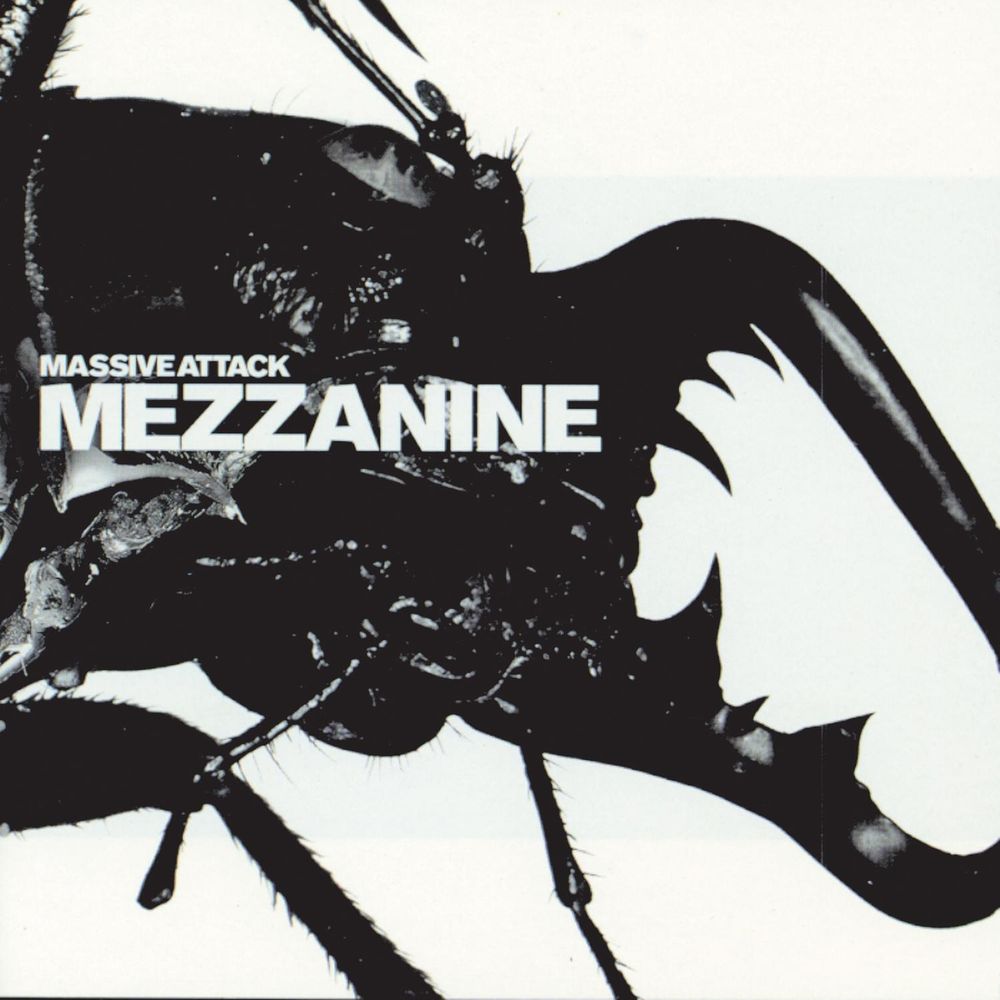
Mezzanine
- Released20 April 1998
- UK peak No. 1
- Weeks on UK chart 69
- Entered UK chart 26 April 1998
- LabelCirca
- Tracks11 · 63 min
3 tracks from it charted as singles. Press a flag to play it in the chart where it peaked.
Tracks
| 1 | Angel No. 30 · 1998 | 6:18 | |
| 2 | Risingson No. 11 · 1997 | 4:59 | |
| 3 | Teardrop No. 10 · 1998 | 5:27 | |
| 4 | Inertia Creeps | 5:56 | |
| 5 | Exchange | 4:11 | |
| 6 | Dissolved Girl | 6:07 | |
| 7 | Man Next Door | 5:55 | |
| 8 | Black Milk | 6:20 | |
| 9 | Mezzanine | 5:54 | |
| 10 | Group Four | 8:13 | |
| 11 | (Exchange) | 4:08 |
About the album
Mezzanine is the third studio album by English electronic music group Massive Attack, released on 20 April 1998 by Circa and Virgin Records. For the album, the group began to explore a darker aesthetic, and focused on a more atmospheric style influenced by British post-punk, industrial music, hip-hop and dub music. The album spawned four singles, "Risingson", "Teardrop", "Angel" and "Inertia Creeps". It was the group's first album not to feature rapper Adrian "Tricky" Thaws and the last to feature Andrew "Mushroom" Vowles. It also marked the first collaboration between Robert "3D" Del Naja and producer Neil Davidge. It also features guest vocals from recurring collaborator Horace Andy, as well as Elizabeth Fraser of Cocteau Twins and Sarah Jay Hawley.
Mezzanine received significant critical acclaim, with many praising the group’s darker sound. It has been named by several publications as one of the best albums of the 1990s and of all time. It is the group's most commercially successful album, topping the charts in the United Kingdom, Australia, Ireland, and New Zealand. It has sold more than 2.5 million copies worldwide.
Background and recording
Mezzanine was conceptualised by lead Massive Attack member Robert Del Naja in 1997, who wanted to focus on exploring a darker audiovisual aesthetic with distinct influences. The production of the album was a stressful process; with tensions arising, it led to disagreements that almost split the group, including discouragement from Andrew Vowles. As a demonstration of the project's sound, Del Naja initially produced instrumental demos sampling songs by British post-punk bands such as Wire and Gang of Four, who had been familiar to him as artists he had enjoyed as a teenager. Grant Marshall supported this direction as he wanted to depart from the "urban soul" of their previous album, Protection, but Vowles was sceptical.
The sessions continued with Vowles and Marshall working on bass and drum loops, while Del Naja continued to produce demos.
Composition
Mezzanine has been described as a trip hop and electronica album with moods of "dark claustrophobia" and melancholy. Musically, the album is a major departure from the jazzy and laidback sound of the first two albums, Blue Lines and Protection, invoking the dark undercurrents which had previously only been vaguely present in the group's music. The album's textured and deep tone relies heavily on abstract and ambient sounds, heavy emphasis on bass, and influences from alternative rock.
Similar to their previous albums, several songs use one or more samples, which range from artists typically sampled in trip hop such as Isaac Hayes and various drum breaks, to bands like the Cure and the Velvet Underground. In particular, "Inertia Creeps" samples Turkish çiftetelli music which Del Naja recorded after partying in Istanbul, with his recorded tape subsequently becoming the rhythmic base for the song. In 1998, Manfred Mann sued Massive Attack for unauthorised use of a sample of the song "Tribute" from Manfred Mann's Earth Band's eponymous 1972 album, used on "Black Milk".
Reception
Mezzanine entered the UK Albums Chart at number one, and was certified platinum by the British Phonographic Industry (BPI) on 4 September 1998 and then double platinum on 22 July 2013. However, it failed to share the same success in North America, peaking at number 60 on the Billboard 200 and number 51 on the Canadian Albums Chart.
The album received significant critical acclaim, which praised the collective's new sound. Rolling Stone's Barney Hoskyns, although praising the album, pointed to its flaws: "Sometimes rhythm and texture are explored at the expense of memorable tunes, and the absence of the bizarre Tricky [...] only highlights the flat, monotonous rapping of the group's 3-D." Robert Christgau of The Village Voice gave the album a two-star honorable mention rating and selected "Risingson" and "Man Next Door" as highlights.
John Bush of AllMusic had positive words for the album's song "Inertia Creeps", saying it "could well be the highlight, another feature for just the core threesome.
Artwork
Nick Knight – photography
Tom Hingston – art direction, design
Robert Del Naja – art direction, design