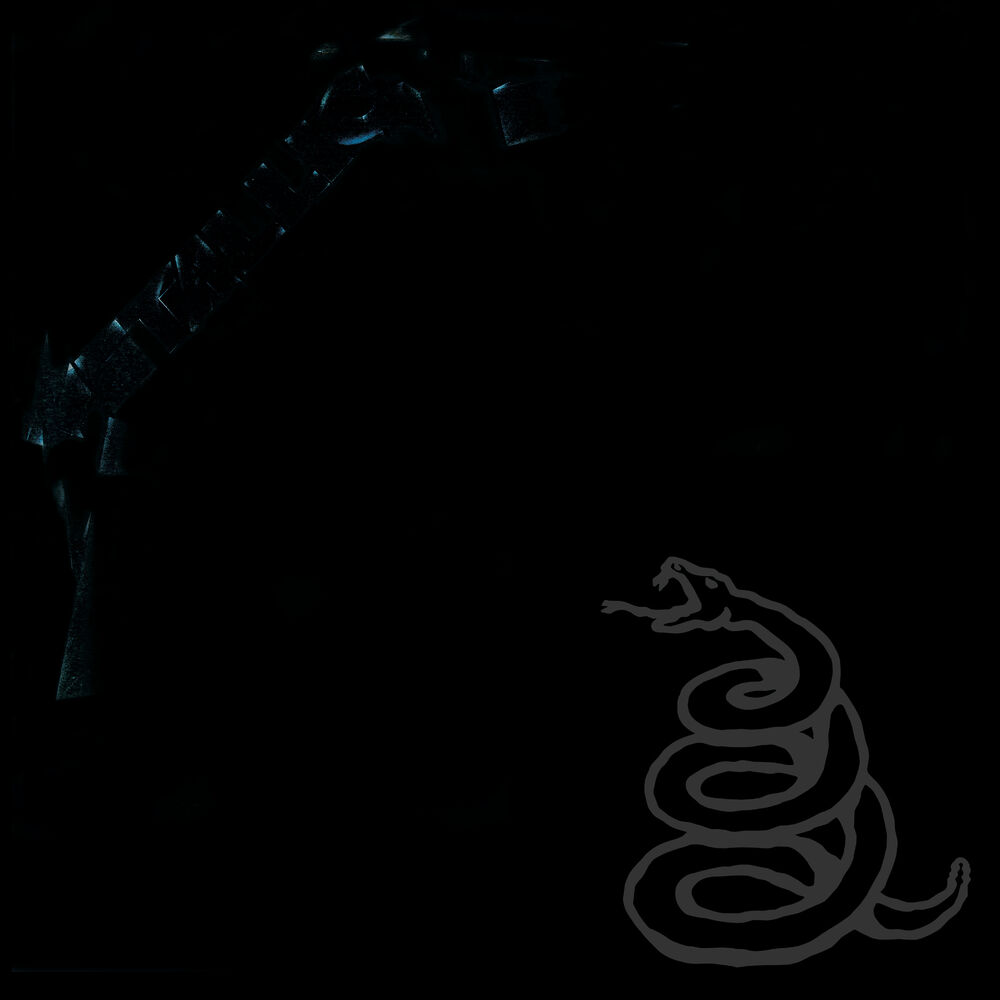
Metallica
- Released30 July 1991
- UK peak No. 1
- Weeks on UK chart 107
- Entered UK chart 18 August 1991
- LabelBlackened Recordings
- Tracks12 · 63 min
5 tracks from it charted as singles. Press a flag to play it in the chart where it peaked.
Tracks
| 1 | 5:31 | ||
| 2 | 5:24 | ||
| 3 | Holier Than Thou | 3:47 | |
| 4 | 6:27 | ||
| 5 | 6:44 | ||
| 6 | Don't Tread On Me | 4:00 | |
| 7 | Through The Never | 4:04 | |
| 8 | 6:28 | ||
| 9 | Of Wolf And Man | 4:16 | |
| 10 | The God That Failed | 5:08 | |
| 11 | My Friend Of Misery | 6:49 | |
| 12 | The Struggle Within | 3:53 |
About the album
Metallica (commonly known as The Black Album) is the fifth studio album by the American heavy metal band Metallica. It was released on August 12, 1991, by Elektra Records. Recording sessions took place at One on One Recording Studios in Los Angeles over an eight-month span that frequently found Metallica at odds with their new producer Bob Rock. The album marked a change in the band's music from the thrash metal style of their previous four albums to a slower, heavier, and more refined sound.
Metallica promoted Metallica with a series of tours. They also released five singles to promote the album: "Enter Sandman", "The Unforgiven", "Nothing Else Matters", "Wherever I May Roam", and "Sad but True", all of which have been considered to be among the band's best-known songs. The song "Don't Tread on Me" was also issued to rock radio shortly after the album's release but did not receive a commercial single release.
Metallica received widespread critical acclaim and became the band's best-selling album. It debuted at number one in ten countries and spent four consecutive weeks at the top of the Billboard 200, making it Metallica's first album to top the album charts. With over 30 million copies sold worldwide, Metallica is one of the best-selling albums of all time, and also one of the best-selling albums in the United States since Nielsen SoundScan tracking began.
Background and recording
At the time of Metallica's recording, the band's songs were written mainly by frontman James Hetfield and drummer Lars Ulrich, with Hetfield being the lyricist. The duo frequently composed together at Ulrich's house in Berkeley, California. Several song ideas and concepts were conceived by other members of the band, lead guitarist Kirk Hammett and bassist Jason Newsted. For instance, Newsted wrote the main riff of "My Friend of Misery", which was originally intended to be an instrumental, one of which had been included on every previous Metallica album. The songs were written in two months in mid-1990; the ideas for some of them were originated during the Damaged Justice Tour. Metallica was impressed with Bob Rock's production work on Mötley Crüe's Dr. Feelgood (1989) and decided to hire him to work on their album. Initially, the band members were not interested in having Rock producing the album as well, but changed their minds.
Composition and lyrics
The album was a change in Metallica's direction from the thrash metal style of the band's previous four studio albums towards a more commercial, heavy metal sound. Despite this, it still had characteristics of thrash metal. Some critics also described the album as hard rock and groove metal. The band took a simpler approach partly because the members felt the songs on ...And Justice for All were too long and complex. Hetfield said that radio airplay was not their intention, but because they felt "we had pretty much done the longer song format to death," and considered a good change doing songs with just two riffs and "only taking two minutes to get the point across". Ulrich added that the band was feeling a musical insecurity — "We felt inadequate as musicians and as songwriters. That made us go too far, around Master of Puppets and Justice, in the direction of trying to prove ourselves.
Packaging
Metallica had many discussions about the album title. The original working title was called Married to Metal as a result of Hammett, Ulrich and Newsted's divorces, but was downplayed as a "running joke", according to Ulrich. Other names considered were Five and the title of one of the songs, but eventually chose an eponym because they "wanted to keep it simple." The album's cover depicts the band's logo angled against the upper left corner and a coiled snake derived from the Gadsden flag in the bottom right corner. For the initial release, both emblems were embossed so they could barely be seen against the black background, giving Metallica the nickname "The Black Album". These emblems also appear on the back cover of the album. For later and current releases, both emblems are dark gray so they stand out more prominently. The motto of the Gadsden flag, "Don't Tread on Me", is also the title of a song on the album. A folded, pageless booklet depicts the faces of the band's members against a black background.
Marketing and sales
"Enter Sandman" was released as Metallica's lead single on July 29, 1991; it reached number 16 on the Billboard Hot 100 singles chart and was certified Platinum by the Recording Industry Association of America (RIAA). The follow-up single, "Don't Tread on Me", was released promotionally but did not chart. The subsequent single, "The Unforgiven", was a Top 40 hit; it peaked in the Top 10 in Australia.
Metallica was released on August 12, 1991, and was the band's first album to debut at number one on the Billboard 200, selling 598,000 copies in its first week. It was certified platinum in two weeks and spent four consecutive weeks atop the Billboard 200. Meanwhile, more singles were released to further success. "Nothing Else Matters" reached number six in the United Kingdom and Ireland, and "Wherever I May Roam" peaked at number two on the Hot Mainstream Rock Tracks singles chart, although the 1993 single "Sad but True" charted only for one week on the Billboard Hot 100 at 98.
Critical reception
Metallica was met with widespread acclaim from both heavy metal journalists and mainstream publications, including NME, The New York Times, and The Village Voice. In Entertainment Weekly, David Browne called it "rock's preeminent speed-metal cyclone", and said, "Metallica may have invented a new genre: progressive thrash". Q magazine's Mark Cooper said he found the album's avoidance of metal's typically clumsy metaphors and glossy production refreshing; he said, "Metallica manage to rekindle the kind of intensity that fired the likes of Black Sabbath before metal fell in love with its own cliches". Select magazine's David Cavanagh believed the album lacks artifice and is "disarmingly genuine". In his review for Spin, Alec Foege found the music's harmonies vividly performed and said that Metallica showcase their "newfound versatility" on songs such as "The Unforgiven" and "Holier than Thou".