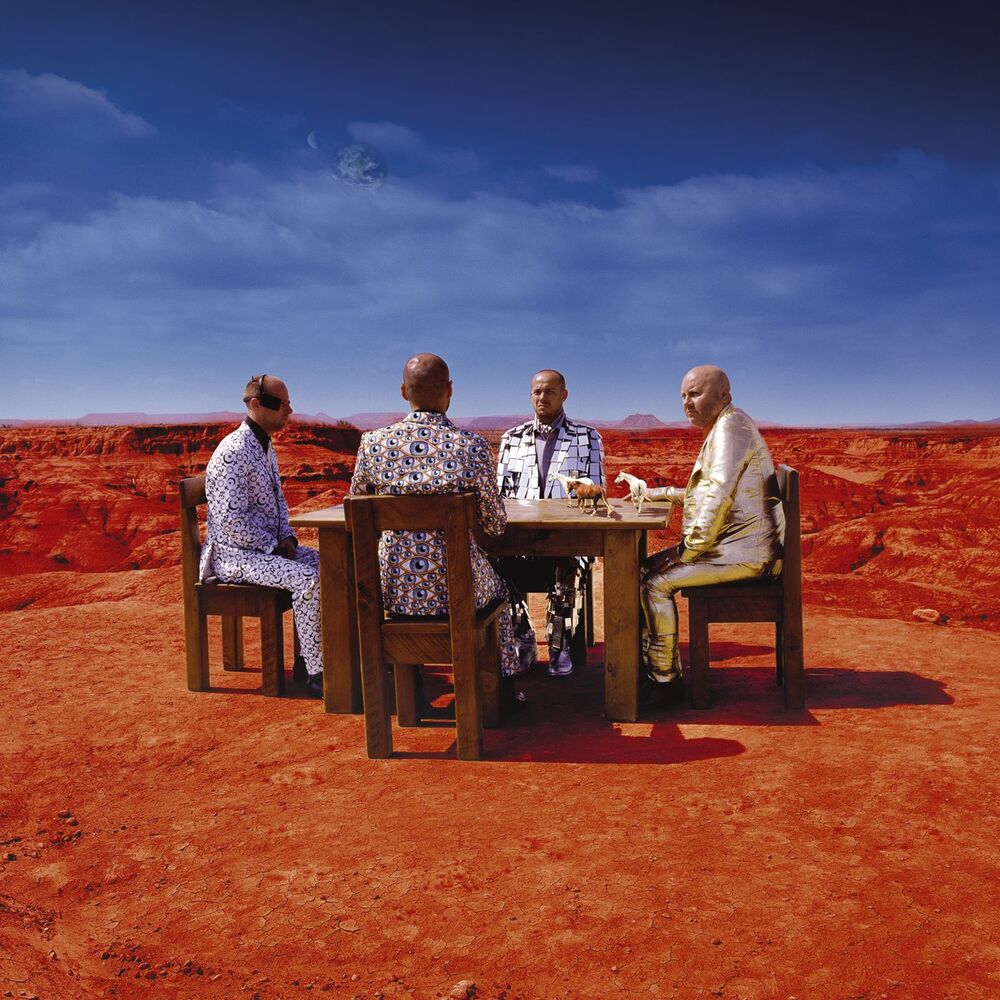
Black Holes and Revelations
- Released19 June 2006
- UK peak No. 1
- Weeks on UK chart 96
- Entered UK chart 9 July 2006
- LabelWarner Records
- Tracks12 · 50 min
5 tracks from it charted as singles. Press a flag to play it in the chart where it peaked.
Tracks
| 1 | Take a Bow | 4:35 | |
| 2 | Starlight No. 13 · 2006 | 4:03 | |
| 3 | Supermassive Black Hole No. 4 · 2006 | 3:32 | |
| 4 | Map of the Problematique No. 18 · 2007 | 4:18 | |
| 5 | Soldier's Poem | 2:04 | |
| 6 | Invincible No. 21 · 2007 | 5:00 | |
| 7 | Assassin | 3:31 | |
| 8 | Exo-Politics | 3:53 | |
| 9 | City of Delusion | 4:48 | |
| 10 | Hoodoo | 3:43 | |
| 11 | Knights of Cydonia No. 10 · 2006 | 6:07 | |
| 12 | Glorious | 4:41 |
About the album
Black Holes and Revelations is the fourth studio album by the English rock band Muse. It was released on 3 July 2006 through Warner Bros. Records and Helium-3. It was produced by Rich Costey over four months in London, Milan, New York City, and southern France.
The album saw a change in style for Muse, with influences including Depeche Mode, Millionaire, Lightning Bolt, Sly and the Family Stone, and music from southern Italy. Like their previous albums, it features political and dystopian themes, with lyrics covering topics such as political corruption, alien invasion, revolution and New World Order conspiracies, as well as more conventional love songs.
Black Holes and Revelations entered the charts at number one in five countries, including the UK, and in the top 10 in several other countries, including the US. It was certified quadruple platinum in the UK and platinum in the US. "Supermassive Black Hole" and "Knights of Cydonia" entered the top 10 of the UK singles chart, while "Starlight", "Map of the Problematique" and "Invincible" reached the top 25. As of 2018, Black Holes and Revelations had sold more than 4.5 million copies worldwide.
Black Holes and Revelations received positive reviews and appeared on several lists of the year's best albums. It was nominated for the Mercury Prize and appeared in the 2007 version of 1001 Albums You Must Hear Before You Die.
Recording
Muse's third album, Absolution (2003), brought them mainstream exposure in the United States. Muse spent about two weeks writing and rehearsing for their next album at Studio Miraval, an old château in southern France. The producer Rich Costey, who had also worked on Absolution, joined them two weeks later.
The songwriter, Matt Bellamy, said Muse wanted to be free from distractions so that they could focus and be absorb different influences. The bassist, Chris Wolstenholme, said writing and recording was more relaxed than previous albums, as the band had no deadline. The group wanted to create a more personal album than Absolution. However, progress was slow and they had difficulty deciding which songs to work on. The group moved to New York City, where Bellamy spent time in clubs and learnt to DJ, influencing the dance elements of "Supermassive Black Hole" and "Map of the Problematique".
Bellamy used guitar amps including a Vox AC30 and a Ampeg V4. Muse took a more active role in using studio technology, having previously left its use to engineers.
Music
On "Take a Bow", Muse wanted to blend classical, electronic and rock music. It opens with string arpeggios inspired by Philip Glass, backed by a Moog synthesiser. The "Map of the Problematique" riff was written on keyboard; at Costey's encouragement, Bellamy recreated it on guitar by splitting the guitar signal into three audio signals, which were processed with pitch shifters and synthesisers. "Assassin", influenced by the noise rock band Lightning Bolt, began as a long progressive rock song with a "huge" piano break before Muse trimmed it. "Supermassive Black Hole", a mixture of dance beats and guitar, was influenced by Bellamy's visits to clubs in New York City and the Belgian band Millionaire. Critics likened it to Prince.
Muse recorded the "Starlight" melody using two pianos at different octaves and layered samples of prepared piano. "Soldier's Poem" was written for Absolution, but rewritten with new lyrics and an arrangement inspired by "Can't Help Falling in Love" by Elvis Presley.
Themes
"Take a Bow" is an "attack on an all but unnamed political leader", incorporating lyrics such as "you corrupt / and bring corruption to all that you touch". These themes are carried in the tracks "Exo-Politics" and "Assassin". Bellamy said "Exo-Politics" describes an “orchestrated alien invasion for the purpose of increasing military budgets and building space weapons”, while "Soldier's Poem" is sung from the perspective of someone realising they are being used.
The themes involve such as the "New World Order conspiracy, unjustifiable war, abusive power, conspiratorial manipulation and populist revolt", and was influenced by the conspiracy theories. Bellamy said he finds "the unknown in general a stimulating area for the imagination", and this interest is reflected throughout the album, which features rebellious paranoia (particularly during "Assassin"). The album also includes more emotional themes, including regret, ambition, and love.
The title is taken from the "Starlight" lyrics.
Artwork
The album artwork was photographed in Bardenas, Spain, and designed by Storm Thorgerson. The motif was inspired by the "galloping" of "Knights of Cydonia" and "Invincible", an allusion to the Four Horsemen of the Apocalypse.
Release
On May 13, Muse performed at BBC Radio 1's Big Weekend in Dundee, Scotland, and performed "Supermassive Black Hole", "Starlight" and "Knights of Cydonia". "Supermassive Black Hole" was released as the lead single on June 19, 2006, and reached number four on the UK singles chart. It was followed by "Starlight", "Knights of Cydonia", "Invincible" and "Map of the Problematique". The album stayed at number one for two weeks on the UK Albums Chart, producing Muse's largest sales up to that point.
The first US single was "Knights of Cydonia", on 13 June 2006, which reached number 10 on the Billboard Modern Rock Tracks chart. It was followed by "Starlight" and "Supermassive Black Hole". "Starlight" was Muse's most popular single in the US at that point, reaching number two on the Modern Rock Tracks chart. The album debuted at number nine on the Billboard 200, making it Muse's first top-ten entry in the US.
Black Holes and Revelations was released on 3 July 2006 in the UK, followed by releases in the US, Australia, Taiwan and Japan.
Accolades
Black Holes and Revelations was nominated for the 2006 Mercury Prize, and listed in the updated 2008 edition of 1001 Albums You Must Hear Before You Die. It was named the year's second-best album by Q and third-best by NME. Classic Rock named it one of the ten essential progressive rock albums of the decade, and voted the 34th-best album of all time by readers of Q in 2006.
In 2011, NME named "Supermassive Black Hole" the 74th-best song of the preceding 15 years and "Knights of Cydonia" the 44th-best. On 26 January 2008, "Knights of Cydonia" was announced as the number-one song on Australia's 2007 Triple J Hottest 100. It was also ranked No. 18 in the Triple J Hottest 100 of All Time, 2009. It was also ranked No. 53 on Rhapsody's list of the Top 100 Tracks of the Decade.