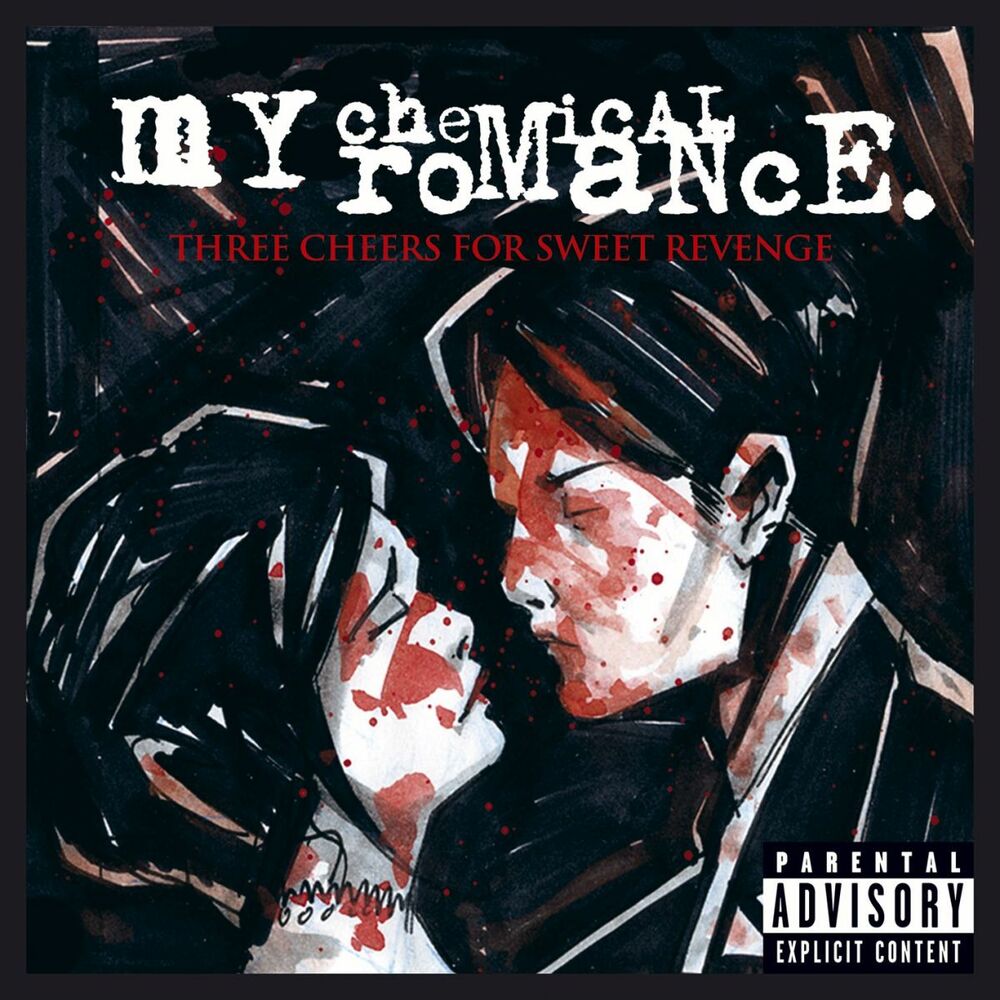
Three Cheers for Sweet Revenge
- Released8 June 2004
- UK peak No. 9
- Weeks on UK chart 41
- Entered UK chart 12 September 2004
- LabelReprise
- Tracks13 · 40 min
4 tracks from it charted as singles. Press a flag to play it in the chart where it peaked.
Tracks
| 1 | 3:24 | ||
| 2 | Give 'Em Hell, Kid | 2:18 | |
| 3 | To the End | 3:01 | |
| 4 | You Know What They Do to Guys Like Us in Prison | 2:53 | |
| 5 | 3:08 | ||
| 6 | 3:14 | ||
| 7 | The Jetset Life Is Gonna Kill You | 3:37 | |
| 8 | Interlude | 0:57 | |
| 9 | Thank You for the Venom No. 71 · 2004 | 3:41 | |
| 10 | Hang 'Em High | 2:47 | |
| 11 | It's Not a Fashion Statement, It's a Deathwish | 3:30 | |
| 12 | Cemetery Drive | 3:08 | |
| 13 | I Never Told You What I Do for a Living | 3:52 |
About the album
Three Cheers for Sweet Revenge (also shortened to Three Cheers or Revenge) is the second studio album by the American rock band My Chemical Romance, released on June 8, 2004, by Reprise Records. The album was produced by Howard Benson, and was written and recorded from late 2003 to March 2004. Writing sessions were highly influenced by the mental health and personal lives of the band members, particularly the death of Gerard and Mikey Way's grandmother.
Three Cheers has been characterized as multiple genres: emo, alternative rock, pop-punk, post-hardcore, punk rock, and pop rock. The album featured an extended production period, which marked a shift from the band's preceding release, I Brought You My Bullets, You Brought Me Your Love (2002). The style of tracks on the album range from punk rock and pop-structured tracks, while its central themes include love, loss, and revenge, while some songs also explore gender identity and sexuality. Revenge follows a loose narrative that serves as a continuation of "Demolition Lovers" from Bullets; following the titular characters deaths, they are separated between heaven and hell, only able to re-unite should the male lover harvest the souls of a thousand men.
The album received positive reviews from critics upon release for its brevity and polished sound.
Background
My Chemical Romance released their debut studio album I Brought You My Bullets, You Brought Me Your Love in July 2002 through Eyeball Records. While moderately successful, its success was limited by the band's small fan base at the time. Their popularity grew as the band continued promoting the album by opening for more popular bands, and they began to receive offers from several record labels. Among them was Reprise, a subsidiary of Warner Records. After several meetings with Craig Aaronson, a representative of Reprise, they signed a deal with the label in August 2003.
They began writing material for their second album while touring in late 2003, still supporting Bullets. By the time that touring had concluded in November, they had already created a good amount of songs from the album. One day after the band's touring concluded, the grandmother of lead singer Gerard Way and bassist Mikey Way, Elena, died. The two brothers were heavily impacted by her death, with Gerard Way being left frustrated with himself over not being able to see her one last time.
Production, writing, and recording
Following another shorter tour throughout the United Kingdom in early 2004, the band traveled to Los Angeles to start work on their second studio album. The impact that the death of Elena left was still being felt by the brothers at this point, who believed that working on new material was one of the only places where they felt peace. The band got into contact with Warner in search of a producer and ultimately chose Howard Benson; the band submitted a demo of songs from Revenge to him shortly afterwards. The sound of the demo was highly influenced by "Headfirst for Halos", a "flamboyant" song from Bullets. Though Benson initially expressed disapproval, he wished to work with the band further. He ultimately asked if the band was willing to "piss off [their] current fans" to create the best album that they could.
Pre-production for Revenge took three weeks. This was longer than the full recording and production process of Bullets, which took only one week.
Composition
Three Cheers for Sweet Revenge has been described as emo, alternative rock, pop-punk, post-hardcore, punk rock, and pop rock. The album's sound is more refined than its predecessor Bullets, which Ed Walton of Distorted Sound Magazine considered rough and unpolished. Aliya Chaudhry of Stereogum described Revenge's sound as a fusion of Toro's metal-influenced style and Iero's punk-influenced style. She also described the album's pacing as "controlled chaos", and that when it seemed like a song was about to go in a specific direction, it did the opposite.
The style of the tracks on Revenge vary. "Give 'Em Hell, Kid", "To the End", and "Thank You for the Venom" take heavier, punk-inspired approaches. Meanwhile, songs like "I'm Not Okay (I Promise)" and "Helena" are more aligned with traditional pop music. Other genre influences on specific songs include western music-influenced sound of "Hang 'Em High"; the arena rock and gothic rock sound on the power ballad "The Ghost of You"; and the glam rock inspired guitar solos on "Thank You for the Venom".
Lyrics and themes
Revenge's central themes include love, loss, and revenge. The meanings of several songs are deeply rooted into the personal lives of the band's members, particularly the Way brothers following the death of their grandmother. Gerard Way said that "every single emotion you go through when you're grieving is on Revenge", and that "when you really break down the record, it's about two little boys losing their grandmother". Themes of coping with loss appear on songs such as "Helena", "To the End", and "Cemetery Drive". "The Ghost of You" reflects on similar themes, while also touching on the impact of war. Resurrection is referenced on "It's Not a Fashion Statement, It's a Fucking Death Wish". The final track on the album, "I Never Told You What I Do for a Living", circles back to these themes with the final acceptance of death. Other personal themes, such as exploring one's gender identity or sexuality, also appear on several songs.
Release and promotion
Three Cheers for Sweet Revenge was released on June 8, 2004. The Japanese version of Three Cheers features a demo of the scrapped album track "Bury Me in Black" as a bonus. The band held a launch party for the album on July 11 at the Starland Ballroom, which 2,500 people attended. Two promotional flash games were made by the band to promote the album: "Revenge", where players would play as a saint traversing through a cathedral in order to save the Demolition Lovers, and "Helena", which put players in the role of a titular character at their funeral while they attempt to come back to life and escape their own grave.
Shortly after the release of Three Cheers for Sweet Revenge, My Chemical Romance kicked out their then-drummer Matt Pelissier, believing that he was unreliable when it came to live performances. He was replaced by Bob Bryar in less than a week. Bryar would go on to appear on most of the associated music videos for Three Cheers for Sweet Revenge.