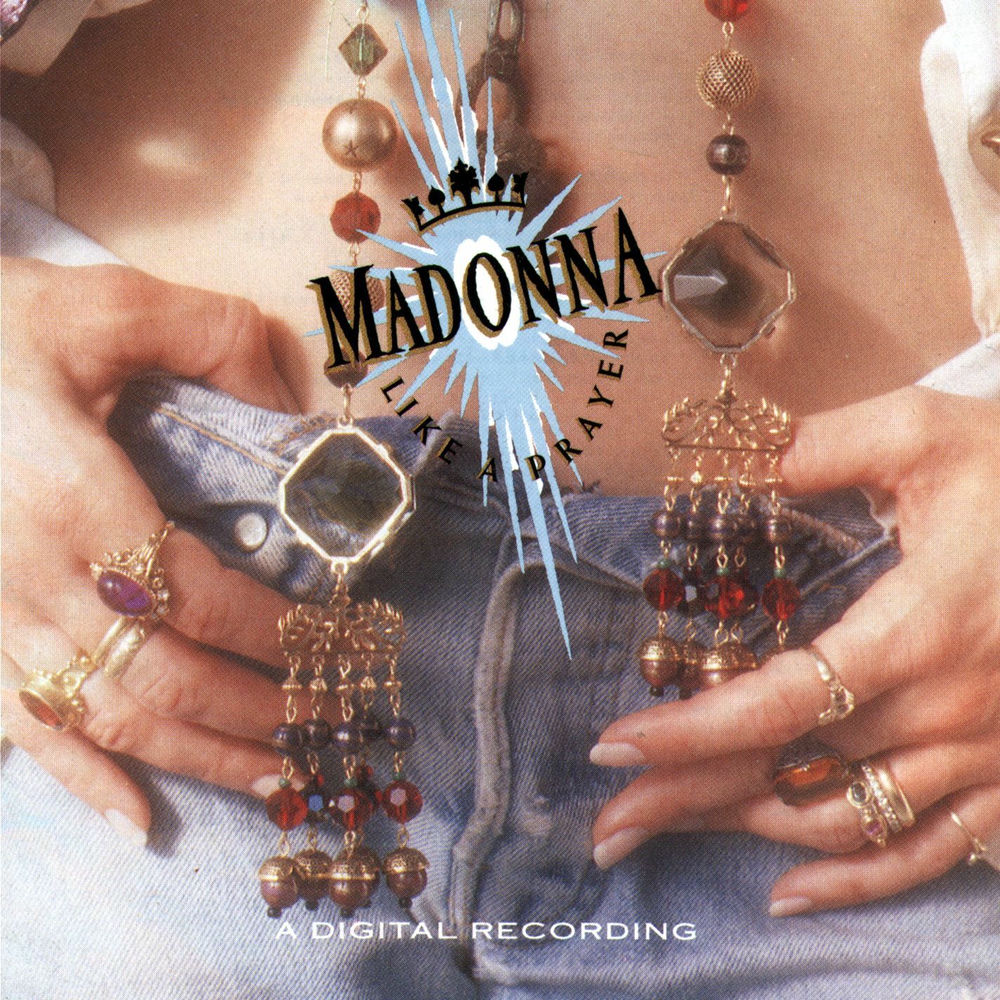
Like a Prayer
- Released17 March 1989
- UK peak No. 1
- Weeks on UK chart 73
- Entered UK chart 26 March 1989
- LabelSire/Warner Records
- Tracks11 · 51 min
6 tracks from it charted as singles. Press a flag to play it in the chart where it peaked.
Tracks
| 1 | 5:40 | ||
| 2 | 4:39 | ||
| 3 | Love Song | 4:52 | |
| 4 | Till Death Do Us Part | 5:18 | |
| 5 | Promise to Try | 3:38 | |
| 6 | 5:03 | ||
| 7 | Dear Jessie No. 5 · 1989 | 4:21 | |
| 8 | 4:58 | ||
| 9 | Keep It Together No. 8 · 1990 | 5:03 | |
| 10 | Spanish Eyes | 5:17 | |
| 11 | Act of Contrition | 2:19 |
About the album
Like a Prayer is the fourth studio album by American singer and songwriter Madonna. It was released on March 20, 1989, by Sire Records. It saw Madonna continue to work with the producers Patrick Leonard and Stephen Bray, with whom she had collaborated on her previous album True Blue (1986), and the soundtrack for the 1987 film Who's That Girl. The musician Prince also collaborated on the record, co-writing and co-producing one of the tracks alongside Madonna. Her most introspective release at the time, Like a Prayer is a pop record with elements of rock and dance-pop. Its lyrics deal with personal themes she had been too afraid to approach on previous albums: her Catholic upbringing, her troubled marriage to actor Sean Penn, the death of her mother, and her relationship with her father.
Upon its release, Like a Prayer received universal acclaim from music critics, who praised its introspective tone, cohesiveness, and Madonna's increased artistic maturity. Commercially, it was an international success, reaching the top of the charts in 20 countries. Certified quadruple platinum by the Recording Industry Association of America, Like a Prayer has sold over five million copies in the US and 15 million copies worldwide.
Background
1988 was a quiet year on the recording front for Madonna. Following the lack of critical and commercial success of her 1987 film Who's That Girl, she acted in the Broadway production Speed-the-Plow. However, unfavorable reviews once again caused her discomfort. Her marriage to actor Sean Penn ended and the couple filed for divorce in January 1989. Madonna had also turned 30, the same age at which her mother had died, and thus experienced more emotional turmoil. "I wouldn't say [turning 30] was traumatic [...] [but] [it] was the age my mother was [when she died]. I just flipped because I kept thinking, 'I'm now outliving my mother'", she recalled.
As the new decade was approaching, the "greed is good" mentality of the mid-1980s was starting to fade away because of Black Monday.
Recording
Recording took place at Los Angeles' Johnny Yuma, Saturn Sound and Ocean Way Recording studios, and Prince's Paisley Park, from September 1988 to January 1989. As it was an album with "so bleak an outlook", sessions were generally very focused; they took place mainly at Johnny Yuma, the studio Madonna and Leonard built with the income from True Blue. According to author Lucy O'Brien, Madonna was a "new woman in the studio"; she had clear knowledge not only of the instrumentation, but knew how to articulate and achieve the sounds she heard in her head. Leonard recalled that Madonna usually worked fast, but due to its emotional tone, it took her "maybe three or four times as long to make [Like a Prayer] because she kept breaking down". As it was the second time she produced an album, Madonna felt she had to "prove to everyone [it] wasn't a fluke", and would get into fights with Leonard.
Composition
Like a Prayer is an album that bends "classic psychedelic rock with then-current synth-pop sounds". It has been described as a pop record with rock and dance elements, with influence from acts from the 1960s and 70s such as the Beatles, Simon & Garfunkel, and Sly and the Family Stone. As Madonna's most personal and introspective album up to that point, its lyrics address, in her own words, "the influence of Catholicism on my life, and the passion it provokes in me [...] They're about an assimilation of experiences I had in my life and in relationships. They're about my mother, my father, and bonds with my family, about the pain of dying, of growing up and letting go".
Opener "Like a Prayer" is a song about a young woman "so in love with God that it is almost as though he were the male figure in her life". It is a pop rock song with elements of gospel music; a choir provides background vocals that heighten the song's spiritual nature, and a rock guitar keeps the music "dark and mysterious".
Artwork and release
For Like a Prayer, Madonna adopted a new image; she dyed her blonde hair dark, wore well-worn jeans, multiple rings on her fingers, garnet-encrusted crucifixes, a string of colored beads and glass gems around her neck. This new look was described as "very sixties" and a "cross between [a] gypsy and [a] hippie" by Mark Bego and Adam Sexton, respectively. It was Madonna's first studio album not to feature her face on the front cover. Shot by Herb Ritts, it depicts a close-up of the singer's crotch and hands; the first two buttons of her fly are undone and her fingers, adorned with rings and beads, hold down the top of her jeans. According to O'Brien, the cover was inspired by Madonna's mother, who used to cover up her Sacred Heart statue with zip-up jeans each time a woman came to visit.
Critics have compared the artwork to that of Sticky Fingers (1971) by the Rolling Stones, which shows a close-up of a male model's crotch, and Born in the U.S.A. (1984) by Bruce Springsteen.
Promotion
To market the album, WEA spent over $2 million, its most expensive campaign up to that point. Promotional items included different-sized posters of the cover and the photograph of Madonna used on the inner sleeve, and badges depicting the logo. Three days before the official release, custom-made press kits with a promotional pre-release CD were sent to the media. A patchouli-scented photograph of Madonna's bare midriff with the slogans "It Shall Be Released" and "Lead Us Into Temptation" was featured in a spread in Billboard magazine. In August 1989, to promote Like a Prayer in Japan, Warner Music released an extended play titled Remixed Prayers, which included several remixes of "Like a Prayer" and "Express Yourself"; it peaked at number 24 on the Oricon chart. The EP was exclusively for Japan until December 1993, when it was released in Australia to coincide with Madonna's visit to the country with the Girlie Show concert tour. Remixed Prayers reached number 92 on the ARIA Albums Chart, where it remained for three weeks.
Singles
The title track "Like a Prayer" was released as lead single on March 3, 1989. Acclaimed by music critics, who deemed it one of Madonna's best, it became her seventh number-one single on the US Billboard Hot 100, remaining there for three consecutive weeks. It was a global success, reaching number one in Canada, Australia, Belgium, Denmark, Spain, Finland, Iceland, Ireland, Italy, Japan, Netherlands, Norway, New Zealand, Poland, Portugal, United Kingdom, Sweden and Switzerland. The accompanying music video, directed by Mary Lambert, sees Madonna with stigmata on her palms, dancing in front of burning crucifixes and praying to a crying statue of a black saint, who comes to life and seduces her. The Vatican condemned the visual, while family and religious groups protested against its broadcast.
Released on May 9, second single "Express Yourself" received positive reviews from critics, who applauded its gender equality message and deemed it a hymn to freedom and encouragement to women and oppressed minorities.