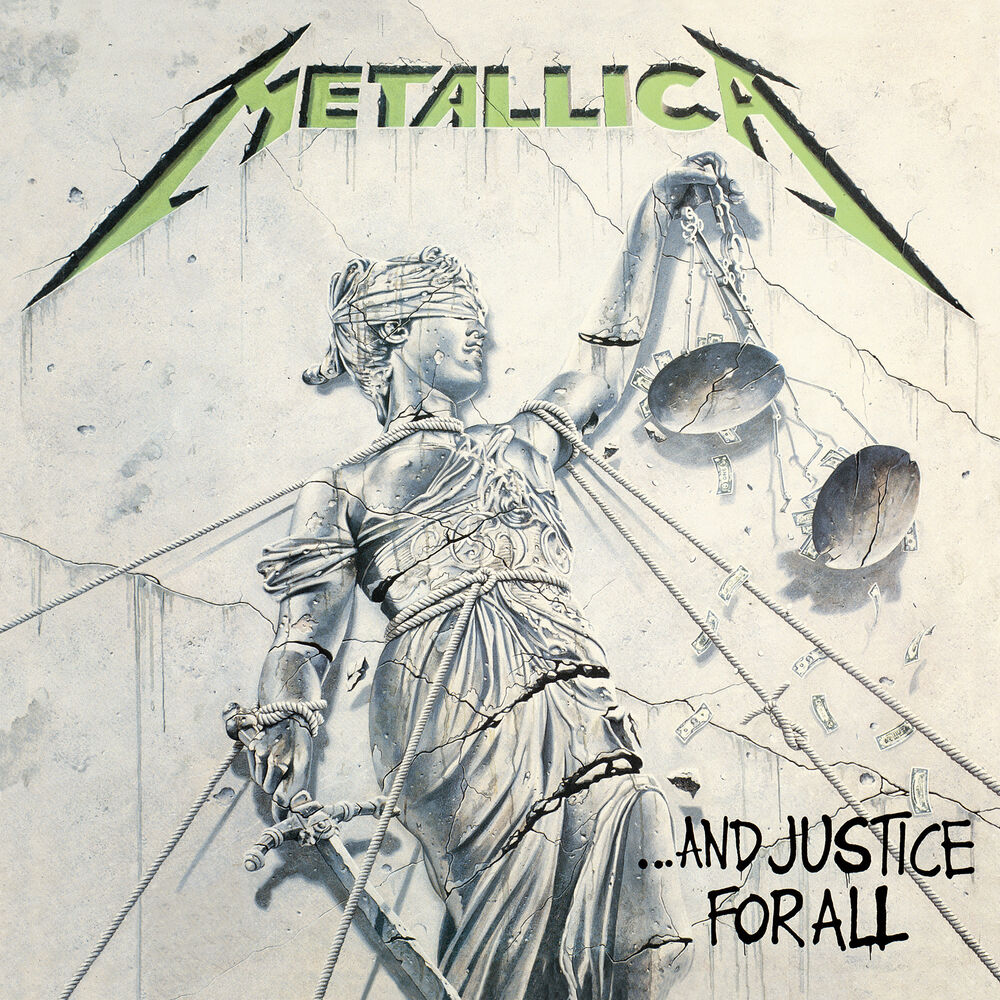
...And Justice for All (Remastered Deluxe Box Set)
- Released2 November 2018
- UK peak No. 4
- Weeks on UK chart 7
- Entered UK chart 11 September 1988
- LabelBlackened Recordings
- Tracks25 · 180 min
3 tracks from it charted as singles. Press a flag to play it in the chart where it peaked.
Tracks
| 1 | Blackened (Remastered) | 6:42 | |
| 2 | ...And Justice for All (Remastered) | 9:45 | |
| 3 | Eye of the Beholder (Remastered) | 6:25 | |
| 4 | 7:26 | ||
| 5 | The Shortest Straw (Remastered) | 6:35 | |
| 6 | Harvester of Sorrow (Remastered) No. 20 · 1988 | 5:45 | |
| 7 | The Frayed Ends of Sanity (Remastered) | 7:43 | |
| 8 | To Live Is to Die (Remastered) | 9:48 | |
| 9 | Dyers Eve (Remastered) | 5:13 | |
| 10 | The Ecstasy of Gold (Ennio Morricone) | 1:58 | |
| 11 | Blackened (Live - Seattle '89) | 6:37 | |
| 12 | For Whom the Bell Tolls (Live - Seattle '89) | 5:30 | |
| 13 | Welcome Home (Sanitarium) (Live - Seattle '89) | 6:46 | |
| 14 | Harvester of Sorrow (Live - Seattle '89) No. 20 · 1988 | 6:10 | |
| 15 | The Four Horsemen (Live - Seattle '89) | 6:00 | |
| 16 | The Thing That Should Not Be (Live - Seattle '89) | 7:08 | |
| 17 | Bass Solo (Live - Seattle '89) | 7:30 | |
| 18 | 8:50 | ||
| 19 | Fade to Black (Live - Seattle '89) | 8:10 | |
| 20 | Seek & Destroy (Live - Seattle '89) | 9:01 | |
| 21 | ...And Justice for All (Live - Seattle '89) | 11:00 | |
| 22 | 9:27 | ||
| 23 | Creeping Death (Live - Seattle '89) | 7:50 | |
| 24 | Guitar Solo (Live - Seattle '89) | 6:36 | |
| 25 | Battery (Live - Seattle '89) | 6:17 |
About the album
...And Justice for All is the fourth studio album by the American heavy metal band Metallica, released on September 7, 1988, by Elektra Records. It was Metallica's first full-length studio album to feature bassist Jason Newsted following the death of Cliff Burton in 1986. Burton received posthumous co-writing credit on "To Live Is to Die".
Metallica recorded the album with producer Flemming Rasmussen over four months in early 1988 at One on One Recording Studios in Los Angeles. It features aggressive complexity, fast tempos, and few verse-chorus structures. The lyrics cover themes of political and legal injustices, government corruption, censorship, and war. The cover depicts Lady Justice bound in ropes with dollar bills from her scales. The album title is derived from the last four words of the American Pledge of Allegiance.
To further promote ...And Justice for All, the band embarked on the Damaged Justice tour, and released three singles. "Harvester of Sorrow" reached the top 20 in the UK singles chart, and "One"—and the band's first music video—garnered significant airplay. The album topped the charts in Finland and received multi-platinum certifications in Australia, Canada and Germany.
Background
...And Justice for All is the first Metallica album to feature bassist Jason Newsted after the death of Cliff Burton in 1986; Newsted had previously played on the 1987 Metallica EP The $5.98 E.P. – Garage Days Re-Revisited. Metallica had intended to record the album earlier, but was sidetracked by the large number of festival dates scheduled for the summer of 1987, including the European leg of the Monsters of Rock festival. Another reason was frontman James Hetfield's arm injury in a skateboarding accident.
Metallica's previous studio album, Master of Puppets (1986), was their last under their contract with the record label Music for Nations. Manager Peter Mensch wanted them to sign with British record distributor Phonogram Records. Phonogram manager Martin Hooker offered them "well over £1 million, which at that time was the biggest deal we'd ever offered anyone". He explained that the final figure for combined British and European sales of all three Metallica albums was more than 1.5 million copies.
Recording
...And Justice for All was recorded from January 30 to May 23, 1988 at One on One Recording Studios in Los Angeles. Metallica produced it with Flemming Rasmussen. Rasmussen was initially unavailable for the planned start in late January 1988, so the band hired Mike Clink, who had caught their attention for producing the debut Guns N' Roses album Appetite for Destruction (1987). However, the sessions did not go well. Clink felt that he and the band were not comfortable working together, with Clink having less influence than he liked: "As much as I believe they wanted me to put my magic on the tracks, I think that they were used to doing things on their own and doing it their own way."
Despite this, the sessions with Clink were not completely wasted; rather, the band spent time warming up and fine-tuning sounds in the studio ahead of Rasmussen's arrival to start the record properly.
Music
A thrash metal and progressive metal record, ...And Justice for All is a musically progressive album featuring long and complex songs, fast tempos and few verse-chorus structures. Metallica decided to broaden its sonic range, writing songs with multiple sections, heavy guitar arpeggios and unusual time signatures. Hetfield explained: "Songwriting-wise, [the album] was just us really showing off and trying to show what we could do. 'We've jammed six riffs into one song? Let's make it eight. Let's go crazy with it.'"
Critic Simon Reynolds noted the riff changes and experimentation with timing on the album's intricately constructed songs: "The tempo shifts, gear changes, lapses, decelerations and abrupt halts". BBC Music's Eamonn Stack wrote that ...And Justice for All sounds different from the band's previous albums, with longer songs, sparser arrangements, and harsher vocals by Hetfield. According to journalist Martin Popoff, the album is less melodic than its predecessors because of its frequent tempo changes, unusual song structures and layered guitars.
Lyrics
The album title was revealed in April 1988: ...And Justice for All, after the final words of the Pledge of Allegiance. The lyrics address political and legal injustice as seen through the prism of war (including nuclear war) and censored speech. The majority of the songs raise issues that differ from the violent retaliation of the previous releases. Tom King writes that for the first time the lyrics dealt with political and environmental issues. He named contemporaries Nuclear Assault as the only other band who applied ecological lyrics to thrash metal songs rather than singing about Satan and Egyptian plagues. McIver noted that Hetfield, the band's main lyricist, wrote about topics that he had not addressed before, such as his revolt against the establishment.
Release and artwork
...And Justice for All was released on September 7, 1988, by Elektra Records in the US and Vertigo Records in the UK. The album was supported by three singles. "Harvester of Sorrow" was released as the first single in Europe only on August 28, 1988, with the cover songs "Breadfan" and "The Prince" as the B-sides. It reached number 20 on the UK singles chart. "Eye of the Beholder" was released as the second single in the US only on October 30, with "Breadfan" as the B-side. The title track was released in edited form as a promotional single in 1988, but failed to chart.
"One" appeared as the third single on January 10, 1989. The US single had "The Prince" as the B-side, while the UK single replaced that with a live version of "Seek & Destroy" (1983), recorded in Dallas, Texas, on February 9, 1989. After years of refusing to release music videos, Metallica released its first for "One". The video features the band performing the song live in a hangar in Long Beach, California, scenes directed by Bill Pope, interspersed with footage from Dalton Trumbo's 1971 film Johnny Got His Gun.