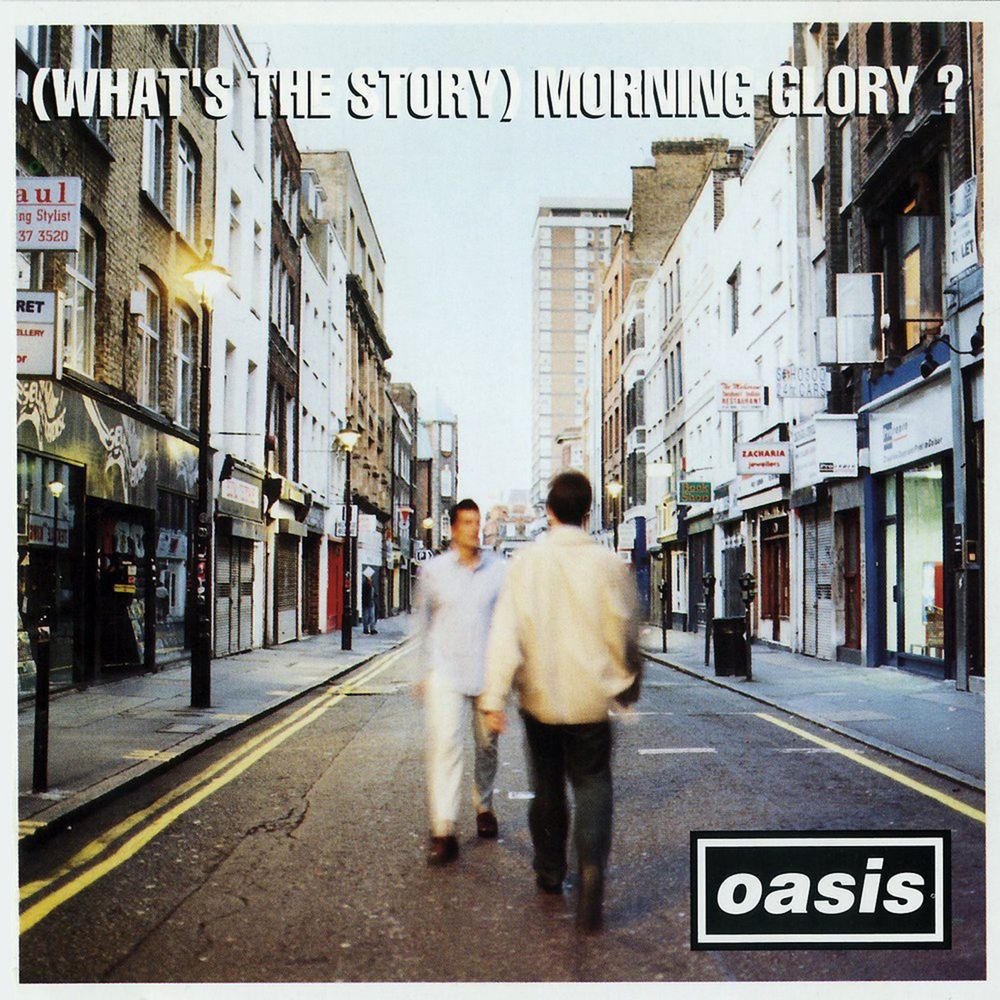
(What's The Story) Morning Glory?
- Released3 October 1995
- UK peak No. 1
- Weeks on UK chart 198
- Entered UK chart 8 October 1995
- LabelBig Brother Recordings Ltd
- Tracks12 · 50 min
4 tracks from it charted as singles. Press a flag to play it in the chart where it peaked.
Tracks
| 1 | Hello | 3:23 | |
| 2 | Roll With It No. 2 · 1995 | 3:59 | |
| 3 | 4:18 | ||
| 4 | 4:47 | ||
| 5 | Hey Now! | 5:41 | |
| 6 | The Swamp Song (Version 1) | 0:44 | |
| 7 | Some Might Say No. 1 · 1995 | 5:27 | |
| 8 | Cast No Shadow | 4:54 | |
| 9 | She's Electric | 3:40 | |
| 10 | Morning Glory | 5:03 | |
| 11 | The Swamp Song (Version 2) | 0:39 | |
| 12 | Champagne Supernova | 7:30 |
About the album
(What's the Story) Morning Glory? is the second studio album by the English rock band Oasis. Released on 2 October 1995 by Creation Records, it was produced by Owen Morris and the group's lead guitarist and songwriter Noel Gallagher. The structure and arrangement style of the album was a significant departure from the band's previous album, Definitely Maybe (1994). Gallagher's compositions were more focused in balladry and placed more emphasis on "huge" choruses and string arrangements. Morning Glory was the group's first album with drummer Alan White, who replaced Tony McCarroll (though McCarroll still appeared on the album, drumming on the track "Some Might Say").
The album propelled Oasis from being a crossover indie act to a worldwide rock phenomenon, and is seen by critics as a significant record in the timeline of British indie music. Morning Glory sold a record-breaking 345,000 copies in its first week in the UK before going on to spend 10 weeks at number one on the UK Albums Chart. It was also the band's breakthrough in the United States, reaching number four on the US Billboard 200 and being certified 4× platinum by the Recording Industry Association of America (RIAA).
Background and recording
"Some Might Say" was the first track written and recorded for Morning Glory, with recording taking place between 24 and 26 February 1995 at Loco Studios in Wales. The track proved problematic to record: the backing track was recorded in one take after Noel Gallagher and Morris drunkenly listened to the demo and decided the new version was played too fast, and Noel woke the rest of the band to re-record it. The backing track was faster than intended, with what Morris described as "a really bad speed up during the first three bars of the first chorus", but the take had to be used because those involved were impressed with Liam Gallagher's vocals, and Morris had to mix the track three times, using delay and other processing to hide the mistakes.
Composition
The music on (What's the Story) Morning Glory? has been characterised by commentators as rock, and Oasis as an essential part of Britpop culture. Music critic John Harris commented in his music history Britpop!: Cool Britannia and the Spectacular Demise of English Rock that much of the music seemed to be "little more inspired than a string of musical hand-me-downs". Among the musical cues Harris noted on the album were Gary Glitter's "Hello, Hello, I'm Back Again", John Lennon's "Imagine" ("Don't Look Back in Anger"), the theme to the 1970s children's programme You and Me and the Beatles' "With a Little Help from My Friends" ("She's Electric"), and the influence of R.E.M.'s "The One I Love" on "Morning Glory". One song, "Step Out", bore such a close resemblance to the song "Uptight (Everything's Alright)" by Stevie Wonder that it was removed from the album shortly before release due to the threat of legal action. Musicologist Allan F.
Promotion
While "Some Might Say", a number one hit, had been released in April, the single chosen to precede the album's release was "Roll with It", planned for release on 14 August, six weeks before the album was due to hit the shelves. This was an unorthodox method for the time, contrasting the standard industry procedure of releasing the lead single three weeks before its parent album. Blur's management had become worried that this would hinder the chances of the group's forthcoming "Country House" single reaching number one the following week. As a reaction, Food Records pushed the release of "Country House" back a week. The NME hailed this oncoming chart battle as a "British Heavyweight Championship" between the two bands and thus started what became known as "The Battle of Britpop".
The event triggered an unprecedented amount of exposure for both bands in national newspapers and on television news bulletins, supposedly symbolising the battle between the middle class of the south and the working class of the north.
Release
(What's the Story) Morning Glory? was released on 2 October 1995. The album sold quickly; the Daily Express reported the day after release that central London HMV stores were selling copies at a rate of two per minute. At the end of the first week of sales, the album had sold a record-breaking 345,000 copies, making it (at the time) the second-fastest-selling album in British history, behind Michael Jackson's Bad.
After the fourth single from the album, "Wonderwall", hit the top ten in several countries, including stays at number one in Australia and New Zealand and achieving a peak of number eight in the United States, the album began to enjoy prolonged international success. Eventually, the album had a five-week run at the top of the Australian albums chart and an eight-week run at the top of the New Zealand albums chart before topping charts in Canada, Ireland, Sweden and Switzerland. The album was also making significant waves in the US market, thanks in part to the success of the "Wonderwall" and "Champagne Supernova" singles on American modern rock radio.
Critical reception
(What's the Story) Morning Glory? was released to lukewarm reviews from the mainstream music press. Contemporary reviewers expressed disappointment at the album's perceived inferiority to Definitely Maybe, taking aim at the "banal lyrics" and the unoriginal nature of the compositions. David Cavanagh of Q magazine said of the lyrics: "They scan; they fill a hole; end of story. They [say] nothing much about anything." Andy Gill of The Independent commented that "She's Electric" is "laddism of a tiresomely generic kind", while "Roll with It" is "drab and chummy". In Spin, Chuck Eddy wrote that the band had eschewed the "Bowie glitter" of their debut for "generic classic rock", while Sydney Morning Herald critic Shane Danielsen felt the Gallaghers lacked the ability to sing or "produce classics". While stating that "Some Might Say" was "the best single of the year", David Stubbs of Melody Maker was critical of the album as a whole; "What's the Story [sounds] laboured and lazy. On this evidence, Oasis are a limited band ...