One track from it charted as a single. Press a flag to play it in the chart where it peaked.
Tracks
| 1 | Hold On, Be Strong | 1:11 | |
| 2 | Return of the "G" | 4:49 | |
| 3 | Rosa Parks No. 55 · 1999 | 5:24 | |
| 4 | Skew It on the Bar-B (feat. Raekwon) | 3:15 | |
| 5 | Aquemini | 5:19 | |
| 6 | Synthesizer (feat. George Clinton) | 5:11 | |
| 7 | Slump | 5:09 | |
| 8 | West Savannah | 4:03 | |
| 9 | Da Art of Storytellin' (Pt. 1) | 3:43 | |
| 10 | Da Art of Storytellin' (Pt. 2) | 2:48 | |
| 11 | Mamacita | 5:52 | |
| 12 | SpottieOttieDopaliscious | 7:07 | |
| 13 | Y'All Scared (feat. T-Mo, Big Gipp & Khujo) | 4:50 | |
| 14 | Nathaniel | 1:10 | |
| 15 | Liberation (with Cee-Lo) | 8:46 | |
| 16 | Chonkyfire | 6:10 |
About the album
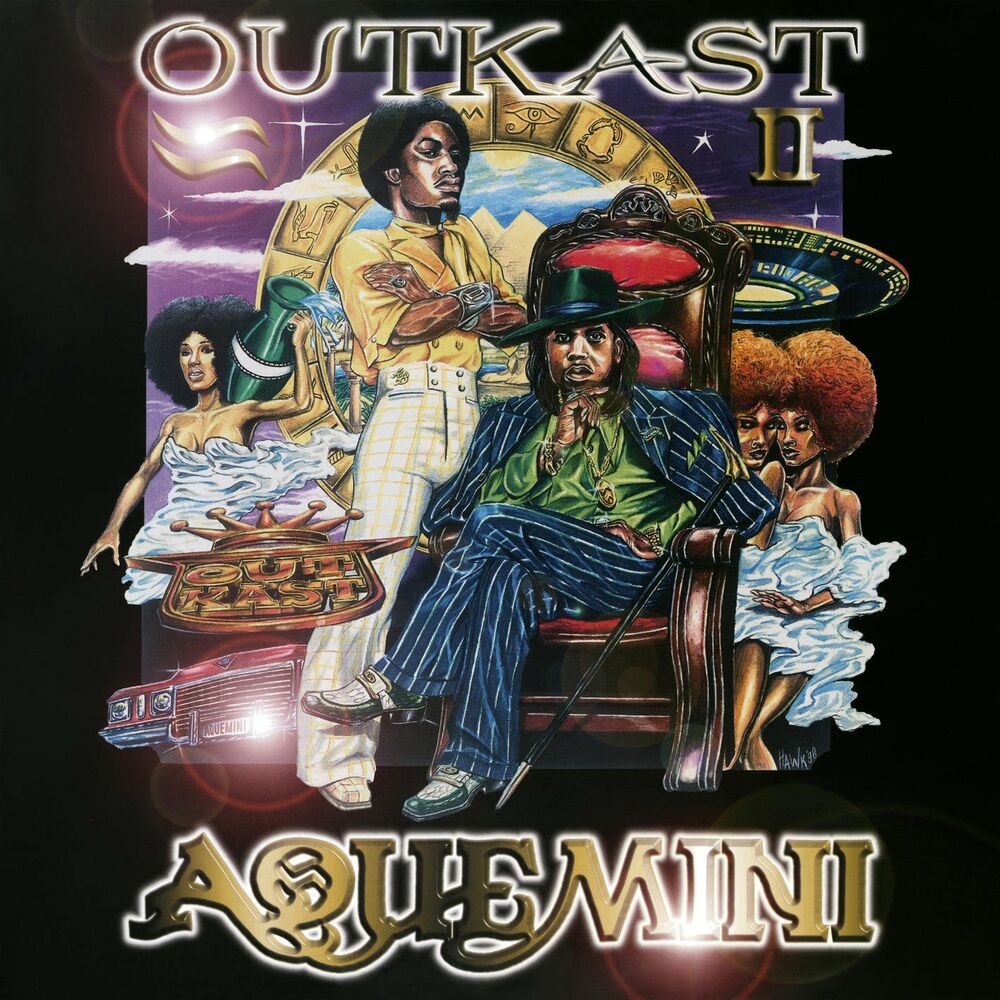
Aquemini () is the third studio album by the American hip hop duo Outkast, released on September 29, 1998, by LaFace Records and Arista Records. The title is a portmanteau of the two performers' Zodiac signs: Aquarius (Big Boi) and Gemini (André 3000), which is indicative of the album's recurring theme of the differing personalities of the two members. The group recorded the majority of the album in Bobby Brown's Bosstown Recording Studios and Doppler Studios, both in Atlanta, Georgia.
Released as the follow-up to the duo's commercially successful 1996 album ATLiens, Aquemini expands on the previous record's outer space-inspired compositions by incorporating live instrumentation and drawing on 1970s funk, southern soul, gospel, country, psychedelic rock, and other influences. The album reflected a greater level of creative freedom for the group, which led to the members self-producing the majority of the tracks and employing a large number of session musicians who filtered in and out of the studio throughout its recording, exerting a major influence on the album's compositional development. Featured guest artists include Raekwon, George Clinton, and Erykah Badu.
Background
In 1994, Outkast released their debut album, Southernplayalisticadillacmuzik, which was recorded when the rappers Big Boi and André 3000 were 18. Bolstered by the success of "Player's Ball", the record established Outkast as prominent figures in the Southern hip hop scene. After the album was certified platinum, LaFace Records gave Outkast more creative control and advanced money for their 1996 follow-up album ATLiens. On ATLiens, André 3000 and Big Boi abandoned the "hard-partying playa characters" of their debut album in favor of personas that were more futuristic, and produced many of the songs on their own for the first time. Critics praised the group's maturing musical style on the record, which debuted at number two on the US Billboard 200 chart and sold nearly 350,000 copies in its first 2 weeks of release.
Recording
Due to OutKast's newfound commercial success and higher budget for the album, the group enjoyed a more relaxed schedule and "could really just live" at the studio. The duo and studio musicians lived and worked in the studio for weeks straight, with Big Boi noting, "It usually takes us two to three years to make a record because we take our time; we ain't giving you that fast food, trying to meet a deadline. It ain't done until it's done sonically." For Aquemini, the duo used live instrumentation and improvisation, bringing a baby grand piano into the studio and hiring musicians who played "everything from stoner funk to prog rock". The producer Neal H. Pogue recalled, "That was the beauty of making all those records – having musicians come in and out. It was almost like a Motown, that's what we had. Or like a Stax Records thing. That's what I loved about it. It brought back that whole feeling of making records.
Release
The group originally planned to create a film in conjunction with Aquemini, completing a script three months before the release of the record. OutKast met with MTV for the project, who, despite liking the idea for the film, hoped to instead buy the project and cast Missy Elliott and Busta Rhymes instead, feeling they had more "star power." Although the duo recalls being "heartbroken" at the time, André 3000 and Big Boi continued to work on ideas for a collaborative film, eventually resulting in the 2006 musical Idlewild starring the group. David Browne of The New York Times viewed the album art as an homage to blaxploitation films of the 1970s. The record's title is a combination of the two members' zodiac signs, with André 3000 being a Gemini and Big Boi being an Aquarius. The packaging featured a sticker describing Big Boi as "the playa" and André as "the poet".
Aquemini debuted behind Jay-Z's Vol. 2... Hard Knock Life at number two on the Billboard Hot 200, the same opening position of both ATLiens and the group's next release, Stankonia.
Critical reception
Aquemini received widespread acclaim from critics. AllMusic's Steve Huey called it "a stroke of brilliance". He praised the record for avoiding the "hardcore clichés" and summed up his review by saying that Aquemini is "a virtuosic masterpiece, and a landmark hip-hop album of the late '90s". Robert Christgau also commented positively on the album, calling the record "evolved G-funk with denser instrumental crosstalk" and "rap-rock every bit as heavy as the bohrium and dubnium compounds hardheads hyped circa the Judgment Night soundtrack". Los Angeles Times writer Soren Baker complimented OutKast's "intelligent hip-hop" and commented that "musically, the collection supplies some of the lushest tracks ever included on a hip-hop record", noting that the music will "stimulate the mind, touch the soul and pack the dance floor." Q named it the group's "third best offering." Sia Michel of The Village Voice called it "an impassioned state-of-hip-hop address". In a brief review for Entertainment Weekly, Cheo Tyehimba qualified Aquemini as the hip-hop album of the year.
S. H. Fernando Jr.
Accolades
Aquemini has been included in several publications' best album lists. In 2003, Rolling Stone ranked it number 500 on its list of the 500 Greatest Albums of All Time. The staff explained the inclusion by stating: "OutKast unleashed an explosive hip-hop that deployed live musicians, social commentary and a heavy dose of deep funk". The album was placed at number 11 on the list of the "100 Best Albums of the Nineties" by the same magazine. In 2020, they revised their 500 Greatest Albums of All Time list and re-ranked the album at number 49, calling it "the greatest record ever to come out of the Dirty South."
Paste called the album "the best Atlanta hip-hop album of all time". Pitchfork ranked the record at number 50 on their "Top 100 Albums of the 1990s", describing it as "smooth and well-conceived". Spin included it on three of their lists. They ranked it number 35 on the "90 Greatest Albums of the '90s" and number three on the "Top 20 Albums of '98". The magazine also ranked it 76th on their 2010 list of "The 125 Best Albums of the Past 25 Years".