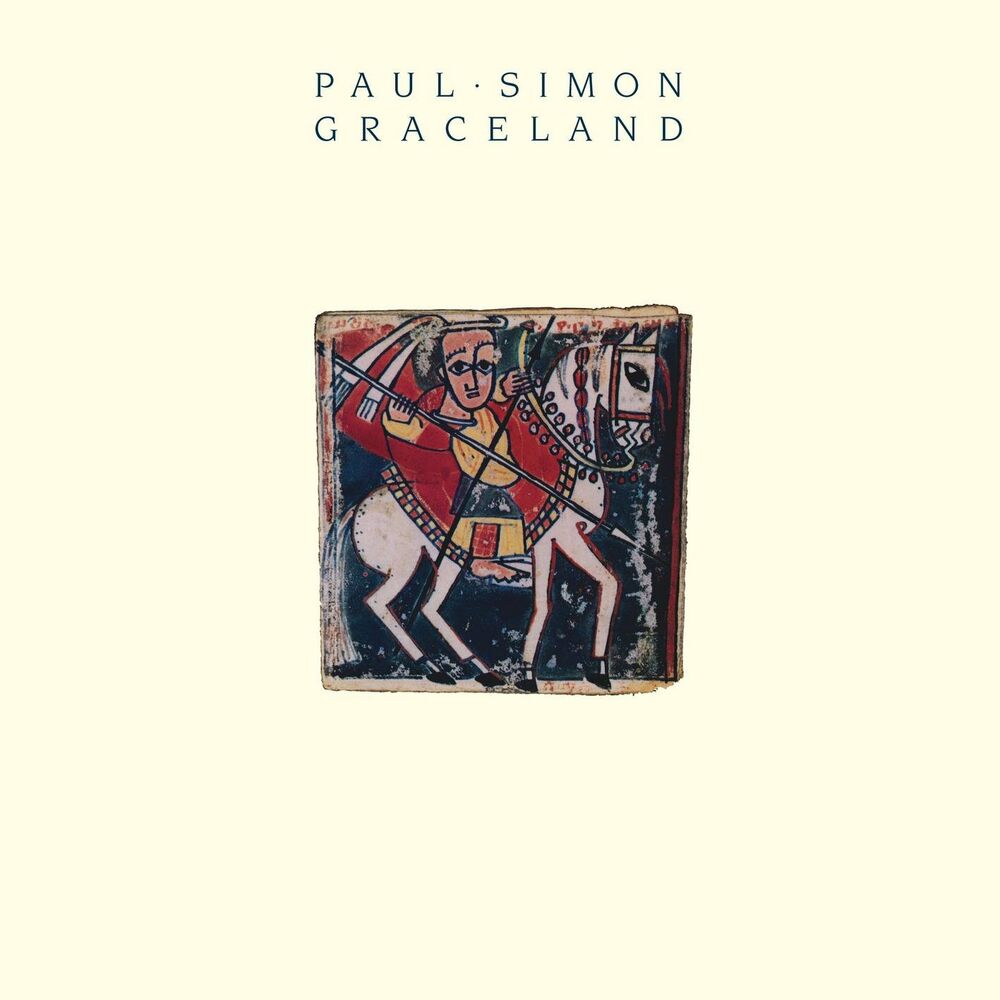
Graceland
- Released25 August 1986
- UK peak No. 1
- Weeks on UK chart 163
- Entered UK chart 7 September 1986
- LabelLegacy Recordings
- Tracks11 · 43 min
3 tracks from it charted as singles. Press a flag to play it in the chart where it peaked.
Tracks
| 1 | 4:00 | ||
| 2 | 4:51 | ||
| 3 | I Know What I Know (with General M.D.Shirinda & The Gaza Sisters) | 3:14 | |
| 4 | Gumboots (with Boyoyo Boys) | 2:45 | |
| 5 | Diamonds on the Soles of Her Shoes | 5:49 | |
| 6 | 4:41 | ||
| 7 | Under African Skies | 3:37 | |
| 8 | Homeless (with Ladysmith Black Mambazo) | 3:49 | |
| 9 | Crazy Love, Vol. II | 4:20 | |
| 10 | That Was Your Mother (with Good Rockin' Doopsie & The Twisters) | 2:53 | |
| 11 | All Around the World or the Myth of Fingerprints (with Los Lobos) | 3:26 |
About the album
Graceland is the seventh solo studio album by the American singer-songwriter Paul Simon. It was produced by Simon, engineered by Roy Halee, and released on August 25, 1986, by Warner Bros. Records. It incorporates multiple genres, including pop, rock, a cappella, zydeco, and South African styles such as isicathamiya and mbaqanga.
In the early 1980s, Simon's relationship with his former musical partner Art Garfunkel had deteriorated, his marriage to the actress Carrie Fisher had collapsed, and his previous record, Hearts and Bones (1983), had been a commercial failure. In 1984, after a period of depression, Simon became fascinated by a bootleg cassette of mbaqanga, South African street music. He and Halee spent two weeks in Johannesburg recording with South African musicians. Further recordings were held in the US with American musicians, including Linda Ronstadt, the Everly Brothers, Rockin' Dopsie and the Twisters, and Los Lobos. Simon toured with South African musicians, performing their music and songs from Graceland.
Graceland became Simon's most successful album and his highest-charting album in over a decade, with estimated sales of more than 16 million copies worldwide. It won the 1987 Grammy for Album of the Year and is frequently cited as one of the best albums in history.
Background
Following a series of hit records released in the 1970s, Simon's career declined. His relationship with his former musical partner Art Garfunkel had again deteriorated; his sixth solo studio album, Hearts and Bones (1983), achieved the lowest sales of his career; and his marriage to the actress Carrie Fisher collapsed. He recalled: "I had a personal blow, a career setback, and the combination of the two put me into a tailspin".
In 1984, Simon agreed to produce an album by the Norwegian multi-instrumentalist Heidi Berg, who had played in the house band for Saturday Night Live and been the bandleader for the short-lived TV series The New Show. Berg was drawn to the cheerful accordion sound in mbaqanga, the Black African street music from Johannesburg's Soweto township, and wanted to fuse Western and African music. Without hearing the music, Simon advised Berg to travel to South Africa and contact local musicians. Berg had been inspired by a bootleg cassette mixtape of obscure South African songs, and lent the cassette to Simon.
Recording
In February 1985, Simon and his longtime engineer, Roy Halee, flew to Johannesburg, intending their visit to be secret. The Warner executives were uninterested in the project, viewing Simon as a bad investment due to the failure of his previous two solo albums. Simon felt their indifference worked in his favor, as it gave him more freedom. Halee believed the executives viewed him and Simon as "crazy".
Rosenthal used his connections to assemble musicians who had inspired Simon, including Lulu Masilela, Tao Ea Matsekha, General M. D. Shirinda and the Gaza Sisters and the Boyoyo Boys Band. Though musicians in Johannesburg were typically paid $15 an hour, Simon arranged to pay them $200 an hour, around triple the rate for top players in New York City. Simon said he "wanted to be as above board as I could possibly be", as many of the musicians did not know who he was and would not be lured by the promise of royalties alone. He also offered royalties to those he felt had contributed to composing songs.
Recording sessions took place at Ovation Studios.
Music
Graceland incorporates genres including pop, rock, a cappella, zydeco, isicathamiya and mbaqanga. Mbaqanga, or "township jive", originated as the street music of Soweto, South Africa. The album was influenced by the work of the South African musicians Johnny Clegg and Sipho Mchunu, and their band Juluka's Zulu-Western pop crossover music. Juluka was South Africa's first integrated pop band. Simon includes thanks to Clegg, Juluka, and Juluka's producer Hilton Rosenthal in the liner notes. He included American "roots" influences with tracks featuring zydeco musicians such as Rockin' Dopsie and Tex-Mex musicians.
Graceland alternates between playful and more serious songs. Simon thought of it as like a play: "As in a play, the mood should keep changing. A serious song may lead into an abstract song, which may be followed by a humorous song." On many songs, Simon and Halee employ a Synclavier to "enhance" the acoustic instruments, creating an electronic "shadow".
"The Boy in the Bubble" is a collaboration with the Lesotho group Tau Ea Matsekha.
Lyrics
To write lyrics, Simon listened to the recordings made during his time in Johannesburg, identifying patterns in the music to fit to verses. He said:
It was very difficult, because patterns that seemed as though they should fit together often didn't. I realized that in African music, the rhythms are always shifting slightly and that the shape of a melody was often dictated by the bassline rather than the guitar. Harmonically, African music consists essentially of three major chords—that's why it sounds so happy—so I could write almost any melody I wanted in a major scale. I improvised in two ways—by making up melodies in falsetto, and by singing any words that came to mind down in my lower and mid range.
Simon told The Village Voice's Robert Christgau in 1986 that he was bad at writing about politics, and felt his strength was writing about relationships and introspection. In contrast to Hearts and Bones, Graceland's subject matter is more upbeat. Simon made an effort to write simply without compromising the language.
Release
Graceland was released by Warner Bros. with little promotion in August 1986. Before its release, Simon speculated that he was no longer "a viable commercial force in popular music".
By July 1987, Graceland had sold six million copies worldwide. That year, Rolling Stone's David Fricke said the album had become "a daily soundtrack in urban yuppie condos and suburban living rooms and on radio airwaves from Australia to Zimbabwe". In South Africa, it was the best-selling release since Michael Jackson's Thriller (1982). It sold 150,000 copies in Australia in 1988, and had sold 470,000 copies there by January 1989. As of 2014, Graceland was estimated to have sold more than 16 million copies.
In 2004, Graceland was reissued with three previously unreleased demo tracks. In 2011, it was reissued in a 25th-anniversary edition with further demos, a live concert DVD, and a documentary. In June 2018, Sony Music and Legacy Records issued Graceland: The Remixes, featuring remixes of Graceland songs by artists including Paul Oakenfold, Groove Armada, and Thievery Corporation.