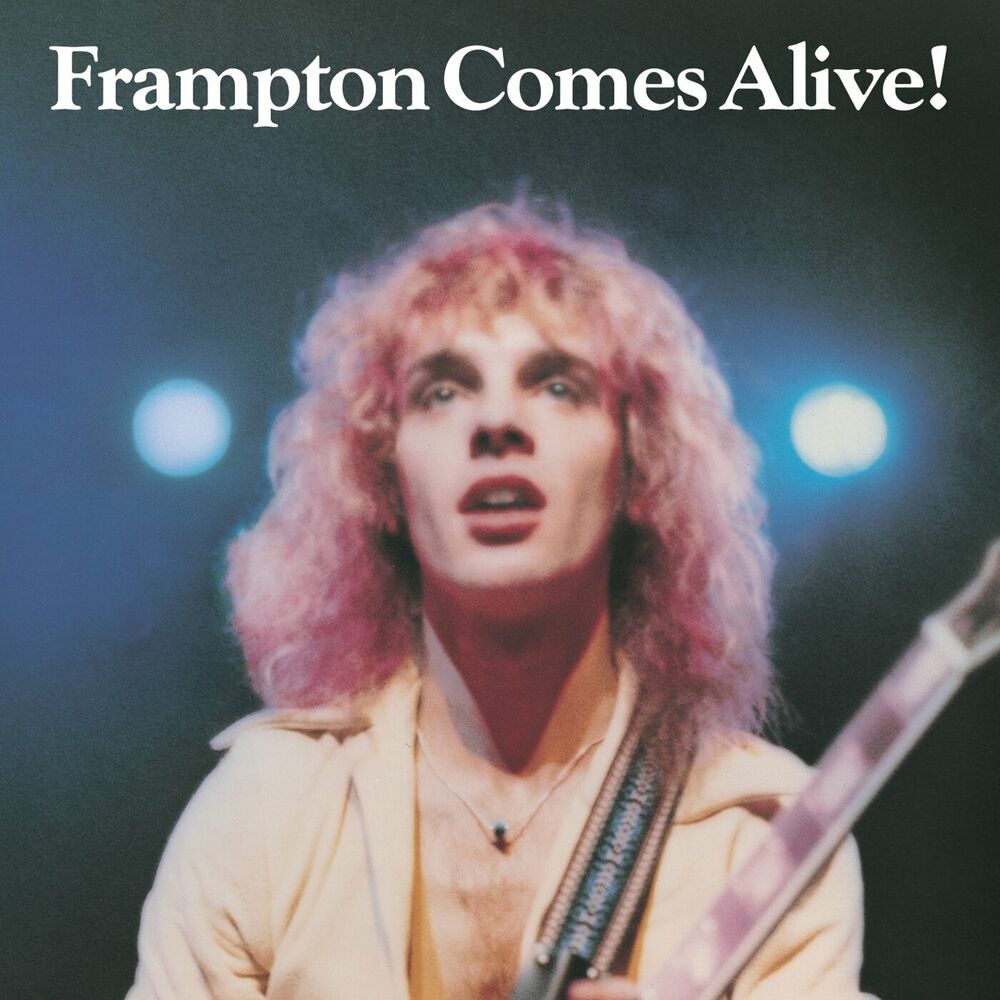
Frampton Comes Alive!
- Released29 March 2024
- UK peak No. 6
- Weeks on UK chart 38
- Entered UK chart 16 May 1976
- LabelA&M
- Tracks14 · 78 min
3 tracks from it charted as singles. Press a flag to play it in the chart where it peaked.
Tracks
| 1 | Something's Happening (Live) | 5:48 | |
| 2 | Doobie Wah (Live) | 5:34 | |
| 3 | 4:38 | ||
| 4 | It's A Plain Shame (Live) | 4:21 | |
| 5 | All I Want To Be (Is By Your Side) (Live) | 3:28 | |
| 6 | Wind Of Change (Live) | 2:52 | |
| 7 | 4:43 | ||
| 8 | I Wanna Go To The Sun (Live) | 7:12 | |
| 9 | Penny For Your Thoughts (Live) | 1:27 | |
| 10 | (I'll Give You) Money (Live) | 5:39 | |
| 11 | Shine On (Live) | 3:35 | |
| 12 | Jumping Jack Flash (Live) | 7:43 | |
| 13 | Lines On My Face (Live) | 7:00 | |
| 14 | 14:17 |
About the album
Frampton Comes Alive! is a double live album by the English musician and songwriter Peter Frampton, released in 1976 by A&M Records. Following four studio albums with little success and sales, Frampton Comes Alive! was a breakthrough for Frampton and is one of the best-selling live albums ever. "Show Me the Way", "Baby, I Love Your Way", and "Do You Feel Like We Do" were released as singles; all three reached the top 10 in Canada and the top 15 on the US Billboard Hot 100, and frequently receive airplay on classic rock radio stations.
Released on 15 January 1976, Frampton Comes Alive! debuted on the charts at No. 191. It reached No. 1 on the Billboard 200 the week ending 10 April 1976, spending 10 non-consecutive weeks in the top spot through October. It was the best-selling album of 1976 and has sold over 8 million copies in the United States.
Frampton Comes Alive! was voted "Album of the Year" in a 1976 Rolling Stone readers' poll. It stayed on the chart for 97 weeks and was still No. 14 on Billboard's 1977 year-end album chart. It was ranked No. 41 on Rolling Stone's "50 Greatest Live Albums of All Time" list. Readers of Rolling Stone ranked it No. 3 in a 2012 poll of all-time favourite live albums.
In 2020, Frampton Comes Alive! was inducted into the Grammy Hall of Fame.
Background and recording
The album Frampton Comes Alive! was recorded between June and November 1975, primarily at the Winterland Ballroom in San Francisco as well as Marin Veterans' Memorial Auditorium in San Rafael, California, Long Island Arena in Commack, New York, and a concert on the SUNY Plattsburgh campus in Plattsburgh, New York. The Winterland songs were recorded on a 24-track recorder. Other concerts were captured on 16-track recorders. Recordings from four shows were used for the original album. Master tapes were recorded at 15 inches per second using professional Dolby "A" noise reduction.
The live album had been intended to be a single LP disc, but at the suggestion of A&M Records, additional shows were recorded, and the album expanded to two LPs for release. On the special features for the Live in Detroit concert DVD, Frampton commented that some difficulties were encountered in mixing after the cable to the bass drum microphone was inadvertently pulled, causing the microphone to face at a 90-degree angle from the drumhead.
Release
The double album was released in the U.S. at a reduced list price of $7.98, only $1.00 more than the standard $6.98 of most single-disc albums in 1976. It was pressed in "automatic sequence", with sides one and four on one record and sides two and three on the other. This arrangement facilitated sequential listening on automatic record changers.
The album produced three hit singles: "Baby, I Love Your Way", "Do You Feel Like We Do", and "Show Me the Way". The talk box guitar effect became closely associated with Frampton due to its use in the latter two singles. The single version of "Do You Feel Like We Do" was edited to 7:19 from the original 14:15 album version, making it one of the longest singles to reach the top 40, surpassing The Beatles' "Hey Jude" at 7:11. The B-side of "Do You Feel Like We Do", the acoustic instrumental "Penny for Your Thoughts", was the shortest track on Frampton Comes Alive, at 1:23.
In January 2001, a 25th Anniversary Deluxe Edition of the album was released.
Production
Audio engineer: Chris Kimsey Engineer Live Recording and Original Mixer 1976
Audio engineer: Ray Thompson
Photography: Mike Zagaris
Mastering: Mike Reese at The Mastering Lab
Remastering: Doug Sax at The Mastering Lab, Los Angeles
Remastering: Roger Wake at Bourbery-Wake
Remastering (25th Anniversary Edition): Bob Ludwig at Gateway Mastering Studios, Portland, ME, October 2000
Remix (25th Anniversary Edition): Chuck Ainlay at Backstage Studios Nashville, TN, August/September 2000