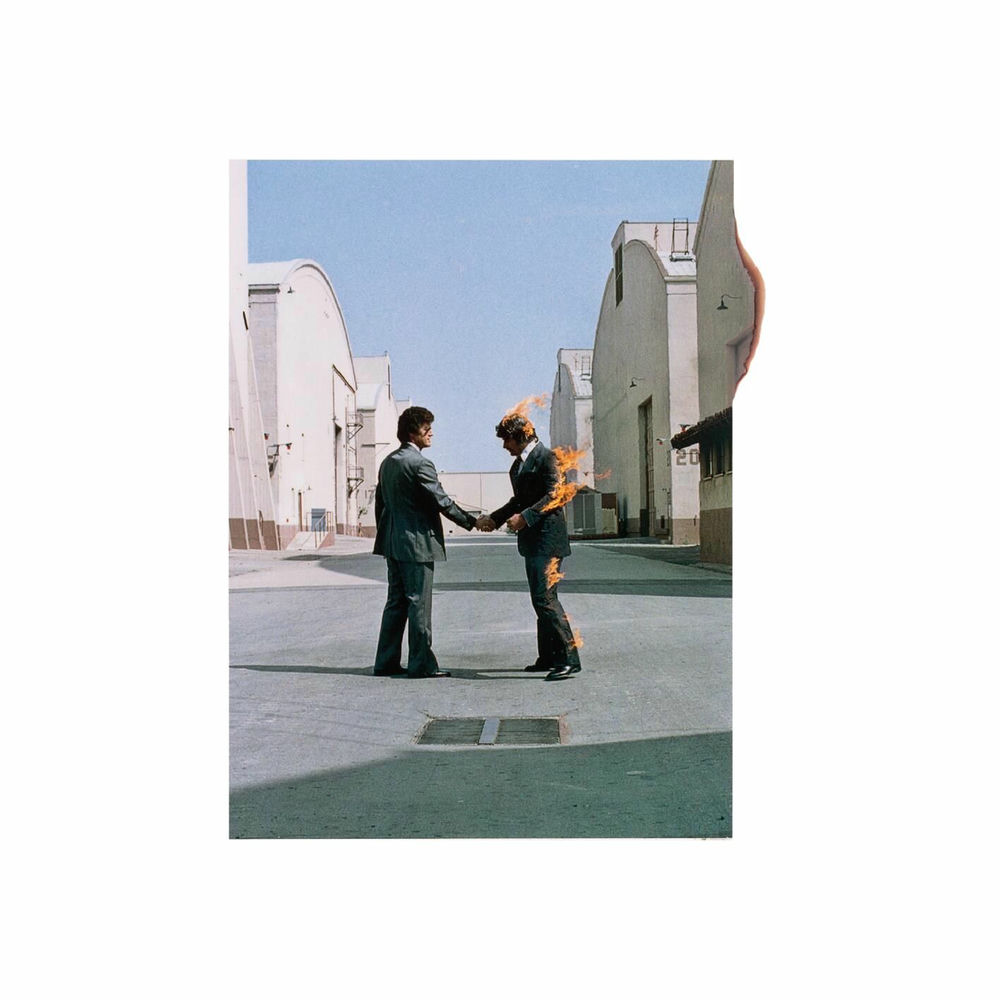
Wish You Were Here
- Released26 September 2011
- UK peak No. 1
- Weeks on UK chart 105
- Entered UK chart 21 September 1975
- LabelPink Floyd Records
- Tracks5 · 44 min
One track from it charted as a single. Press a flag to play it in the chart where it peaked.
Tracks
| 1 | Shine On You Crazy Diamond (Pts. 1-5) | 13:32 | |
| 2 | Welcome to the Machine | 7:31 | |
| 3 | Have a Cigar | 5:07 | |
| 4 | Wish You Were Here No. 68 · 2012 | 5:34 | |
| 5 | Shine On You Crazy Diamond (Pts. 6-9) | 12:29 |
About the album
Wish You Were Here is the ninth studio album by the English rock band Pink Floyd, released on 12 September 1975 through Harvest Records in the United Kingdom and a day later in the United States through Columbia Records, as the band's first album for the label. Based on material composed while performing in Europe, Wish You Were Here was recorded over numerous sessions throughout 1975 at EMI Studios in London.
The lyrics express longing, alienation, and sardonic criticism of the music industry. The bulk of the album is taken up by "Shine On You Crazy Diamond", a nine-part tribute to Syd Barrett, a Pink Floyd co-founder who had left seven years earlier due to his deteriorating mental health; Barrett coincidentally visited the studio during recording. As with their previous release, The Dark Side of the Moon (1973), Pink Floyd employed studio effects and synthesisers. Guest singers included Roy Harper, who sang lead on "Have a Cigar", and Venetta Fields and Carlena Williams, who sang backing vocals on "Shine On You Crazy Diamond". To promote the album, Pink Floyd released the double A-side single "Have a Cigar" / "Welcome to the Machine".
Wish You Were Here topped charts in several countries, including the UK Albums Chart and US Billboard 200. It was certified gold in the UK and US in its year of release, and by 2004, it had sold an estimated 13 million copies worldwide.
Background
In 1974, Pink Floyd sketched out three new songs, "Raving and Drooling", "You Gotta Be Crazy", and "Shine On You Crazy Diamond". These songs were performed during a series of concerts in France and England, the band's first tour since 1973's The Dark Side of the Moon. As Pink Floyd had never employed a publicist and kept themselves distant from the press, their relationship with the media began to sour. Nick Mason said later that a critical NME review by Nick Kent, who Mason felt preferred the band's earlier music, may have influenced the band to return to the studio during the first week of 1975.
Concept
Wish You Were Here is the second Pink Floyd album with a conceptual theme, mostly at Roger Waters's direction, reflecting his feeling that the previous communal structure of the band had disappeared in favour of more professional musicianship. "I had some criticisms of Dark Side of the Moon", noted David Gilmour, saying that "[o]ne or two of the vehicles carrying the ideas were not as strong as the ideas that they carried. I thought we should try and work harder on marrying the idea and the vehicle that carried it, so that they both had an equal magic [...] It's something I was personally pushing when we made Wish You Were Here." The album begins with a long instrumental introduction shifting from ambient music to the main refrain of "Shine On You Crazy Diamond", the lyrics of which were penned as a tribute to Syd Barrett, whose mental breakdown had forced him to leave the group seven years earlier.
Wish You Were Here also features lyrical criticism of the rock music industry and the then-recent mainstream perception of the band.
Recording
Alan Parsons, the EMI Studios (now Abbey Road Studios) staff engineer for Pink Floyd's previous studio album, The Dark Side of the Moon, declined to continue working with them due to the recent formation of his own group and working on their first album. Pink Floyd had worked with the engineer Brian Humphries on More, recorded at Pye Studios, and again in 1974 when he replaced an inexperienced concert engineer. Humphries, being a stranger to EMI's Abbey Road set-up, encountered some early difficulties. On one occasion, Humphries inadvertently spoiled the backing tracks for "Shine On", a piece that Waters and drummer Nick Mason had spent many hours perfecting, with echo. The entire piece had to be re-recorded.
The sessions for Wish You Were Here at EMI's Studio Three lasted from January until July 1975, recording on four days each week from 2:30 pm until very late in the evening. The group found it difficult at first to devise any new material, especially as the success of The Dark Side of the Moon had left all four physically and emotionally drained.
Packaging and album cover art
Wish You Were Here was sold in one of the more elaborate packages to accompany a Pink Floyd album. Storm Thorgerson had accompanied the band on their 1974 tour and had given serious thought to the meaning of the lyrics, eventually deciding that the songs were, in general, concerned with "unfulfilled presence", rather than Barrett's illness. This theme of absence was reflected in the ideas produced by his long hours spent brainstorming with the band. Thorgerson had noted that Roxy Music's Country Life was sold in an opaque green cellophane sleeve – censoring the cover image – and he copied the idea, concealing the artwork for Wish You Were Here in a black-coloured shrink-wrap (therefore making the album art "absent").
Release
Wish You Were Here was released on 12 September 1975 in the UK, and on the following day in the US. It was Pink Floyd's first album with Columbia Records, an affiliate of CBS; the band and their manager Steve O'Rourke had been dissatisfied with the efforts of EMI's US label Capitol Records. The band remained with EMI's Harvest Records in Europe.
In Britain, with 250,000 advance sales, the album debuted at number three and reached number one the following week. Demand was such that EMI informed retailers that only half of their orders would be fulfilled. With 900,000 advance orders (the largest for any Columbia release) it reached number one on the US Billboard chart in its second week. Wish You Were Here was Pink Floyd's fastest-selling album ever. It was certified silver and gold (60,000 and 100,000 sales respectively) in the UK on 1 August 1975, and Gold in the US on 17 September 1975. It was certified seven-times platinum in the US on 12 December 2025, and by 2004 had sold an estimated 13 million copies worldwide.
Critical reception and legacy
Wish You Were Here initially received mixed reviews. Ben Edmonds wrote in Rolling Stone that the band's "lackadaisical demeanor" leaves the subject of Barrett "unrealised; they give such a matter-of-fact reading of the goddamn thing that they might as well be singing about Roger Waters's brother-in-law getting a parking ticket". Edmonds concluded the band is "devoid" of the "sincere passion for their 'art'" that contemporary space rock acts purportedly have. Melody Maker's reviewer wrote: "From whichever direction one approaches Wish You Were Here, it still sounds unconvincing in its ponderous sincerity and displays a critical lack of imagination in all departments."
In The Village Voice, Robert Christgau wrote: "The music is not only simple and attractive, with the synthesizer used mostly for texture and the guitar breaks for comment, but it actually achieves some of the symphonic dignity (and cross-referencing) that The Dark Side of the Moon simulated so ponderously." Years later, he wrote that Wish You Were Here was his favourite Pink Floyd album: "It has soul [...] It's Roger Wa