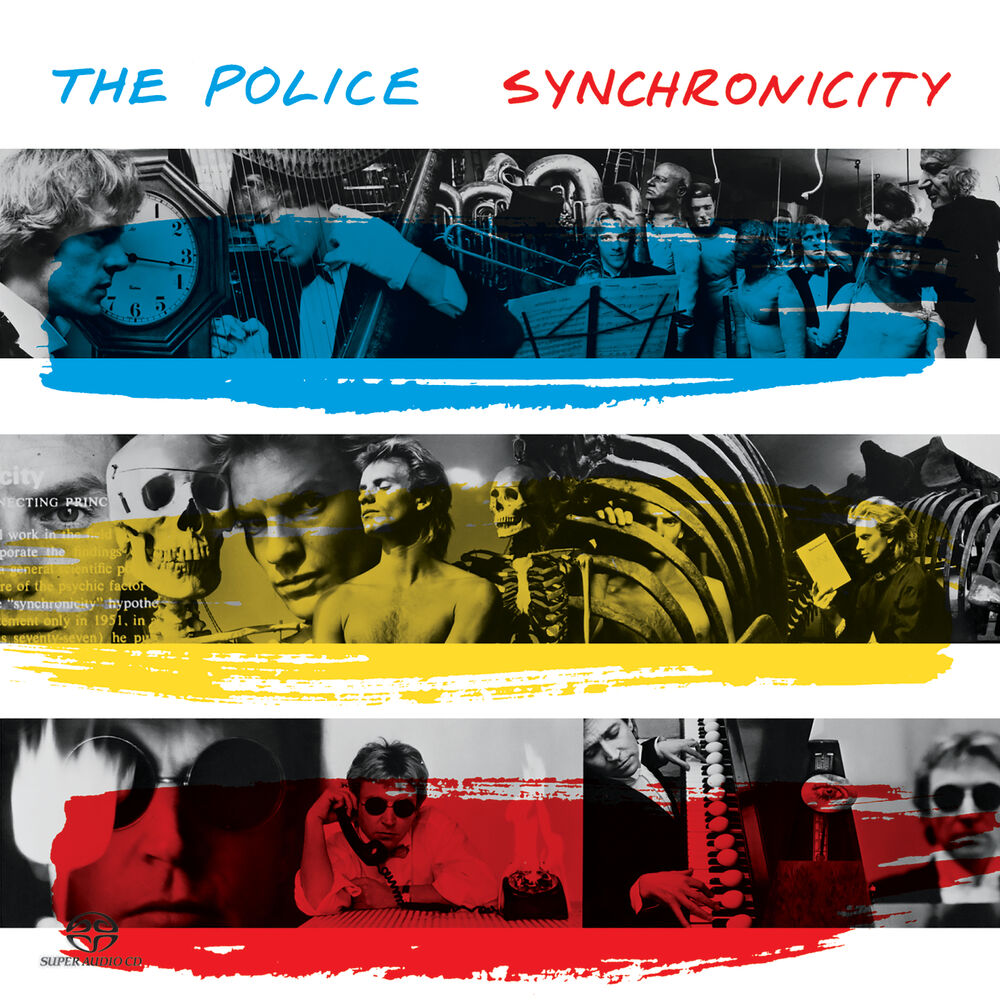
Synchronicity (Remastered 2003)
- Released15 April 2019
- UK peak No. 1
- Weeks on UK chart 48
- Entered UK chart 19 June 1983
- LabelPolydor Records
- Tracks11 · 44 min
4 tracks from it charted as singles. Press a flag to play it in the chart where it peaked.
Tracks
| 1 | Synchronicity I | 3:23 | |
| 2 | Walking In Your Footsteps | 3:35 | |
| 3 | O My God | 4:02 | |
| 4 | Mother | 3:03 | |
| 5 | Miss Gradenko | 2:00 | |
| 6 | 5:00 | ||
| 7 | 4:13 | ||
| 8 | 4:59 | ||
| 9 | 5:14 | ||
| 10 | Tea In The Sahara | 4:19 | |
| 11 | Murder By Numbers | 4:36 |
About the album
Synchronicity is the fifth and final studio album by the English rock band the Police, released on 17 June 1983 by A&M Records. The band's most successful release, the album includes the hit singles "Every Breath You Take", "King of Pain", "Wrapped Around Your Finger", and "Synchronicity II". The album's title and much of the material for the songs were inspired by Arthur Koestler's book The Roots of Coincidence (1972). At the 1984 Grammy Awards the album was nominated for a total of five awards, including Album of the Year, and won three. At the time of its release and following the Synchronicity Tour, the Police's popularity was at such a high that they were arguably, according to BBC and The Guardian, the "biggest band in the world".
Synchronicity reached number one on both the UK Albums Chart and the US Billboard 200, and sold over eight million copies in the US. The album was widely acclaimed by critics. Praise centered on its cohesive merging of disparate genres and sonic experimentation. Rolling Stone described "each cut on Synchronicity [as] not simply a song but a miniature, discrete soundtrack". It was ranked number 17 in the magazine's lists of the "100 Best Albums of the Eighties" and number 159 on the "500 Greatest Albums of All Time". In 2009, Synchronicity was inducted into the Grammy Hall of Fame.
Recording
The album's title was inspired by the Carl Jung book Synchronicity: An Acausal Connecting Principle, going so far as to quote the book's title in the lyrics of the albums first song Synchronicity I, singing "Synchronicity...a connecting principle...".
The album marked a significant reduction in the reggae influences that were a part of the band's first four studio albums, instead continuing the trend of production-heavy textures and liberal use of synthesizers featured in their previous album's hit single "Spirits in the Material World". This direction sometimes drove entire songs ("Synchronicity I", "Wrapped Around Your Finger"). The influence of world music can also be heard in songs such as "Tea in the Sahara" and "Walking in Your Footsteps". As opposed to the band's previous effort, Ghost in the Machine, the songs have no overdubbed saxophone(s). Sting explains:I enjoyed making Ghost in the Machine and playing with the tools of the studio, just building things up and sticking more vocals on. Great fun. But listening to it, I thought.
Release
Synchronicity was released in the United Kingdom on 17 June 1983. The album was issued on LP, CD, and cassette. Synchronicity debuted at number one on the UK Albums Chart and spent two weeks at the top position. In the United States, the album topped the Billboard 200 in late July and ultimately spent 17 nonconsecutive weeks at number one on the chart, interrupting the dominance of Michael Jackson's Thriller (1982). In Canada, the album went to number one for a record 24 (consecutive) weeks. Synchronicity's 24 weeks at number one surpassed the Saturday Night Fever soundtrack (22 consecutive weeks) for most weeks at number one all-time on the Canadian album charts.
Critical reception
Professional music critics at the time of release and afterwards have been mostly positive towards the album. Richard Cook of NME called Synchronicity "a record of real passion that is impossible to truly decipher", and felt that "although [the album] magnifies the difference between Sting and Summers and Copeland it also evolves the group into a unique state: a mega-band playing off glittering experimentation against the sounding board of a giant audience. It's the sound of a group coming apart and coming together, a widescreen drama with a fascination at a molecular level. Some of the music fuses intuitive pop genius with willfully dense orchestration so powerfully it stuns. It is occasionally sensational."
In Melody Maker Adam Sweeting was less enthusiastic, saying, "I would guess that devotees of this extremely sussed trio will find plenty to amuse them, and indeed Sting has sown all sorts of cryptic little clues and messages throughout his songs...
Accolades
In the 1983 Rolling Stone readers' poll, Synchronicity was voted "Album of the Year". It was voted the fifth best album of 1983 in The Village Voice's year-end Pazz & Jop critics' poll. At the 1984 Grammy Awards ceremony, Synchronicity won the award for Best Rock Performance by a Duo or Group with Vocal, and was nominated for Album of the Year. "Every Breath You Take" won the awards for Song of the Year and Best Pop Performance by a Duo or Group with Vocals, and received a nomination for Record of the Year.
In 1989, Synchronicity was ranked No. 17 on Rolling Stone's list of the 100 best albums of the 1980s. Pitchfork ranked the record at No. 55 on its 2002 list of the decade's 100 best albums. In 2006, Q placed Synchronicity at No. 25 on its list of the 40 best 1980s albums. In 2016, Paste ranked Synchronicity sixth on its list of the 50 best new wave albums, and 17th on its list of the 50 best post-punk albums.
Synchronicity has appeared on numerous rankings of the greatest albums of all time. In 2000, it was listed at No. 91 in the Virgin All Time Top 1000 Albums book.