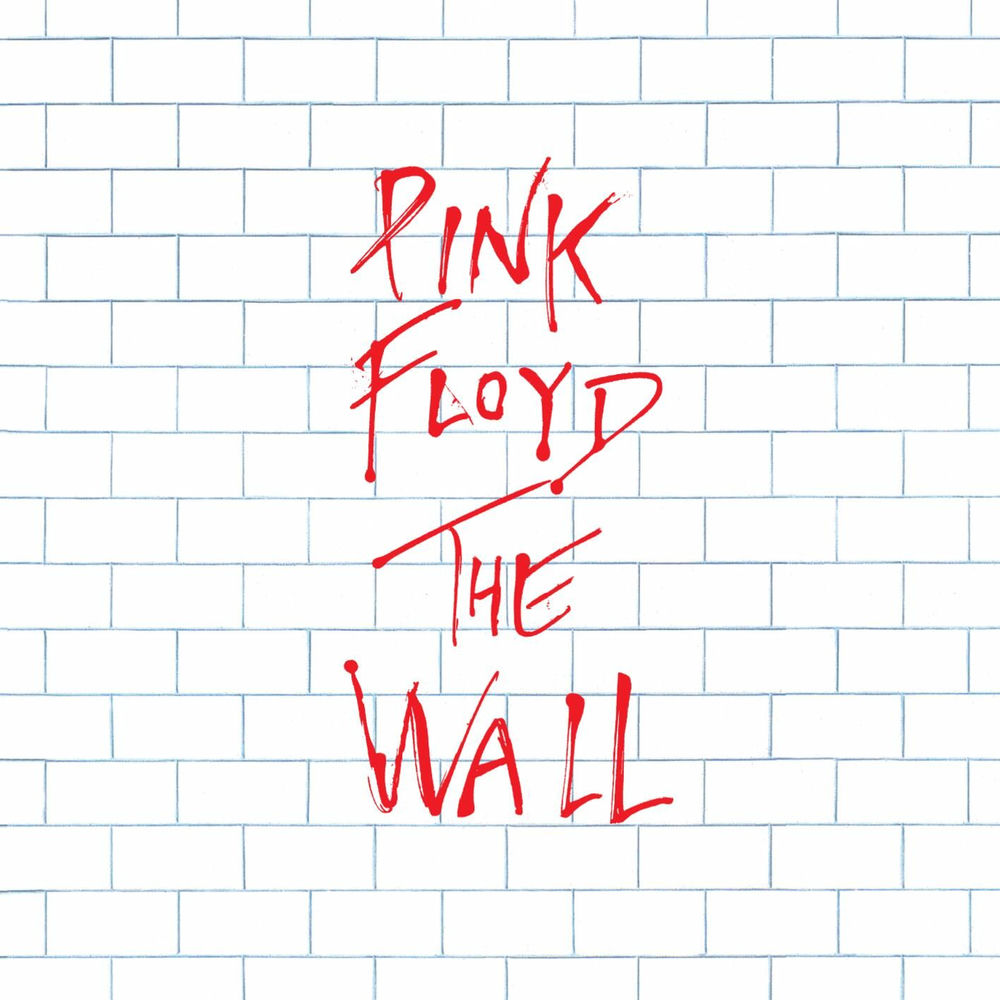
The Wall
- Released30 November 1979
- UK peak No. 3
- Weeks on UK chart 68
- Entered UK chart 2 December 1979
- LabelPink Floyd Records
- Tracks25 · 79 min
One track from it charted as a single. Press a flag to play it in the chart where it peaked.
Tracks
| 1 | In the Flesh? | 3:18 | |
| 2 | The Thin Ice | 2:26 | |
| 3 | Another Brick in the Wall, Pt. 1 | 3:11 | |
| 4 | The Happiest Days of Our Lives | 1:51 | |
| 5 | Another Brick in the Wall, Pt. 2 | 3:58 | |
| 6 | Mother | 5:34 | |
| 7 | Goodbye Blue Sky | 2:47 | |
| 8 | Empty Spaces | 2:07 | |
| 9 | Young Lust | 3:29 | |
| 10 | One of My Turns | 3:36 | |
| 11 | Don't Leave Me Now | 4:15 | |
| 12 | Another Brick in the Wall, Pt. 3 | 1:14 | |
| 13 | Goodbye Cruel World | 1:14 | |
| 14 | Hey You | 4:39 | |
| 15 | Is There Anybody Out There? | 2:41 | |
| 16 | Nobody Home | 3:22 | |
| 17 | Vera | 1:33 | |
| 18 | Bring the Boys Back Home | 1:27 | |
| 19 | Comfortably Numb | 6:22 | |
| 20 | The Show Must Go On | 1:36 | |
| 21 | In the Flesh | 4:15 | |
| 22 | Run Like Hell No. 53 · 1980 | 4:23 | |
| 23 | Waiting for the Worms | 3:57 | |
| 24 | Stop | 0:30 | |
| 25 | The Trial | 5:18 |
About the album
The Wall is the eleventh studio album by the English rock band Pink Floyd, released on 30 November 1979 by Harvest/EMI and Columbia/CBS Records. It is the last album to include all four post-Barrett–era band members. A double album rock opera, it follows the story of "Pink", a jaded rock star, as he builds a psychological "wall" of isolation around himself. The Wall topped the US charts for 15 weeks and reached number three in the UK. It initially received mixed reviews from critics, many of whom found it overblown and pretentious, but later received accolades as one of the greatest albums of all time.
The group's bassist Roger Waters conceived The Wall during Pink Floyd's 1977 In the Flesh tour, modelling the character of Pink after himself and former founding member Syd Barrett. Recording spanned from December 1978 to November 1979. Co-producer Bob Ezrin helped to refine the concept and bridge tensions during recording, as the band members were struggling with personal and financial problems. The group's keyboardist, Richard Wright, was fired by Waters during production but stayed on during the tour as a salaried musician.
Three singles were issued: "Another Brick in the Wall, Part 2" (Pink Floyd's only UK and US number-one single), "Run Like Hell", and "Comfortably Numb". From 1980 to 1981, Pink Floyd performed the album on a tour that featured elaborate theatrical effects.
Background
Throughout 1977, Pink Floyd played the In the Flesh tour to promote their new album Animals. Roger Waters despised the experience – angered by the audience's rowdy behavior (such as setting off fireworks in the middle of songs) and convinced that they were not really listening to the music. During the final show on 6 July 1977 at the Montreal Olympic Stadium, a group of noisy and excited fans near the stage irritated Waters so much that he leaned over the side and spat on one of them. Waters said of the incident, "Immediately afterwards I was shocked by my behaviour. I realised that what had once been a worthwhile and manageable exchange between us (the band) and them (the audience) had been utterly perverted by scale, corporate avarice and ego. All that remained was an arrangement that was essentially sado-masochistic." That night, Waters spoke with producer Bob Ezrin and a psychiatrist friend of Ezrin's about the alienation and despair he was experiencing. He articulated his desire to isolate himself by constructing a wall across the stage between the band and the audience.
Concept and storyline
The Wall is a rock opera that explores abandonment, cycles of violence, and isolation, symbolized by a wall. The songs create a storyline of events in the life of Pink, a fictional rock star based on Waters and Pink Floyd's former frontman Syd Barrett. The first half of the album largely features events from Waters' childhood and young adulthood, such as the death of his father in WWII, and his wife's infidelity. The album also includes several references to Barrett, namely the track "Nobody Home", which mirrors lyrically one of Barrett's final songs for the Floyd, the unreleased B-side "Vegetable Man" through descriptions of the narrator's possessions and character. "Comfortably Numb" was inspired by Waters' injection with a muscle relaxant to combat the effects of hepatitis during the In the Flesh tour in Philadelphia. In the song "In the Flesh", Waters "imagines himself as a fascist dictator".
Recording
The Wall was recorded in several locations. Super Bear Studios in France was used between January and July 1979, and Waters recorded his vocals at the nearby Studio Miraval. Michael Kamen supervised the orchestral arrangements at CBS Studios in New York in September. Over the next two months the band used Cherokee Studios, Producers Workshop and The Village Recorder in Los Angeles. A plan to work with the Beach Boys at the Sundance Productions studio in Los Angeles was cancelled (although Beach Boys member Bruce Johnston does sing backing vocals on "In the Flesh?", "The Show Must Go On", the side 4 version of "In the Flesh", and "Waiting for the Worms").
James Guthrie, recommended by previous Floyd collaborator Alan Parsons, arrived early in the production process. He replaced engineer Brian Humphries, who was emotionally drained by his five years with the band. Guthrie was hired as a co-producer, but was initially unaware of Ezrin's role: "I saw myself as a hot young producer ...
Release
When the completed album was played for an assembled group of executives at Columbia's headquarters in California, several were reportedly unimpressed by what they heard. Matters had not been helped when Columbia Records offered Waters smaller publishing rights on the grounds that The Wall was a double album, a position he did not accept. When one executive offered to settle the dispute with a coin toss, Waters asked why he should gamble on something he owned. He eventually prevailed. The record company's concerns were alleviated when "Another Brick in the Wall, Part 2" reached number one in the UK, US, Norway, Portugal, West Germany and South Africa. It was certified platinum in the UK in December 1979, and platinum in the US three months later. In Germany, the album reached the one million sales mark within three months of its release. In Canada, the album was No. 1 for 13 weeks and had sold 830,000 copies by January 1981.
The Wall was released in the UK and in the US on 30 November 1979.
Artwork and packaging
The album's cover art is one of Pink Floyd's most minimal – a white brick wall and no text. Waters had a falling out with Hipgnosis designer Storm Thorgerson a few years earlier when Thorgerson had included the cover of Animals in his book The Work of Hipgnosis: 'Walk Away René'. The Wall is therefore the first album cover of the band since The Piper at the Gates of Dawn not to be created by the design group.
Issues of the album included the lettering of the artist name and album title by cartoonist Gerald Scarfe, either as a sticker on sleeve wrapping or printed onto the cover itself, in either black or red. Scarfe, who had previously created animations for the band's In the Flesh tour, also created the LP's inside sleeve art and labels of both vinyl records of the album, showing the eponymous wall in various stages of construction, accompanied by characters from the story.
The drawings were translated into dolls for The Wall Tour, as well as into Scarfe's animated segments shown during the tour and the film based on the album.