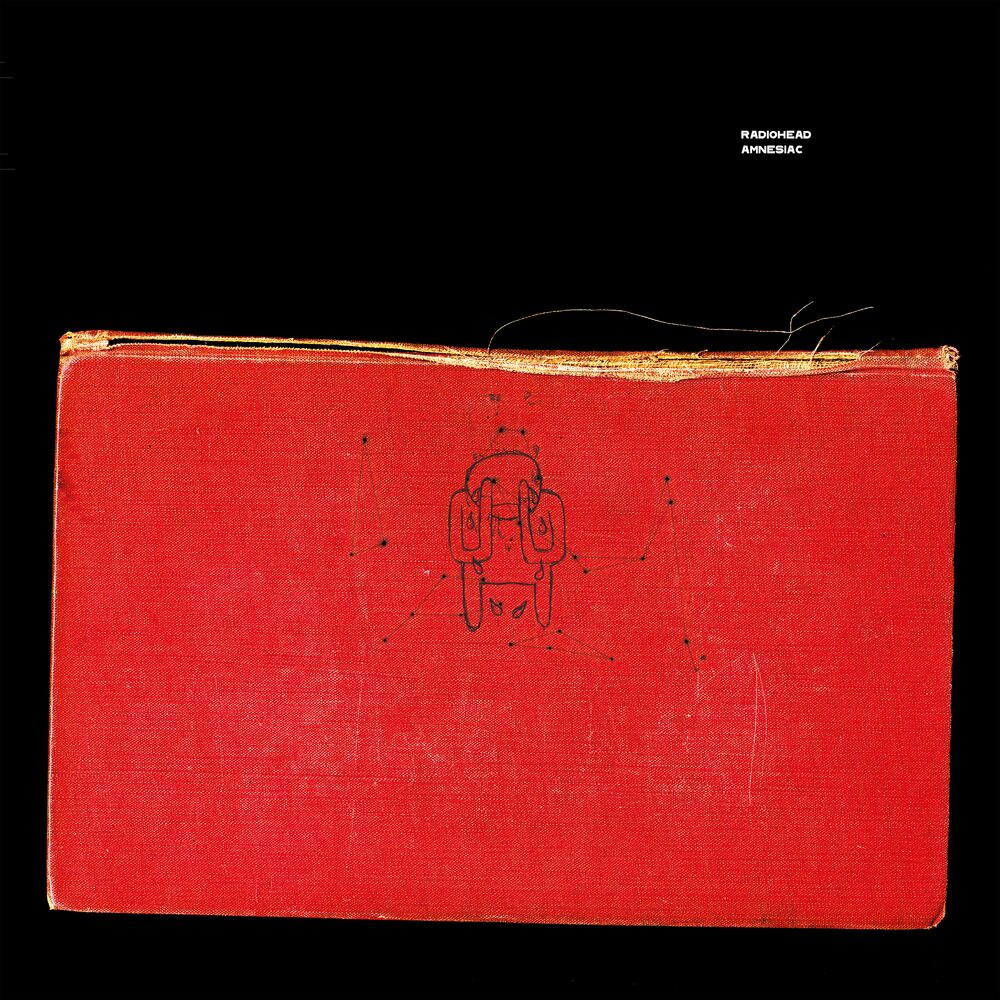
Amnesiac
- Released12 March 2001
- UK peak No. 1
- Weeks on UK chart 17
- Entered UK chart 10 June 2001
- LabelXL Recordings
- Tracks11 · 44 min
2 tracks from it charted as singles. Press a flag to play it in the chart where it peaked.
Tracks
| 1 | Packt Like Sardines In a Crushd Tin Box | 4:00 | |
| 2 | Pyramid Song No. 5 · 2001 | 4:48 | |
| 3 | Pulk/Pull Revolving Doors | 4:07 | |
| 4 | You And Whose Army? | 3:11 | |
| 5 | I Might Be Wrong | 4:53 | |
| 6 | Knives Out No. 13 · 2001 | 4:14 | |
| 7 | Morning Bell/Amnesiac | 3:14 | |
| 8 | Dollars and Cents | 4:51 | |
| 9 | Hunting Bears | 2:01 | |
| 10 | Like Spinning Plates | 3:57 | |
| 11 | Life In a Glasshouse | 4:36 |
About the album
Amnesiac is the fifth studio album by the English rock band Radiohead, released on 30 May 2001 by EMI. It was recorded with the producer Nigel Godrich in the same sessions as Radiohead's previous album, Kid A (2000). Radiohead split the work in two as they felt it was too dense for a double album. As with Kid A, Amnesiac incorporates influences from electronic music, 20th-century classical music, jazz and krautrock. The final track, "Life in a Glasshouse", is a collaboration with the jazz trumpeter Humphrey Lyttelton and his band.
After having released no singles for Kid A, Radiohead promoted Amnesiac with the singles "Pyramid Song" and "Knives Out", accompanied by music videos. Videos were also made for "Pulk/Pull Revolving Doors" and "Like Spinning Plates", as well as "I Might Be Wrong", which was released as a promotional single. Radiohead also launched GooglyMinotaur, a chatbot with which fans could interact on AIM. In June 2001, Radiohead began the Amnesiac tour, incorporating their first North American tour in three years and a homecoming performance in Oxford.
Amnesiac debuted at number one on the UK Albums Chart and number two on the US Billboard 200. By October 2008, it had sold over 900,000 copies worldwide. It is certified platinum in the UK, the US and Canada, and gold in Japan.
Recording
Radiohead and their producer, Nigel Godrich, recorded Amnesiac during the same sessions as their previous album, Kid A, released in October 2000. The sessions took place from January 1999 to mid-2000 in Guillaume Studios in Paris, Medley Studios in Copenhagen, and Radiohead's newly built studio in Oxfordshire. The drummer, Philip Selway, said the sessions had "two frames of mind ... a tension between our old approach of all being in a room playing together and the other extreme of manufacturing music in the studio. I think Amnesiac comes out stronger in the band-arrangement way."
The sessions drew influence from electronic music, 20th-century classical music, jazz and krautrock, using synthesisers, ondes Martenot, drum machines, strings and brass. The strings, arranged by the guitarist Jonny Greenwood, were performed by the Orchestra of St John's and recorded in Dorchester Abbey, a 12th-century church close to Radiohead's studio.
Radiohead considered releasing the work as a double album, but felt it was too dense.
Music and lyrics
Amnesiac was described as experimental rock, electronica and alternative rock, with elements of jazz. Simon Reynolds described it as post-rock. Colin Greenwood said it contained "traditional Radiohead-type songs" alongside more experimental work, and said that in both albums "the guitar becomes one more texture, difficult to separate from other textures". The Atlantic contrasted Amnesiac with "the surgical glint" of Kid A, with "swampy and foggy" arrangements and "uneasy" chords and rhythms. Uncut wrote that, whereas Kid A sounded futuristic, Amnesiac references music that predates rock, particularly the work of jazz musicians such as Miles Davis, Charlie Mingus and Chet Baker. In The Independent, Nick Hasted wrote that it "re-engaged with anger and activism" after the "glacial beauty" of Kid A.
The first track, "Packt Like Sardines in a Crushd Tin Box", is an electronic song with synthesisers and metallic percussion. "Pyramid Song", a swung ballad with piano and strings, was inspired by the Mingus song "Freedom".
Artwork and packaging
The Amnesiac artwork was created by Yorke and the longtime Radiohead collaborator Stanley Donwood. For inspiration, Donwood explored London taking notes, likening the city to the labyrinth of Greek mythology. He scanned blank pages of old books and superimposed onto them photos of fireworks and Tokyo tower blocks, copies of Piranesi's Imaginary Prisons drawings, and lyrics and phrases printed by Yorke on a broken typewriter.
The Minotaur of Greek mythology is a motif of the Amnesiac artwork, and represents the "maze" Yorke felt he had become lost in during his depression after OK Computer. Donwood described it as a "tragic figure", at once monstrous and self-pitying. Other figures included in the album booklet include faceless terrorists, self-serving politicians and corporate executives. Yorke said they represented "the abstracted, semi-comical, stupidly dark, false voices that battled us as we tried to work".
For the special edition, Donwood designed a package with a hardback CD case in the style of a mislaid library book.
Release
Radiohead announced Amnesiac on their website in January 2001, three months after the release of Kid A. It was released in Japan on 30 May by EMI, in the UK on 4 June by Parlophone and in the US on 5 June by Capitol, both subsidiaries of EMI. Amnesiac debuted at number one on the UK Albums Chart. On the US Billboard 200, it debuted at number two, with sales of 231,000, surpassing the 207,000 first-week sales of Kid A. It is certified gold in Japan for shipments of 100,000 copies. By October 2008, Amnesiac had sold more than 900,000 copies worldwide. In July 2013, it was certified platinum in the UK for sales of more than 300,000. As of May 2016, it had sold more than 1 million digital copies.
Promotion
Radiohead released no singles from Kid A, as Yorke wanted to avoid the stress of publicity he had struggled with on OK Computer. He regretted the choice, feeling it meant much of the early judgement of the album came from critics, and said Amnesiac would have more promotion. "Pyramid Song" was released as a single in May, followed by "Knives Out" in July, backed by music videos. Two videos were created for "I Might Be Wrong", which was released as a promotional single in June.
"Pulk/Pull Revolving Doors" and "Like Spinning Plates" were combined for a computer-animated video directed by Johnny Hardstaff. The video premiered on November 29, 2001, at an animation festival at the Centre For Contemporary Arts, Glasgow. It features imagery of killer whales swimming under UV light, a machine taking shape and conjoined babies spinning in a centrifuge. The video received little airplay from MTV, who felt it was "of a sensitive nature" and would only broadcast it with a warning.