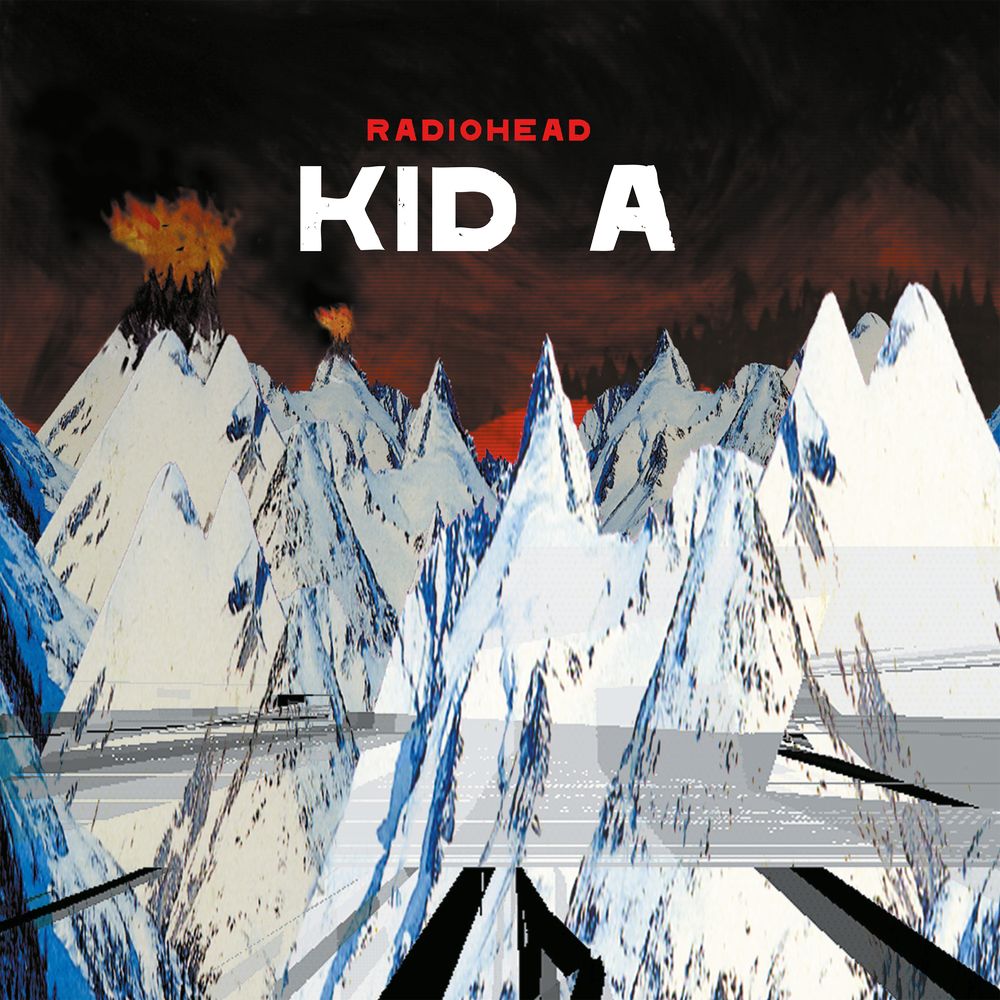
Kid A
- Released2 October 2000
- UK peak No. 1
- Weeks on UK chart 17
- Entered UK chart 8 October 2000
- LabelXL Recordings
- Tracks11 · 47 min
Tracks
| 1 | Everything In Its Right Place | 4:11 | |
| 2 | Kid A | 4:44 | |
| 3 | The National Anthem | 5:51 | |
| 4 | How to Disappear Completely | 5:56 | |
| 5 | Treefingers | 3:42 | |
| 6 | Optimistic | 5:15 | |
| 7 | In Limbo | 3:31 | |
| 8 | Idioteque | 5:09 | |
| 9 | Morning Bell | 4:35 | |
| 10 | Motion Picture Soundtrack | 3:20 | |
| 11 | Untitled | 0:52 |
About the album
Kid A is the fourth studio album by the English rock band Radiohead, released on 2 October 2000 by Parlophone. It was recorded with their producer, Nigel Godrich, in Paris, Copenhagen, Gloucestershire and Oxfordshire. Departing from their earlier sound, Radiohead incorporated influences from electronic music, krautrock, jazz and 20th-century classical music, with a wider range of instruments and effects. The singer, Thom Yorke, wrote abstract lyrics, cutting up phrases and assembling them at random.
In a departure from industry practice, Radiohead released no singles and conducted few interviews and photoshoots. Instead, they released short animations and became one of the first major acts to use the internet for promotion. Bootlegs of early performances were shared on filesharing services, and Kid A was leaked before release. In 2000, Radiohead toured Europe in a custom-built tent without corporate sponsors.
Kid A debuted at number one on the UK Albums Chart and became Radiohead's first number-one album on the US Billboard 200. It was certified platinum in the UK, the US, Australia, Canada, France and Japan. Its new sound divided listeners, and some dismissed it as pretentious, derivative or wilfully obscure.
Background
Following the critical and commercial success of their 1997 album OK Computer, the members of Radiohead suffered burnout. The songwriter, Thom Yorke, became ill, describing himself as "a complete fucking mess ... completely unhinged". He was troubled by new acts he felt were imitating Radiohead and became hostile to the music media. He told The Observer: "I always used to use music as a way of moving on and dealing with things, and I sort of felt like that the thing that helped me deal with things had been sold to the highest bidder and I was simply doing its bidding. And I couldn't handle that."
Yorke suffered from writer's block and could not finish writing songs on guitar. He became disillusioned with the "mythology" of rock music, feeling the genre had "run its course". He began to listen almost exclusively to the electronic music of artists signed to the record label Warp, such as Aphex Twin and Autechre, and said: "It was refreshing because the music was all structures and had no human voices in it.
Recording
After the success of OK Computer, Radiohead bought a barn in Oxfordshire and converted it into a recording studio. Yorke planned to use it as the German band Can had used their studio in Cologne, recording everything they played and then editing it. As the studio would not be complete until late 1999, Radiohead began work in Guillaume Tell Studios, Paris, in January 1999.
Radiohead worked with the OK Computer producer, Nigel Godrich, and had no deadline. Yorke, who had the greatest control, was still facing writer's block. His new songs were incomplete, and some consisted of little more than sounds or rhythms; few had clear verses or choruses. Yorke's lack of lyrics created problems, as these had provided points of reference and inspiration for his bandmates in the past.
The group struggled with Yorke's new direction. According to Godrich, Yorke did not communicate much, and according to Yorke, Godrich "didn't understand why, if we had such a strength in one thing, we would want to do something else".
Style and influences
Critics identified elements of electronica, post-rock, art pop, experimental rock, ambient, post-prog, and electronic rock. Though guitar is less prominent than on previous Radiohead albums, it was used on most tracks. "Treefingers", an ambient instrumental, was created by digitally processing O'Brien's guitar loops. Many of Yorke's vocals were manipulated with effects; for example, his vocals on the title track were spoken, then vocoded with the ondes Martenot to create the melody.
Kid A incorporates influences from electronic artists on Warp Records such as the 1990s IDM artists Aphex Twin and Autechre; 1970s Krautrock bands such as Can; the jazz of Charles Mingus, Alice Coltrane and Miles Davis; and abstract hip-hop from the Mo'Wax label, including Blackalicious and DJ Krush. Yorke cited Remain in Light (1980) by Talking Heads as a "massive reference point". Björk was another major influence, particularly her 1997 album Homogenic, as was the Beta Band.
Lyrics
Yorke's lyrics on Kid A are less personal than on earlier albums, and instead incorporate abstract and surreal themes. He cut up phrases and assembled them at random, combining cliches and banal observations; for example, "Morning Bell" features repeated contrasting lines such as "Where'd you park the car?" and "Cut the kids in half". Yorke described the lyrics as "like shattered bits of mirror ... like pieces of something broken", and said he was not trying to communicate anything specific.
Yorke cited David Byrne's approach to lyrics on Remain in Light as an influence: "When they made that record, they had no real songs, just wrote it all as they went along. Byrne turned up with pages and pages, and just picked stuff up and threw bits in all the time. And that's exactly how I approached Kid A." Radiohead used Yorke's lyrics "like pieces in a collage ... [creating] an artwork out of a lot of different little things".
Artwork
The Kid A artwork and packaging was created by Yorke with Stanley Donwood, who has worked with Radiohead since their 1994 EP My Iron Lung. Whereas the pair had previously created album artwork through collage, photography and digital manipulation, for Kid A they used paint for the first time. Donwood used canvases measuring six square feet. He painted on them with knives and sticks and used Artex to create textured surfaces, which Yorke photographed and manipulated with Photoshop. Donwood focused on painting, while Yorke focused on digital editing. While working on the artwork, Yorke and Donwood became "obsessed" with the Worldwatch Institute website, which was full of "scary statistics about ice caps melting, and weather patterns changing"; this inspired them to use an image of a mountain range as the cover art. Donwood said he saw the mountains as "some sort of cataclysmic power".
Donwood was inspired by a photograph taken during the Kosovo war depicting a square metre of snow full of the "detritus of war", such as military equipment and cigarette stains.