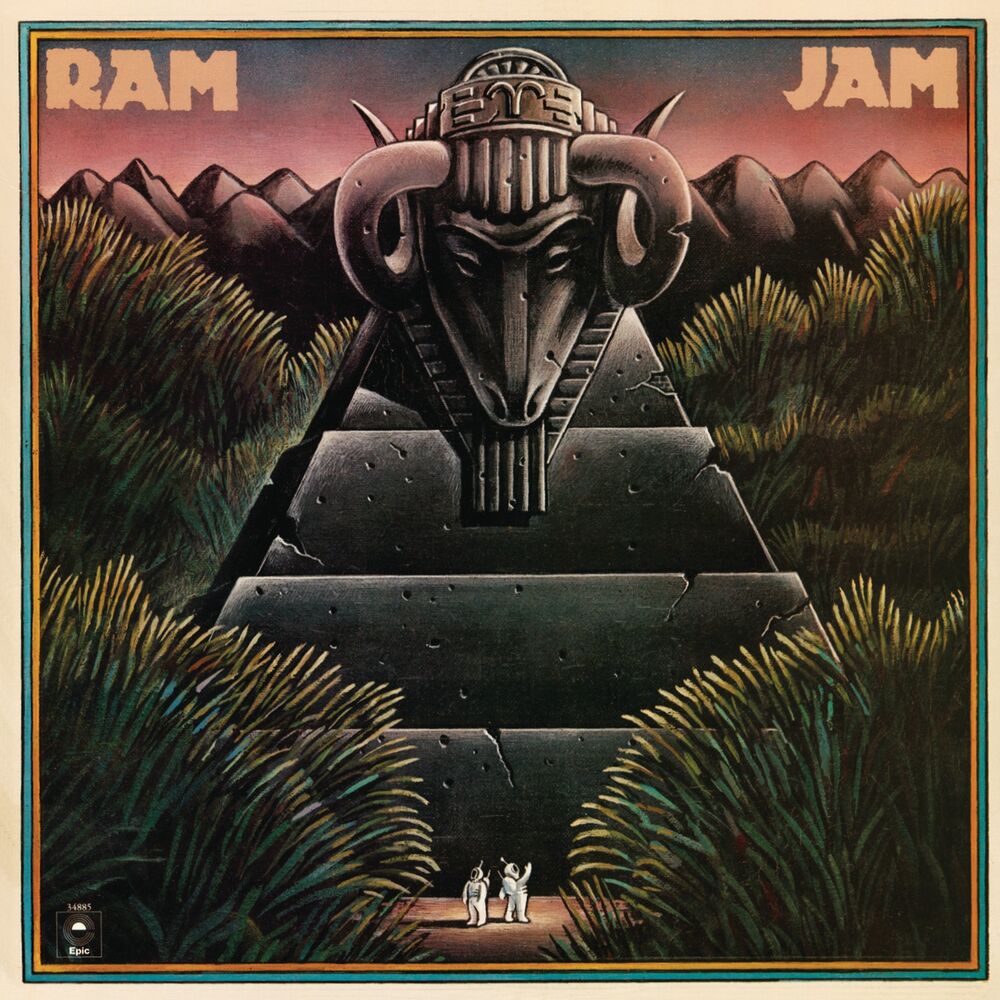
One track from it charted as a single. Press a flag to play it in the chart where it peaked.
Tracks
| 1 | 3:57 | ||
| 2 | Let It All Out | 4:00 | |
| 3 | Keep Your Hands on the Wheel | 3:41 | |
| 4 | Right on the Money | 3:01 | |
| 5 | All for the Love of Rock N' Roll | 3:01 | |
| 6 | 404 | 3:44 | |
| 7 | High Steppin' | 3:40 | |
| 8 | Overloaded | 2:56 | |
| 9 | Hey Boogie Woman | 3:10 | |
| 10 | Too Bad on Your Birthday | 3:10 |
About the album
Ram (also stylised in all caps) is the only studio album credited to the spousal music duo Paul and Linda McCartney, and the former's second solo album after leaving the Beatles. Released in May 1971 through Apple Records, it was recorded between October 1970 and April 1971 in New York City and Los Angeles with guitarists David Spinozza and Hugh McCracken and future Wings drummer Denny Seiwell. Paul included Linda in the project because she helped him get through a difficult period following the Beatles' break-up. The recording sessions yielded over 20 songs, including the non-album single "Another Day" / "Oh Woman, Oh Why", released in February 1971.
The album's creation coincided with a period of acrimony between McCartney and the other former Beatles, including his legal action in the United Kingdom's High Court of Justice to dissolve the Beatles partnership. His feelings at the time were reflected in the album's lyrics, which included digs at John Lennon in "Too Many People" (which he responded to with "How Do You Sleep?"), while others centre on the McCartneys' relationship and life in rural Scotland. Ram features an eclectic mix of styles, including 1950s rock and roll, blues, country, jazz and folk. The album's title evokes the idea of pushing forward in the face of negativity.
Background
Following the break-up of the Beatles and the release of his first solo album McCartney (1970), Paul McCartney wanted to try something new for his next project. While McCartney is a minimalist record featuring him on every instrument, he was now thinking more ambitiously, wanting superb session players and the best studios. In the 2025 book Wings: The Story of a Band on the Run, he describes Ram as a response to his first album's reception: "... it didn't do well with critics; some of those reviews were pretty vicious. So I thought, 'Okay – I'll do the opposite next time, then!' So Ram was done with the top people in the top studio." Having written at least 30 songs during the summer of 1970, McCartney and his family travelled by boat from London to New York City in October to begin auditions for musicians; they were gathered under the guise of recording a commercial jingle.
Auditions began on 9 October 1970 in the basement of an old apartment building on Manhattan's 43rd Street.
Artwork and packaging
The album's title came to Paul one day when he and Linda were driving in England: "I remember driving up to Liverpool at some point and deciding that Ram would be a good title for the album, then the picture came, and you can 'ram' a door down, and a 'ram' is a male, like a stag. It just seemed like a good word." He also said "there was the idea of ramming ... pushing ahead strongly". The cover artwork depicts Paul McCartney grabbing a ram's horns. Photographed by Linda in black and white, Paul cut the top off the original picture and glued it onto a piece of cardboard. From there, he coloured in the remaining image with magic markers, using yellow for the sky, a blue rectangular outline for the album title, and a purple, red, yellow and green zigzag border.
Release and promotion
Before Ram's recording was completed, "Another Day" / "Oh Woman, Oh Why" was released as McCartney's debut solo single on 19 February 1971 in the UK and three days later in the US. It became a worldwide hit, reaching number 2 in the US, number 5 in the UK, and the top 10 in 17 other countries. According to the author Michael Frontani, "Another Day" introduced McCartney's new musical direction, emphasising his and Linda's vocals, while "Oh Woman, Oh Why" showcased that he still possessed the vocal power he demonstrated on early Beatles singles such as "Long Tall Sally" (1964) and "I'm Down" (1965).
Ram was released through Apple Records on 17 May 1971 in the US and four days later in the UK. It is the only album credited jointly to Paul and Linda McCartney. Asked why he credited the album to both of them in 2012, Paul said:
It was a co-effort. On a few songs, we actually sat down and worked them out together. I would sit in the kitchen, plonking away, and she’d sing something and I'd write it down. But the most important thing was her support at the time. It was our album.
Critical reception
Upon its release, Ram was panned by music critics. In a particularly vitriolic review for Rolling Stone, Jon Landau said the album "represented the nadir in the decomposition of Sixties rock thus far". Further calling it "incredibly inconsequential" and "monumentally irrelevant", he wrote that the album exposes McCartney as having benefited from working with the Beatles, particularly Lennon, who "held the reins in on McCartney's cutsie-pie, florid attempts at pure rock muzak" and kept him from "going off the deep end that leads to an album as emotionally vacuous as Ram". McCartney was hurt by the harsh reviews, as he had attempted to address the points raised in criticism of McCartney by taking a more professional approach.
Other critics were vehement in their reactions to Ram.
Reissues
Ram, along with McCartney's Wings over America (1976) and Tug of War (1982) albums, was issued in the US on compact disc on 18 January 1988. In 1993, the album was remastered and reissued on CD as part of The Paul McCartney Collection series with "Another Day" and "Oh Woman, Oh Why" as bonus tracks.
On 21 May 2012 (in the UK) and 22 May (in the US), the album was reissued by McCartney's current label, Hear Music, as part of the Paul McCartney Archive Collection. This reissue included a new remaster of the original album, the mono mix (appearing officially for the first time on compact disc), various bonus tracks from the recording sessions, the original Thrillington album, a DVD of films and music videos (including a documentary on the album's making), a 112-page book about the album's history and various memorabilia. The mono version was also released commercially in 2012 as a limited edition LP.