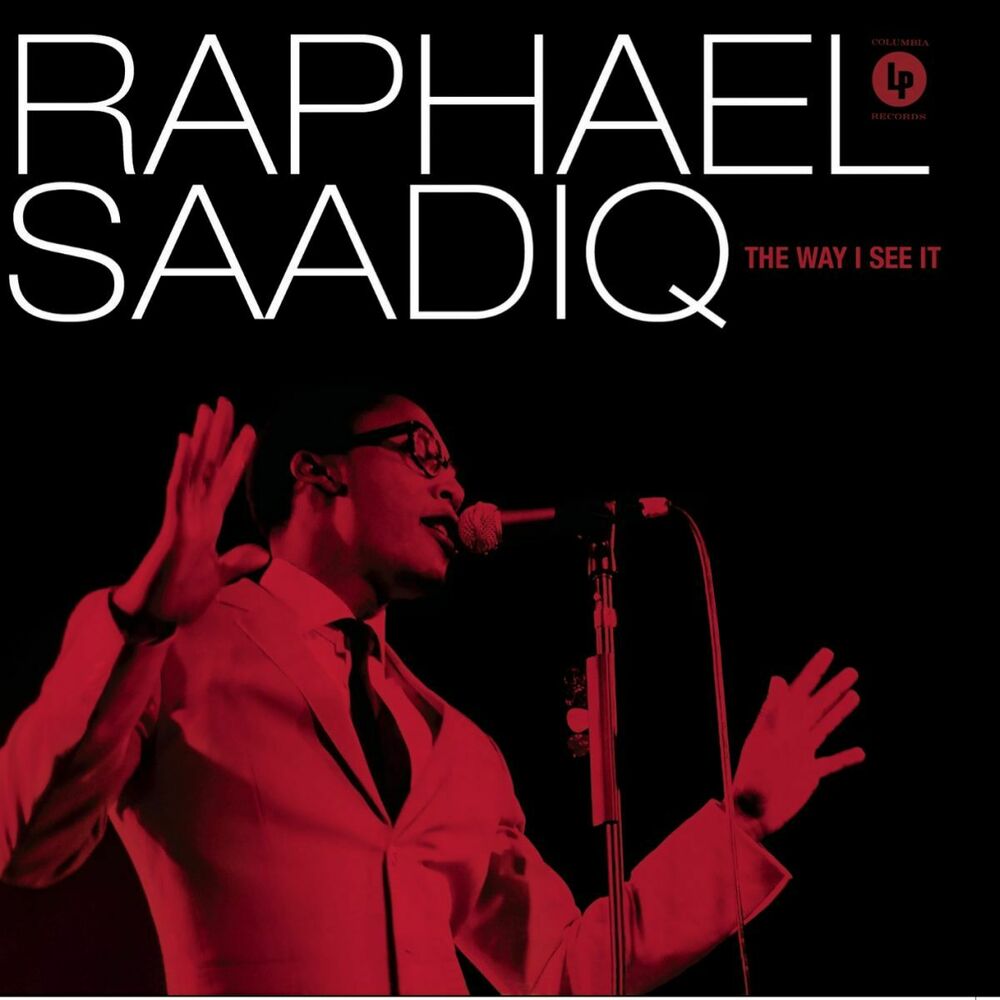
The Way I See It
- Released15 September 2008
- UK peak No. 75
- Weeks on UK chart 2
- Entered UK chart 3 May 2009
- LabelColumbia
- Tracks13 · 42 min
Tracks
| 1 | Sure Hope You Mean It | 3:40 | |
| 2 | 100 Yard Dash | 2:18 | |
| 3 | Keep Marchin' (Album Version) | 2:38 | |
| 4 | Big Easy (feat. The Infamous Young Spodie & The Rebirth Brass Band) (Album Version) | 3:19 | |
| 5 | Just One Kiss (feat. Joss Stone) (Album Version) | 2:32 | |
| 6 | Love That Girl | 3:04 | |
| 7 | Calling | 3:45 | |
| 8 | Staying In Love (Album Version) | 2:54 | |
| 9 | Oh Girl | 3:35 | |
| 10 | Let's Take a Walk | 2:28 | |
| 11 | Never Give You Up (feat. Stevie Wonder & CJ) (Album Version) | 4:12 | |
| 12 | Sometimes (Album Version) | 4:04 | |
| 13 | Oh Girl (feat. JAY-Z) (featuring Jay-Z) | 3:41 |
About the album
The Way I See It is the third album by the American R&B singer, songwriter, and producer Raphael Saadiq. It was released on September 16, 2008, by Columbia Records – his first for the label. Prior to signing with Columbia, Saadiq had independently released his 2004 album Ray Ray, recorded with the songwriting and production duo Jake and the Phatman. He developed a creative partnership with their colleague, audio engineer Charles Brungardt, who shared Saadiq's fascination with historic recording techniques and equipment. In 2008, the singer returned from a vacation that had inspired him to pursue classic soul music and recorded The Way I See It primarily at his North Hollywood studio with Brungardt.
Saadiq and Brungardt disregarded their previous experience in recording production while making The Way I See It. Instead, they experimented with older recording techniques in an attempt to recreate the Motown music aesthetic of the 1960s, producing a traditional soul album that emphasizes upbeat hooks and draws on the Motown Sound and Philadelphia soul styles. Saadiq, whose lyrics mostly deal with romantic subject matter, described it as a series of love songs about music and remaining faithful to it despite trends.
Background
After independently releasing his second studio album Ray Ray in 2004, Raphael Saadiq continued working as a producer, composer, and instrumentalist on other recording artists' music. He was introduced to audio engineer Charles Brungardt through production and songwriting team Jake and the Phatman, who had worked on Ray Ray. Brungardt interned at Blakeslee Recording Company, Saadiq's North Hollywood recording studio, and eventually became his principal sonic partner on projects. The two shared a fascination with historic recording techniques and equipment. They also studied the 2006 book Recording the Beatles together and had an interest in the knowledge of recording gear by engineers and technicians for the English rock band the Beatles.
Recording and production
After returning from his vacation, Saadiq started writing and recording The Way I See It, which took four months. In an interview for Sound on Sound, he discussed his comfort level when returning to Blakeslee Recording Company: "The music for this album flowed organically, naturally, and since I have my own studio I was able to perfect it and take my time to make it right. I was able to live with it day after day, and I think that had a lot to do with how the album turned out." He wrote the songs extemporaneously, often by playing guitar and improvising riffs. He subsequently sung them while playing each instrument one at a time, including guitar, bass, and basic piano parts that he planned to include on the recordings. He attributed this secluded approach to "the state of the industry" and idealized "bounc[ing] ideas off other people, do some writing with them, take the material to my band and say, 'OK, let's cut it,' with the orchestra already there. That's my dream.
Music and lyrics
The Way I See It has a traditional soul style fashioned after the 1960s Motown Sound and Philadelphia soul. It is a departure from Saadiq's previous work with neo soul, which bears a hip hop influence. J. Gabriel Boylan of The New York Observer said that Saadiq expands further beyond his work as a producer for other recording artists, for whom he encouraged a "classic aesthetic, heavy on organic sounds and light on studio magic, deeply indebted to the past and distrustful of easy formulas". BBC Music's Chris Jones interpreted Saadiq's use of 1960s soul as the album's source material to be a reflection of "America's most recent great political and cultural shift ... the first true post-Obama expression of hope in record form." Saadiq viewed his rootsy direction as a response to the state of popular music and found it analogous to modern politics: "You force so many terrible things on people, they get tired of it.
Title and packaging
Saadiq titled The Way I See It as a declaration to listeners about how his perspective was more informed by classic soul than before in his career. "This is what I really love", he later explained. "And everything you've heard from me before has been based on the roots of this music."
The cover photo was taken at a show in 2006 at Sweet's Ballroom in Oakland, in which Saadiq performed Marvin Gaye's 1965 song "Ain't That Peculiar". It showed Saadiq singing into a microphone with his arms raised and wearing a suit, tie, and thick-rimmed glasses: a look similar to that of Temptations singer David Ruffin. According to Saadiq, the photo "set the tone for the whole album ... me singing that song, me wearing that suit, it said everything that this album should be." Music journalist Greg Kot believed the cover "evokes the dramatic portraits and color schemes of old-school jazz and soul albums. Think Ray Charles on Atlantic, Sonny Rollins on Blue Note, Sam and Dave on Stax ...
Marketing and sales
Before completing The Way I See It, Saadiq previewed its songs in May 2008 to music industry associates and journalists at the Sony Club in New York City. He also planned a grassroots marketing strategy for the record, which evolved from his difficulty with Columbia executives to promote the album and their idea of issuing its songs as vinyl records. He felt that "nobody at the label knew" him in an interview with The Dallas Morning News: "They had this record that I turned in that sounded like a '60s record. 'What the hell do we do with this record?' It was quality. There was not a lot of marketing and promotion, but they knew I had the credibility so you don't just throw it in the garbage ... I don't mind being a slow burn because that's actually a better road to take. I have to go in one more time and prove myself again because I am starting over again."
In September 2008, Columbia released the album both on CD and as a collector's edition box set with 7-inch vinyl singles.
Critical reception
The Way I See It was met with generally positive reviews. At Metacritic, which assigns a normalized rating out of 100 to reviews from professional publications, the album received an average score of 79, based on 20 reviews. Aggregator AnyDecentMusic? gave it 7.2 out of 10, based on their assessment of the critical consensus.
Reviewing the album for The Guardian in April 2009, Caroline Sullivan found it flawlessly produced and performed by Saadiq, while Rolling Stone magazine's Will Hermes said the record showcased an original take on classic Northern soul. Andy Gill of The Independent wrote that it was one of 2008's most captivating albums because "few have managed to retro-fabricate that classic sound so accurately, nor in as many subtle variations" like Saadiq. AllMusic's Andy Kellman stated, "Here's where a modern master, backed by living and breathing session musicians ...