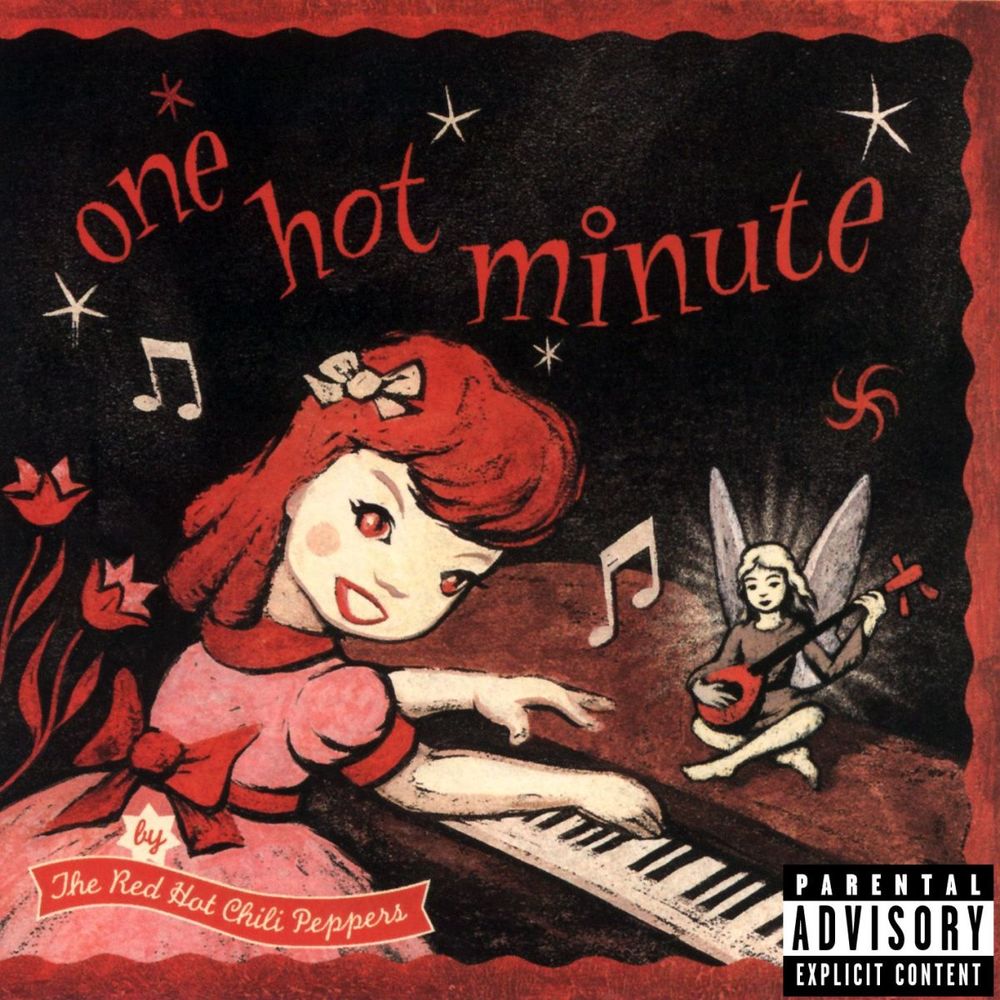
One Hot Minute (Deluxe Edition)
- Released29 August 1995
- UK peak No. 2
- Weeks on UK chart 16
- Entered UK chart 17 September 1995
- LabelWarner Records
- Tracks16 · 79 min
3 tracks from it charted as singles. Press a flag to play it in the chart where it peaked.
Tracks
| 1 | Warped No. 31 · 1995 | 5:04 | |
| 2 | Aeroplane No. 11 · 1996 | 4:45 | |
| 3 | Deep Kick | 6:33 | |
| 4 | My Friends No. 29 · 1995 | 4:08 | |
| 5 | Coffee Shop | 3:08 | |
| 6 | Pea | 1:47 | |
| 7 | One Big Mob | 6:02 | |
| 8 | Walkabout | 5:07 | |
| 9 | Tearjerker | 4:19 | |
| 10 | One Hot Minute | 6:23 | |
| 11 | Falling into Grace | 3:48 | |
| 12 | Shallow Be Thy Game | 4:33 | |
| 13 | Transcending | 5:46 | |
| 14 | Let's Make Evil (2006 Remaster) | 5:17 | |
| 15 | Stretch You Out (2006 Remaster) | 6:18 | |
| 16 | Bob (2006 Remaster) | 5:43 |
About the album
One Hot Minute is the sixth studio album by American rock band Red Hot Chili Peppers, released on September 12, 1995, by Warner Bros. Records. The worldwide success of the band's previous album Blood Sugar Sex Magik (1991) caused guitarist John Frusciante to become uncomfortable with their popularity, eventually quitting mid-tour in 1992. Following a series of short-term replacements, the band hired guitarist Dave Navarro in 1993; it was his only studio album with the band. Recording for the album took place at the Sound Factory in Hollywood from June 1994 to February 1995. It marked the second collaboration between the band and producer Rick Rubin.
One Hot Minute moves away from the funk of Blood Sugar Sex Magik, instead favoring heavier riffs and, at times, veering toward a psychedelic rock sound. This shift was primarily due to the influence of Navarro, formerly of Jane's Addiction. Vocalist Anthony Kiedis, who had resumed addictions to cocaine and heroin in 1994 after being sober for more than five years, approached his lyricism with a reflective outlook on drugs and their harsh effects. As such, the lyrics reflect mostly dark and melancholy themes.
Background
Red Hot Chili Peppers had released Blood Sugar Sex Magik in 1991. The album was an instant hit, selling more than seven million copies in the United States, and turned the band into an international sensation. Guitarist John Frusciante was having difficulty coping with the band's newfound fame and began to dislike it. Frusciante often argued with his band mates and sabotaged performances. He began taking heroin and steadily increased his usage of the drug over time. Frusciante ultimately quit the band in 1992, during the Japanese leg of their tour. Frusciante returned to his home in California and became a recluse.
Stunned, the remaining Chili Peppers, who had no suitable replacement, hired Arik Marshall to play the remaining dates after being forced to reschedule. Upon returning to Hollywood, the band placed an ad in the L.A. Weekly for open guitar auditions, which Kiedis considered to be a waste of time. After several months of unsuccessfully looking for a suitable guitarist, drummer Chad Smith suggested Dave Navarro.
Recording and production
Kiedis knew that the band's sound would inevitably change when Navarro joined. In June 1994, the band entered The Sound Factory, a recording studio in Los Angeles, to begin recording its next album. The band completed a few basic tracks before Kiedis began having difficulty singing. He'd been through a dental procedure in which an addictive sedative, Valium, was used. The medication triggered a relapse, and he once again became dependent on drugs. Kiedis had slipped from five years of sobriety and began reusing narcotics he'd sworn never to use again. The band took a short break from recording to perform at Woodstock '94, the first show Navarro played with the Peppers.
After resuming production, Navarro questioned the methods of the Peppers' recording procedures. He wondered why such a considerable amount of jamming was involved with the album's conception. Various qualms followed, and the process soon became uncomfortable for the band. Months went by, and only small amounts of material were written.
Writing and composition
Considering that Kiedis had resumed heavy drug use and Frusciante was no longer present for collaboration, songs were written at a far slower rate. Working with Frusciante had been something Kiedis took for granted: "John Frusciante had been a true anomaly when it came to song writing. He made it even easier than Hillel Slovak to create music, even though I'd known Hillel for years. I just figured that was how all guitar players were, that you showed them your lyrics and sang a little bit and the next thing you knew you had a song. That didn't happen right off the bat with Dave." Drummer Chad Smith suggested it was writer's block that was holding Kiedis back from coming up with lyrics, however Kiedis strongly denied this. With the writing process taking too much time and Kiedis returning to his drug habit, for the first time on any of the band's albums, Flea, besides contributing music as usual, wrote some of the lyrics, including "Transcending", his tribute to River Phoenix along with the intro and outro to "Deep Kick", a song that told the story of his and Kiedis's youth.
Promotion and release
While piecing together the final components of the album, the band recorded a video for "Warped". They asked Flea's brother-in-law, Gavin Bowden, to direct it. The video feature the members of the band scantily clad and involved Kiedis and Navarro kissing towards the end as a way of breaking the monotony of cumbersome video recording. Thinking nothing of it, they continued to shoot and finished several days later. Warner Bros., however, saw the video and instantly wanted it thrown away, considering it to be unmarketable and that the kiss and the homoerotic imagery would alienate a large portion of the band's fan base. The band came to a consensus to let the kiss remain on the final cut, prompting a backlash from the college segment of their audience, who took offense at the action. Kiedis said of the situation: "If they couldn't accept what we were doing, we didn't need them anymore."
One Hot Minute was released on September 12, 1995. It was certified Gold just more than two months later on November 11; since then it has gone Double Platinum in the United States.
Critical reception
One Hot Minute was not as universally well received as Blood Sugar Sex Magik, and was ultimately considered to be a poor follow-up. It did, however, receive mixed to positive reviews from critics. Daina Darzin of Rolling Stone said "One Hot Minute dives into the emotionally deep end of drug addiction and loss", and that the album "is a ferociously eclectic and imaginative disc that also presents the band members as more thoughtful, spiritual—even grown-up. After a 10 plus-year career, they're realizing their potential at last." David Browne of Entertainment Weekly said that "One Hot Minute wails and flails like a mosh-pit workout tape, but it also has moments of outright subtlety and maturity." He goes on to praise Kiedis for "keeping his boorish tendencies under control." Browne, however, criticizes the band for "attempts at cosmic philosophy which often trip up on hippie-dippie sentiments", and some songs "fall back on tired frat-funk flop sweat." "The Peppers work their own little patch with considerable expertise," wrote Peter Kane in Q.