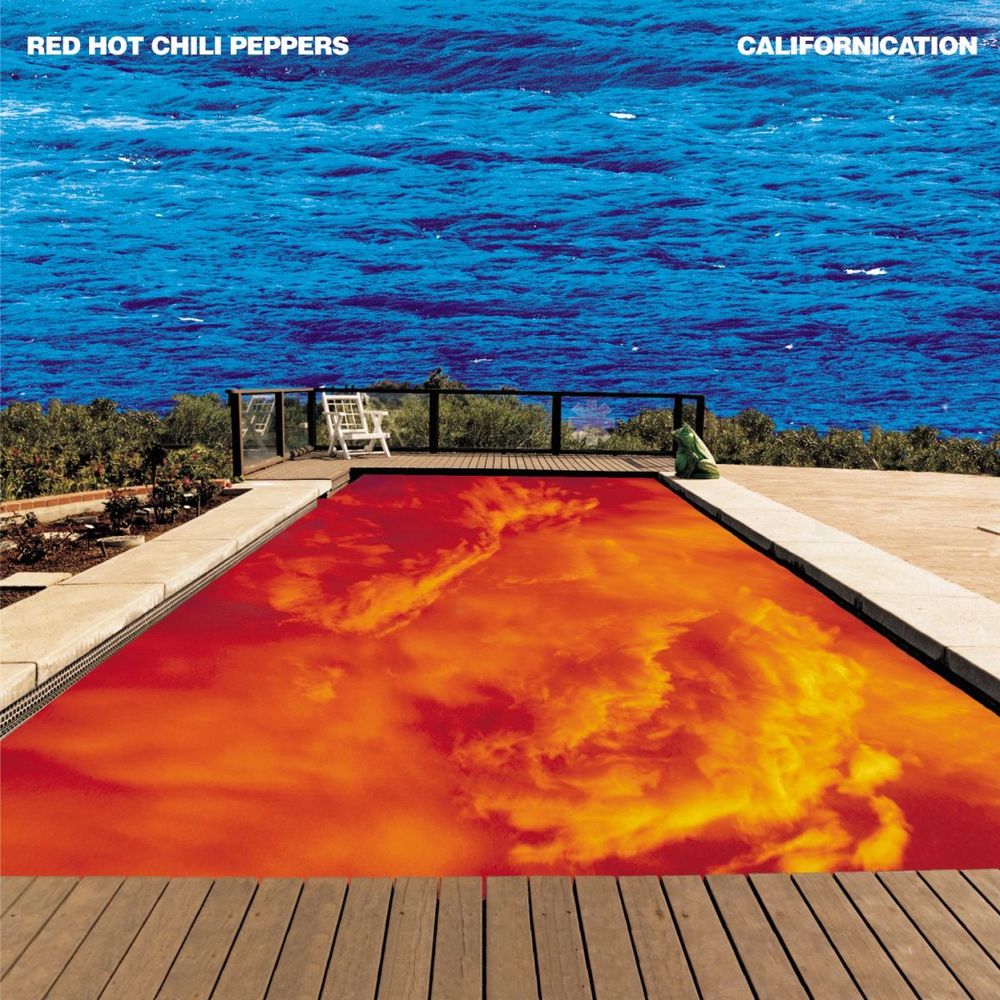
Californication
- Released7 June 1999
- UK peak No. 5
- Weeks on UK chart 169
- Entered UK chart 13 June 1999
- LabelWarner Records
- Tracks15 · 56 min
5 tracks from it charted as singles. Press a flag to play it in the chart where it peaked.
Tracks
| 1 | Around the World No. 35 · 1999 | 3:58 | |
| 2 | Parallel Universe | 4:29 | |
| 3 | 3:35 | ||
| 4 | 4:15 | ||
| 5 | Get on Top | 3:18 | |
| 6 | 5:29 | ||
| 7 | Easily | 3:51 | |
| 8 | Porcelain | 2:43 | |
| 9 | Emit Remmus | 4:00 | |
| 10 | I Like Dirt | 2:37 | |
| 11 | This Velvet Glove | 3:45 | |
| 12 | Savior | 4:52 | |
| 13 | Purple Stain | 4:13 | |
| 14 | Right on Time | 1:52 | |
| 15 | Road Trippin' No. 30 · 2001 | 3:25 |
About the album
Californication is the seventh studio album by the American rock band Red Hot Chili Peppers, released on June 8, 1999, on Warner Bros. Records. It was produced by Rick Rubin. Along with Blood Sugar Sex Magik, Californication is one of the band's best-selling albums.
Californication marked the return of guitarist John Frusciante, who'd previously appeared on Mother's Milk and Blood Sugar Sex Magik, and shifted the band's style. The lyrics incorporated the sexual innuendos already associated with the band, but added themes including death, California, suicide, drugs, globalization and travel.
Californication is the Chili Peppers' most commercially successful studio release to date, with more than 17 million copies sold worldwide, and more than eight million in the United States alone. As of 2002, the album had sold more than four million copies in Europe. The record yielded several hits for the band, including "Otherside," the title track and the Grammy Award-winning "Scar Tissue." Californication peaked at number three on the U.S. Billboard 200.
The record marked a significant change in style for the band: Rolling Stone's Greg Tate noted that "while all previous Chili Peppers projects have been highly spirited, Californication dares to be spiritual and epiphanic".
Background
In 1991, the Red Hot Chili Peppers released their breakthrough album Blood Sugar Sex Magik on Warner Bros. Records. The album sold seven million copies in the United States, and became a seminal component of the alternative rock explosion in the early 1990s. After the release of Blood Sugar Sex Magik, guitarist John Frusciante left the Red Hot Chili Peppers, as he became overwhelmed by the band's newfound popularity. Dave Navarro was hired as his replacement, and incorporated elements of heavy metal and psychedelic rock on the band's 1995 album One Hot Minute. The album failed to match the critical and commercial success of its predecessor, and Navarro left in early 1998.
In the years following his departure, Frusciante became addicted to heroin and cocaine, leaving him in poverty and near death. Friends convinced Frusciante to enter drug rehabilitation, and in 1998, he rejoined the Red Hot Chili Peppers at the insistence of bassist Flea.
Writing and recording
The majority of the music for Californication was written at Flea's makeshift garage studio in the summer of 1998. It took Frusciante several weeks to readjust to playing with bandmates, especially while recovering from drug addiction. Singer Anthony Kiedis noted that as a result of this readjustment period, Frusciante adopted a minimalist approach to guitar playing. According to biographer Jeff Apter, the Red Hot Chili Peppers wrote between 30 and 40 songs for the album, which would eventually get distilled to 15 for the release. The band members took on a laid-back approach to writing music. As Kiedis said: "Everyone was having fun. It was as if we had nothing to lose, nothing to gain. We didn't care; we were making music for the sake of making music."
Californication was recorded at Cello Studios in Los Angeles, and took a little over three weeks to complete. The band chose Rick Rubin to produce the album. Rubin had worked with the Red Hot Chili Peppers on their two previous albums, and Kiedis noted that there was some hesitation to reenlist him.
Composition
Most of the material and lyrics throughout the songs in the album came from the "personal and professional turmoil" that different members of the band went through or were currently going through at the time. This resulted in the "sensitive approach that one might not expect from a band whose followers are skate-punks and fraternity boys". Kiedis's main point behind this album was to "tell tales of wandering souls who've lost their way searching for the American dream in California".
Californication's lyrics were derived from Kiedis' ideas, outlooks, and perceptions of life and its meaning. "Porcelain" resulted from Kiedis' meeting with a young single mother at the YMCA, who was attempting to battle her heroin addiction while living with her infant daughter in Los Angeles during the summer of 1998. Regarding the meeting that inspired the song, Kiedis said in 1999, "[the] Mum's in a haze, strung out on heroin, but the little girl's this beaming-wide sunball of an angel.
Promotion and release
To promote Californication, the Red Hot Chili Peppers developed what biographer Jeff Apter called an "Internet presence opening themselves up to a whole new type of listener – the cyber geek." From June 4 to June 8, three new Californication songs were streamed every day on the band's website. Flea engaged with fans online with a series of Internet posts called "Fleamail", in which he would discuss the recording process, upcoming tour dates, and occasionally stream of consciousness style thoughts about his life. The Red Hot Chili Peppers also performed at various high school proms across the United States shortly before the release of the album. The idea was to reintroduce the Red Hot Chili Peppers to a younger audience. The theme of these performances was "Stop The Hate", which was in response to the Columbine High School massacre. The price of admission was a written suggestion on how to prevent bullying and hatred among high school students.
Californication was released on June 8, 1999, by Warner Bros. Records.
Critical reception
Californication was very well-received by music critics in contrast to One Hot Minute and it was a greater success worldwide. Rolling Stone credited Kiedis for his drastically improved vocals: "[his] vocal cords have apparently been down to some crossroads and over the rehab, and returned with heretofore unheard-of range, body, pitch, soulfulness, and melodic sensibility." Songs such as "Otherside" and "Porcelain" were called "Pumpkins-esque", while the album as a whole was "epiphanal" and the "RHCP furthermuckers are now moving toward funk's real Holy Grail: that salty marriage of esoteric mythology and insatiable musicality that salvages souls, binds communities and heals the sick." Howard Cohen hailed Californication as a major improvement over its predecessor in the Miami Herald, finding it features the band's "most accomplished music" to date. The Edmonton Journal's Sandra Sperounes predicted that the "mighty dope" album would be a success, and "Scar Tissue" and "Otherside" would be chart toppers.