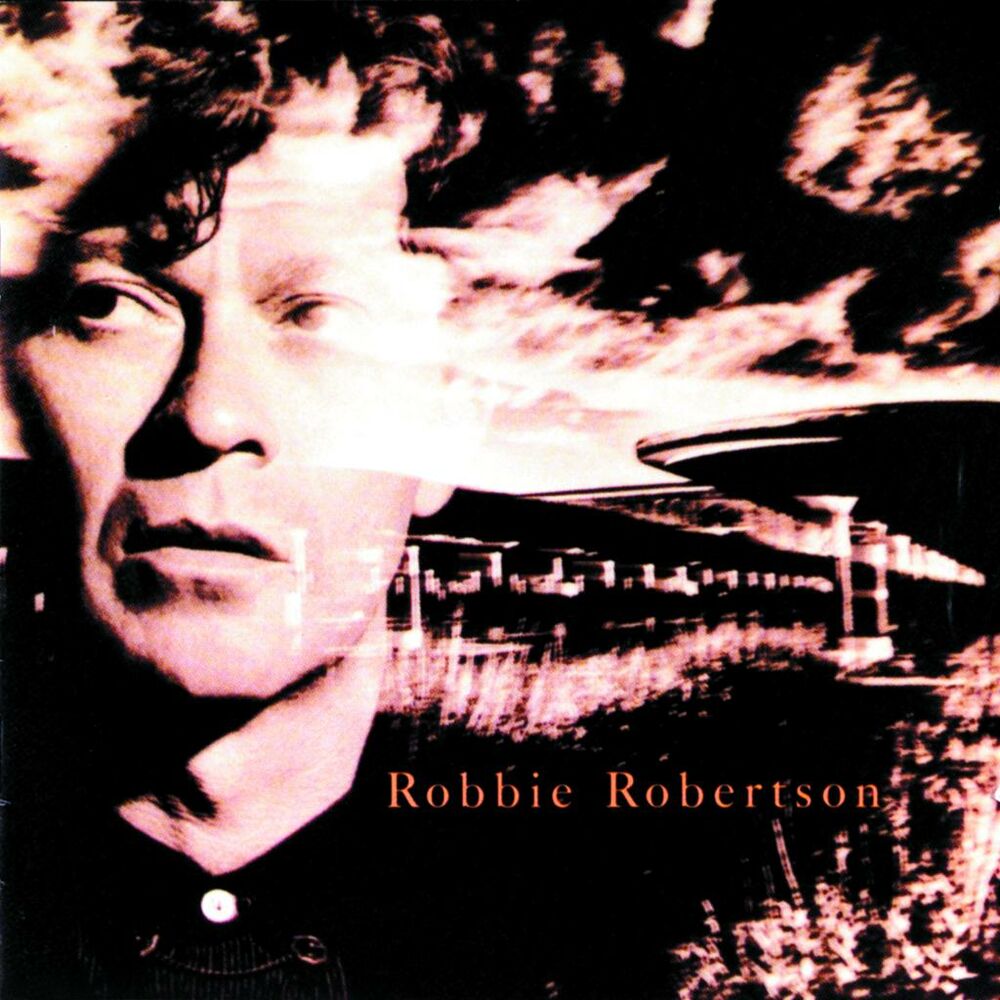
Robbie Robertson
- Released20 March 1999
- UK peak No. 23
- Weeks on UK chart 14
- Entered UK chart 8 November 1987
- LabelGeffen
- Tracks9 · 44 min
2 tracks from it charted as singles. Press a flag to play it in the chart where it peaked.
Tracks
| 1 | Fallen Angel No. 95 · 1988 | 5:54 | |
| 2 | Showdown At Big Sky | 4:48 | |
| 3 | Broken Arrow | 5:23 | |
| 4 | Sweet Fire Of Love | 5:17 | |
| 5 | American Roulette | 4:57 | |
| 6 | Somewhere Down The Crazy River No. 15 · 1988 | 4:58 | |
| 7 | Hell's Half Acre | 4:21 | |
| 8 | Sonny Got Caught In The Moonlight | 3:52 | |
| 9 | Testimony | 4:50 |
About the album
Robbie Robertson is the solo debut album by Canadian rock musician Robbie Robertson, released in 1987. Though Robertson had been a professional musician since the late 1950s, notably a founder of and primary songwriter for The Band, this was his first solo album. Robbie Robertson won the Juno Award for "Album of the Year", and producers Daniel Lanois and Robertson won the "Producer of the Year" Juno award, both in 1989; there were no Juno Awards in 1988.
The album includes contributions from Rick Danko and Garth Hudson of The Band, as well as U2 and Peter Gabriel, both of whom had worked with Lanois. U2 were recording The Joshua Tree concurrent to the early stages of this album, and Gabriel had recorded So the previous year. U2's contributions are heard in the song "Sweet Fire of Love", a duet of sorts between Robertson and U2 lead singer Bono, and in "Testimony" again featuring backing by U2. Gabriel's contributions are heard on the song "Fallen Angel", which was dedicated to Richard Manuel, Robertson's former bandmate in The Band, and "Broken Arrow", which reverberates with Gabriel's signature Yamaha CP-80 electric piano. In addition, Tony Levin and Manu Katché, who were recording with Gabriel, are featured prominently on this record.
In 2005 the album was reissued together with its follow-up, Storyville, as a two-CD set, in an expanded edition, each with two bonus tracks.
Background
After a lengthy sabbatical, Robertson announced via a 1983 article in Billboard magazine that he was returning and available to work on projects. Film producer Art Linson encouraged Robertson to focus on creating a solo record when the two vacationed together in Rome that same year. Robertson then began conceptualizing the idea, starting with creating a setting called "The Shadowland" where the songs in the album would take place. Robertson imagined The Shadowland to be a mythical place "that moves around according to [the] clouds that cover [it]", and imagined himself to be a wanderer who would narrate the events that would take place in this mythical locale.
Robertson was signed to EMI Records by then head of A&R and longtime The Band fan Gary Gersh. Preliminary discussions and preproduction for Robertson's first solo album began in autumn 1984. Gersh then moved to Geffen Records, and convinced the label to buy out Robertson's contract with EMI.
Robertson spent $50,000 on pre-production work traveling across Europe to vet potential producers.
Recording
Robertson kept an office on the property of the recording studio The Village Recorder in West Los Angeles, California, where he would work out ideas for the album. Much of the album was recorded there. Robertson's basic backing band included guitar player Bill Dillon, a friend of Lanois' who had also played for Ronnie Hawkins, as well as bass player Tony Levin, and Parisian drummer Manu Katché. Robertson brought in drummer Terry Bozzio after Katché had to return to Paris. Robertson also brought in The BoDeans to provide group vocals for some of the tracks on the album, most notably on "Showdown at Big Sky". BoDeans member Sam Llanas created a faux female voice that was used on the chorus of "Somewhere Down the Crazy River".
Release
Released on October 26, 1987, Robbie Robertson peaked at No. 35 on the Billboard 200, remaining in the Top 40 for 3 weeks. Prior to the album's release, Radio & Records announced that Westwood One would air a radio special titled The Robbie Robertson Album Premiere Party. The publication said that the radio special would be hosted by Sky Daniels of San Francisco's KFOG on October 22 and feature a Q&A portion where listeners could call a toll-free hotline to ask Robertson questions about his career and debut album.
Robbie Robertson produced several hits on the Billboard Mainstream Rock charts, with "Showdown at Big Sky" coming in the highest (No. 2) and "Sweet Fire of Love" the second highest (no. 7). The album was nominated for a Grammy Award for "Best Rock / Vocal Album". Robbie Robertson was certified gold in the United States in 1991. Music videos for "Fallen Angel" and "Showdown at Big Sky" were also created on the Acoma Pueblo American Indian reservation in New Mexico.
Critical reception
Robbie Robertson was well received at the time of its release. The Canadian music magazine RPM thought that the album had "several really lean numbers" and that it would unlikely go unnoticed with the contributions of U2 and Peter Gabriel. In their review of the album, the pan-European magazine Music & Media felt that the album had "a beautiful blend of material", with its musical roots "solidly in US soil" and the presence of Gabriel and U2 providing additional "European influences" to the tracks. Billboard called it a "beautifully realized first solo work" with a "powerful collection of songs". Cashbox felt that the album was a "creatively stunning, spiritually fulfilled work" with "astute and penetrating" lyrics.
The album was listed in the Top Ten Albums of the Year by several of the critics in Billboard magazine's 1987 "The Critics' Choice" end-of-the-year feature, and in February 1988, the album was listed in Stereo Review magazine's "Best Recordings of The Month" feature. In 1989, the album was listed as No. 77 in Rolling Stone's "100 Best Albums of the Eighties".