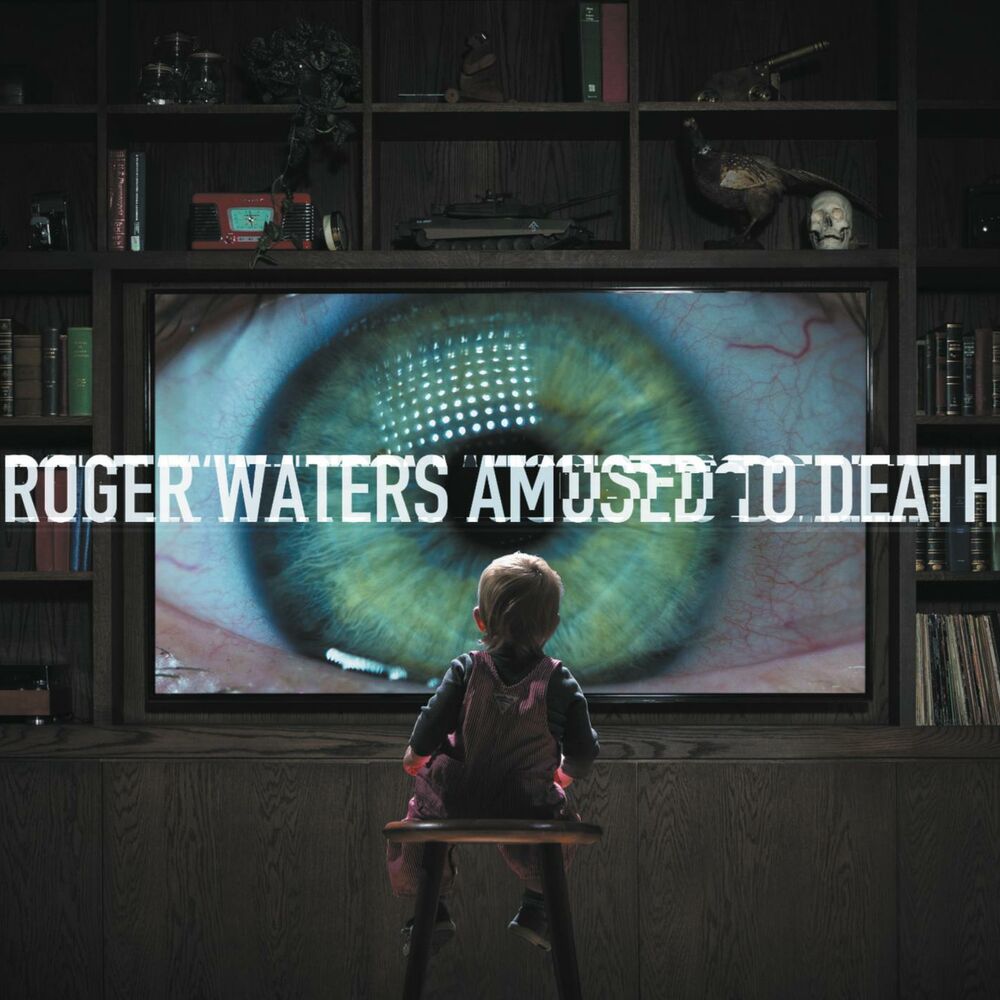
Amused to Death
- Released24 July 2015
- UK peak No. 8
- Weeks on UK chart 6
- Entered UK chart 13 September 1992
- LabelColumbia/Legacy
- Tracks14 · 73 min
Tracks
| 1 | The Ballad of Bill Hubbard | 4:19 | |
| 2 | What God Wants, Pt. I | 6:00 | |
| 3 | Perfect Sense, Pt. I | 4:16 | |
| 4 | Perfect Sense, Pt. II | 2:51 | |
| 5 | The Bravery of Being Out of Range | 4:43 | |
| 6 | Late Home Tonight, Pt. I | 4:01 | |
| 7 | Late Home Tonight, Pt. II | 2:13 | |
| 8 | Too Much Rope | 5:47 | |
| 9 | What God Wants, Pt. II | 3:42 | |
| 10 | What God Wants, Pt. III | 4:18 | |
| 11 | Watching TV | 6:08 | |
| 12 | Three Wishes | 6:50 | |
| 13 | It's a Miracle | 8:30 | |
| 14 | Amused to Death | 9:07 |
About the album
Amused to Death is the third studio album by the English singer-songwriter Roger Waters, released on 7 September 1992 by Columbia Records. Produced by Waters and Patrick Leonard, it was mixed in QSound to enhance its spatial feel. The album features Jeff Beck on lead guitar on several tracks. The album's title was inspired by Neil Postman's 1985 book Amusing Ourselves to Death.
In 2015, the album was remixed and re-released with new artwork and in different formats, including a new 5.1 surround sound mix by original engineer James Guthrie, assisted by Joel Plante.
Background and production
Roger Waters started working on Amused to Death in 1987 when he first wrote "Perfect Sense." It was several years before the album was released.
Amused to Death was produced by Waters and Patrick Leonard, with co-production by Nick Griffiths. It was recorded in London at The Billiard Room, Olympic Studios, CTS Studios, Angel Recording Studios and Abbey Road Studios. The album was engineered by Hayden Bendall, Jerry Jordan, and Stephen McLaughlan and mixed by James Guthrie. The album is mixed in QSound to enhance the spatial feel of the audio, and the many sound effects on the album – rifle range ambience, sleigh-bells, cars, planes, distant horses, chirping crickets, and dogs – all make use of the 3-D facility.
Themes
The album is loosely organized around the idea of an ape randomly switching channels on a television, but explores numerous political and social themes, including critiques of the First Gulf War in "The Bravery of Being Out of Range" and "Perfect Sense".
The first track, "The Ballad of Bill Hubbard", features the voice of World War I veteran Alfred Razzell. A member of the Royal Fusiliers, he describes finding fellow soldier William "Bill" Hubbard (1888-3 May 1917) – to whom the album is dedicated – severely wounded on the battlefield during the Second Battle of Arras. After failed attempts to take him to safety, Razzell is forced to abandon him in no man's land. The tale is continued at the end of the title track, at the very end of the album, providing a coda to the tragic story, with Razzell describing how he finally found peace. The excerpts are from BBC Television's 1991 Everyman documentary, "A Game of Ghosts", marking the 75th anniversary of the start of the Battle of the Somme. "I found it very moving," Waters remarked.
Title
The album's title was inspired by Neil Postman's book Amusing Ourselves to Death. In Postman's later book The End of Education, he remarks on the album:
Roger Waters, once the lead singer of Pink Floyd, was sufficiently inspired by a book of mine to produce a CD called Amused to Death. This fact so elevated my prestige among undergraduates that I am hardly in a position to repudiate him or his kind of music. Nor do I have the inclination for any other reason. Nonetheless, the level of sensibility required to appreciate the music of Roger Waters is both different and lower than what is required to appreciate, let us say, a Chopin étude.
Packaging
The album's original artwork features a chimpanzee watching television in reference to Kubrick's film 2001: A Space Odyssey. The image on the television is a gigantic eyeball staring at the viewer. According to Waters, the ape was "a symbol for anyone who's been sitting with his mouth open in front of the network and cable news for the last 10 years."
Reception
AllMusic described the album as "a masterpiece in the sense that it brings together all of his obsessions in one grand, but not unwieldy, package". Record Collector wrote that the album shows Waters "at his most bleakly inspired since the cautionary parable of The Wall". However, the Los Angeles Times was less favorable, writing "The result is blurred structure (partly improved by the moving old-soldier's tale Waters uses as a framing device), too much repetition and a certain distance and overintellectualization. [...] overall there's a dearth of the good old pop-rock appeal that always lifted the better Pink Floyd records." A negative review came from Chicago Tribune, writing "self-importance doesn't equal profundity, and the world's most mind-blowing engineering couldn't cover up the deterioration of Waters' singing and melodic sense since his days with Floyd." Ultimate Classic Rock included Amused to Death on their list "Top 100 90's Rock Albums".
Legacy
Waters told Classic Rock: "My view is that I've been involved in two absolutely classic albums – The Dark Side of the Moon and The Wall [...] And if you haven't got Amused to Death, you haven't got the full set. So this album [In the Flesh – Live] – the live one, which pulls together songs from all three albums – hopefully redresses the balance." On 19 September 2013, Waters told BBC HardTalk that Amused to Death has been completely underrated.
On 15 April 2015, Waters announced that the album would be remastered and reissued on 24 July 2015 featuring a new 5.1 multichannel audio mix, as well as a new stereo mix. It was made available in a number of formats, including CD, SACD, Blu-ray and high-resolution downloads. In a review of the 2015 remastering of the album, journalist J.C. Maçek III of Spectrum Culture wrote that "Not every album can be a masterpiece, but Waters has stated that Amused to Death is an underrated effort that serves as a third part to Dark Side of the Moon and The Wall. But it's nowhere near those other albums.
Commercial performance
Amused to Death reached No. 8 on the UK Albums Chart, Waters' first Top 10 as a solo artist in his homeland, and a career high of No. 21 on the Billboard 200, aided by "What God Wants, Part I", which hit No. 4 on Billboard's Mainstream Rock Tracks chart in 1992. It was also certified Gold by the British Phonographic Industry for selling over 100,000 units, which became his first and only studio album to be certified Gold in his home country.